
If you’re here because you snapped at someone, went blank when you wanted to speak, walked away from a conversation you actually cared about, or heard yourself say yes while something inside you was saying no, it is worth understanding what happened. Not because you need another label. You probably don’t. Understanding the fight, flight, freeze, fawn framework can help you notice where the reaction begins to take over, what may be happening underneath it, and what the moment might need next, whether that is a pause, a repair, a boundary, more context, or support.
A lot of explanations of fight, flight, freeze and fawn stop once the four responses have been named. Fight looks like this, flight looks like that, then you are encouraged to work out which “type” you are. I have never found that part especially useful on its own. What usually matters more is what happened just before the reaction, what the situation seemed to mean to you, and whether the response that showed up still makes sense in the situation you are actually in.
Someone asks a question, and your answer comes out sharper than you intended. A message arrives, and you put your phone down without replying. During an argument, the words disappear. Or you hear yourself saying, “Of course, that’s fine,” while quietly wishing you had said no.
Later, you replay it and wonder, Why did I react like that? Why couldn’t I just explain what I meant? In psychology writing and teaching, I keep coming back to another question: What was this reaction trying to protect, and what would give me a little more choice next time?
That does not excuse what happened. It simply gives us somewhere more useful to look. The reaction may need attention, but so might the situation around it. Maybe you need to apologise, maybe a boundary has been crossed, or maybe you were already carrying far too much before the conversation even began. Trying to “regulate better” without looking at any of that can miss quite a lot.
If This Feels Familiar
You may recognise yourself here if criticism makes you snap before you have really heard what was said, difficult conversations keep getting postponed, your mind seems to empty under pressure, or you agree to things before checking what you actually need.
You may already have searched fight, flight, freeze and fawn. Maybe more than once. So the point here is not to give you another four-box graphic and send you away with a new label. It is to slow the pattern down enough to notice what happens around it, because that is usually where the more useful information sits.
Before We Go Further
This is educational information, not a diagnosis, treatment plan, or replacement for professional mental health care. Recognising yourself in these descriptions cannot establish whether you have experienced trauma, have PTSD, dissociation, or another mental health condition.
Understanding why a reaction happened does not automatically excuse harmful behaviour either. If these patterns become intense, repeated, overwhelming, or unsafe, qualified support can help.
The Short Version
Fight pushes back, flight moves away, freeze becomes still or struggles to respond, and fawn appeases in an attempt to reduce perceived danger or conflict.
The same person can respond very differently depending on the relationship, situation, power balance, or sense of safety involved. Behaviour that looks like one of these responses can also have other explanations, so the goal is not to find your “type.” Start by noticing what happened, what seemed to shift inside you, whether you are safe, and what one small next step makes sense now.
What Are Fight, Flight, Freeze and Fawn?
Fight, flight, freeze and fawn are terms people use for protective responses that may appear when something feels threatening, overwhelming, exposing, or difficult to manage. They can be useful words because having language for an experience can make it easier to notice what happened without immediately judging yourself for it.
A simple starting point is:
- Fight: pushing back against something that feels threatening.
- Flight: creating distance from a threat or overwhelming situation.
- Freeze: becoming still or finding it difficult to respond during threat.
- Fawn: pleasing or appeasing someone in an effort to feel safer.
“Threat” can mean physical danger, but in everyday conversations people also use this language when they feel emotionally cornered, criticised, socially exposed, rejected, or powerless. Those situations are not identical, and neither are the reactions.
Someone raising their voice may be frightened, angry, exhausted, defensive, or responding to something genuinely unfair. Someone going quiet may be overwhelmed, thinking, disengaged, uncertain, or simply not ready to answer. We cannot reliably work backward from one behaviour and know exactly what happened inside a person.
In 2015, Kasia Kozlowska, Peter Walker, Loyola McLean and Pascal Carrive reviewed the research on defensive states in Fear and the Defense Cascade. Their review described a much broader defensive sequence than four neat categories, including arousal, fight or flight, freezing, tonic immobility, collapsed immobility, and later recovery-related states.
More recent neuroscience points in the same general direction. In 2024, Chandrashekhar Borkar and Jonathan Fadok wrote about distributed brain circuits involved in transitions between freezing, flight, and fight. The important word there, at least for this discussion, is transitions. Defensive responding is dynamic. It is not especially helpful to imagine that each person carries one fixed response style that appears in every difficult situation.
Fawn has a different history. In 2003, psychotherapist Pete Walker wrote about the fawn response as an appeasing pattern in which keeping another person satisfied can become linked with feeling safer.
The term has since moved much further into popular psychology. It is also beginning to appear more explicitly in academic work. A 2026 review by Angel Algarin, Ji-Young Lee and Xiangming Zhan, for example, used a fight, flight, fawn, freeze framework while looking at adversity and substance use. The authors also noted that fawning remains comparatively underdeveloped theoretically and inconsistently measured.
So fight, flight, freeze and fawn are often grouped together, but they are not four equally established biological categories. They are not a diagnostic test, and they are not a complete map of everything a person can do under stress.
That distinction is worth keeping. Useful psychological language can become strangely rigid once it starts circulating online. A description gradually turns into an identity, then everyday behaviour starts getting interpreted through the label.
A protective response is not automatically unhealthy either. Moving away from danger can be wise. Pushing back can be necessary. Pausing may stop a conversation from becoming worse, and appeasing someone can sometimes be a deliberate safety strategy.
So the question is not simply, “Did I fight, flee, freeze or fawn?” It is also, “Did this response fit what was actually happening?”
A Few Clues Worth Noticing
Maybe you push back before hearing the whole question, suddenly find several reasons to postpone a conversation, lose access to your words when pressure rises, or agree before checking what you actually want.
You might apologise quickly, become unusually busy, notice your jaw tightening halfway through someone’s sentence, or feel the urge to leave before you have consciously decided that you want to. These are clues, not proof. No single behaviour tells you which response occurred or why.
Fight vs Flight vs Freeze vs Fawn at a Glance
Sometimes seeing the patterns beside each other helps. Just don’t treat the table like a personality test.
| Response | What it might look like | A possible inner experience | Possible cues |
| Fight | Arguing, interrupting, defending | “I feel cornered. I need to push back.” | Heat, a tight jaw, clenched hands |
| Flight | Leaving, avoiding, staying busy | “This feels too much. I need distance.” | Racing heart, restless legs, urge to leave |
| Freeze | Silence, stillness, difficulty answering | “I feel stuck. The words won’t come.” | Tension, stillness, blankness, heaviness or numbness |
| Fawn | Agreeing, apologising, smoothing things over | “Keeping them happy feels safer.” | Stomach tension, nervous smiling, quick agreement |
The physical signs overlap, and they can also have causes that have nothing to do with a defensive response. Instead of “My jaw tightened, therefore I was in fight mode,” it is usually more useful to stay a little uncertain: “Something changed for me during that conversation. What was happening there?”
Why Your Body Can React Before Your Mind Catches Up
This is the part many people recognise immediately. Your jaw tightens while the other person is still speaking. You begin explaining yourself before they have finished the question. You read a message, put the phone face down, and do not touch it again for three hours. Or “yes” comes out before you have checked whether the answer is actually yes.
The reaction can arrive before the explanation.
Kozlowska and colleagues described this in 2015 as part of a broader defense cascade, rather than one simple alarm switching on. Attention changes, muscles prepare, autonomic arousal shifts, and the body begins organising around what it thinks may be needed.
Then there is threat appraisal, which sounds more technical than it really is. Basically, what did this moment seem to mean to you?
Was it just a question, or did you hear criticism? Was someone disappointed, or did their disappointment somehow feel dangerous to the relationship? Was the feedback about the work, or did it land as something about you?
Here’s a very ordinary version of it. Someone is finishing work at 4:47 p.m. and sees a message from their manager: “Can we talk about yesterday’s deadline before you leave?” Nothing else. Their stomach drops. Before the conversation even starts, they are preparing a defence, remembering every extra task they completed that week and wondering whether their job is at risk.
Maybe the manager only wants an update. Maybe not. At that point, neither they nor we know.
But their body has already responded to what the message might mean.
Previous experiences can shape that response. So can fatigue, relationships, current stress, power differences, and whatever else you were carrying into the moment.
Accumulated strain matters too. Researchers use allostatic load to describe cumulative physiological dysregulation associated with repeated or prolonged stress exposure. A large 2023 analysis led by Cathal McCrory, using data from more than 67,000 adults, highlighted something worth remembering: researchers still do not measure allostatic load in one completely consistent way.
So I would not use the term to explain why someone reacted sharply on a particular Tuesday afternoon. It is a broader research concept. But the observation underneath it is familiar in everyday life. Poor sleep, too many decisions, noise, deadlines, caregiving, unresolved tension, and then one apparently small comment arrives at exactly the wrong time.
The “small thing” no longer feels particularly small.
That is often when “What is wrong with me?” appears. A more useful question might be: What felt difficult in that moment, what did I do next, and what needs attention now?
Are Fight, Flight, Freeze and Fawn Always Trauma Responses?
No. This is probably one of the most important distinctions to keep clear, especially now that the phrase “trauma response” is used so casually online.
Everyday stress can change how you think, feel, and behave. The National Institute of Mental Health describes stress as a response to external demands such as school pressure, illness, life changes, deadlines, and arguments. You do not need a trauma history for stress to affect your body or behaviour.
Trauma, ongoing stress, and unsafe circumstances can absolutely shape these patterns for some people. But recognising yourself in “I go quiet during conflict” or “I become defensive when criticised” does not establish trauma, PTSD, or another diagnosis.
Your history matters, but so does what is happening now. The relationship matters. The power balance matters. How often this happens matters, and so does what it is doing to your everyday life.
This is also where tidy advice starts to break down. “Notice the response, breathe, and communicate clearly” sounds reasonable until the other person keeps interrupting, you have not slept properly for three nights, a boundary has already been ignored, or the situation itself really is unfair.
You may need regulation. You may need to repair what you did. A firmer limit may be overdue. Or the real problem may be that you are trying to treat a difficult environment as if it were only a problem inside your nervous system.
Can You Have More Than One Stress Response?
Yes. Most people will not fit neatly into one response across every relationship and situation.
You may agree quickly with a parent, go blank when someone in authority questions you, become defensive with a partner, and then avoid the whole conversation afterward. From the outside that can look inconsistent, but context is often doing more of the work than the label.
The person, place, power balance, previous experiences, current stress level, and sense of safety can all influence what shows up. That is why “I’m a fawn person” tells us less than “I find it very difficult to disagree with this person.”
The second observation is narrower, but it gives you somewhere much more useful to begin.
Why Knowing the Pattern Doesn’t Automatically Make It Easy
Knowing a useful phrase and being able to say it under pressure are two different things.
You can understand boundaries very well on a quiet Sunday afternoon, then say yes on Monday morning before you have even thought about whether you have time. You can know that one person’s criticism does not define you and still feel yourself defending every detail.
You can rehearse a conversation in the car and know exactly what you want to say. Then the person sits down in front of you and half the words disappear.
That gap can turn into shame quickly: I know this stuff. Why do I still do it?
I used to think the useful part was mostly finding the right sentence. Say the boundary clearly. Ask for the pause. Name the feeling. Those things do matter, but over time I have become less convinced that the sentence is where the hardest work sits.
Sometimes the difficult part happens five seconds before the sentence. The tightening chest, the sudden urgency, the fear that saying no will change the relationship, or the thought that you have to defend yourself immediately or you will somehow lose the argument.
There is newer research that makes this messiness easier to understand. In a 2025 systematic review, Katja Langer, Oliver Wolf, Christian Merz and Valerie Jentsch looked at how acute stress and stress hormones affect cognitive emotion regulation. The findings were not neat. Timing, the regulation strategy being used, physiological stress systems, stimulus intensity, and sex could all influence what happened.
That matters because “stress makes you bad at regulating emotions” is too simple, but so is “just use the right coping skill.” Regulation under pressure depends on more than knowing what you are supposed to do.
“Take a breath and explain how you feel” may be fine advice in theory. Try doing it while someone interrupts every ten seconds or demands an answer now.
Maybe a pause is better. Maybe you write instead of speaking. Maybe the conversation needs to happen later.
If you have been trying coping tools and wondering why they do not seem to work when you actually need them, why emotional regulation skills may not seem to work yet looks more closely at that gap.
Difficulty using a skill does not necessarily mean the skill is useless. Sometimes the timing is wrong, sometimes the intensity is too high, and sometimes you are trying to regulate something that actually needs a decision.
How These Responses Show Up in Everyday Life
These are ordinary examples, not explanations you should automatically apply to yourself or anyone else. Once people learn these labels, it is surprisingly easy to start seeing them everywhere, so a little caution helps.
The Fight Response: When Protection Looks Like Defensiveness
In immediate danger, fight means moving against the threat. In ordinary conversations, people also use the term for defensive reactions such as snapping, arguing, interrupting, blaming, or trying to control the exchange.
Someone asks why a task is not finished, and you hear criticism. “Why is everything always my fault?” comes out before you have really thought about it. Now you are listing everything you have done all day, and the original question has disappeared somewhere in the middle.
There may be fear underneath the anger. Hurt. A sense of being dismissed. There may also be something genuinely unfair happening.
Not every angry feeling is a stress response, which is why I find the distinction between feeling anger and acting aggressively more useful. Anger may be telling you something. Aggression can still cause harm.
Assertiveness leaves room for your needs and the other person’s safety: “I can talk about the delay, but I need us to do that without insults.”
Threats and intimidation still require accountability, whatever came before them. If this response feels familiar, look for the point where the conversation changed. Was it the question itself, the tone, an assumption you made, or were you already carrying something into the room?
The Flight Response: When Distance Feels Easier
Flight is movement away from threat. In everyday life, it can look much less dramatic than physically running from danger.
You leave the room, postpone the discussion, stay busy, or suddenly remember six jobs that need doing just as a personal conversation begins.
You planned to talk about the disagreement after dinner. Instead, you are reorganising a cupboard that has survived quite well for three years without your attention.
That does not automatically mean “flight.” Busyness, procrastination, and overworking can come from workload, fatigue, difficulty organising tasks, or simply not wanting to do something.
A more useful question is: Am I choosing this activity, or am I using it to keep this particular conversation out of reach?
Taking space can be healthy, and sometimes it is exactly what is needed. If the conversation is safe enough to return to, make the pause clearer: “I need half an hour. Can we try again afterward?”
Avoidance becomes more of a problem when there is never a workable time to return and important parts of life stay untouched. Someone can care deeply and still pull away. Those two things are not as contradictory as they first sound.
If withdrawal is something you keep noticing, the difference between avoidant attachment and emotional detachment may help before you assume every form of distance means the same thing.
The Freeze Response: When the Words Disappear
Freeze can be confusing because very little may be happening on the outside.
Someone is asked a question in a tense meeting. They know the answer and prepared for this, but nothing useful seems to come out. An hour later, on the drive home, the sentences are suddenly perfect.
In 2015, Kozlowska and colleagues made an important distinction between freezing and tonic immobility. Freezing involves inhibited movement alongside readiness for action, while tonic immobility is a much more profound involuntary inability to move associated with overwhelming and inescapable threat.
A 2023 systematic review and meta-analysis led by Bruno Messina Coimbra looked more closely at tonic immobility and PTSD. Across 27 eligible studies, tonic immobility was associated with greater PTSD symptom severity, but the authors also noted that longitudinal evidence was limited. That is another reason to be careful about casually using the same term for every experience of “going blank.”
When someone says, “I froze” because they went quiet during an argument, that does not automatically mean the same physiological state described in trauma research. Everyday words such as “blank,” “numb,” “stuck,” or “shut down” do not establish either state.
Dissociation is separate again. It can involve feeling disconnected from yourself or your surroundings, but a quiet moment during conflict does not establish a dissociative disorder. Research on trauma-related dissociation is itself more complicated than a simple “low arousal” explanation, with systematic reviews finding substantial variation in physiological patterns.
For an ordinary difficult conversation, reducing pressure may help. Ask for time, write instead, or say, “I’m finding it hard to answer right now.”
Silence by itself does not prove someone is weak, lazy, indifferent, manipulative, or deliberately withholding. Sometimes the best thing you can do is stop demanding an explanation before the person can find one.
The Fawn Response: When People-Pleasing Feels Safer
Fawning is usually described as appeasing another person when agreement feels safer than disagreement.
In 2003, Pete Walker wrote about the fawn response in relation to people giving up needs and boundaries when maintaining another person’s approval or calm had become tied to safety.
One reluctant yes does not mean you are fawning, and neither does being kind. Culture matters. Family roles matter. Responsibilities matter. Sometimes you agree because you genuinely want to.
The pattern starts to look different when the yes arrives before you have even checked what you want.
Someone asks for help on your only free afternoon. “Of course,” you say immediately. Ten minutes later, there is a knot in your stomach because you had actually needed that afternoon.
The question I tend to come back to here is not “Am I a fawner?” It is: Did this choice have any room for me in it?
Could you ask for time, offer another day, disagree, or say no without fearing punishment? Healthy compromise still includes awareness of both people.
If your first reaction is often to apologise, smooth things over, or make yourself easier to deal with, the MindCovez piece on boundaries for highly empathic people may be useful here. It looks at the part that is not only about knowing how to say no, but also about what happens emotionally after you say it.
And if saying no could genuinely lead to retaliation, that changes the problem completely. You do not prove that you have “healed” by putting yourself in danger.
Across Family, Work, School and Friendships
The same person can look very different depending on the room they are in.
- During a decision: someone questions your choice, and you rush to defend it before asking what actually concerns them.
- With family: you agree to a visit you cannot comfortably manage because explaining the limit feels harder than rearranging everything.
- With a partner or friend: a difficult subject comes up, and you suddenly need to leave or cannot find words.
- At work: feedback feels exposing, and you start defending every detail instead of clarifying what needs to change.
- At school: a student goes quiet after being corrected publicly. A private, low-pressure conversation may reveal much more than calling the silence defiance.
A response deserves context. A workplace may actually be punitive, a family member may repeatedly dismiss your feelings, or a relationship may contain a real power imbalance. In situations like these, working on your own response can still help, but it is only part of the picture.
When dismissal keeps becoming part of the pattern, what to do when someone dismisses your feelings is worth reading alongside any work you do on your own response. Your reaction deserves attention, and so does the other person’s behaviour.
Online and in Texting
The same patterns can show up on a screen. You send the angry reply too quickly, leave a message unread because you do not want to deal with what it contains, open another message five times without answering, or type “no worries” when there are actually several worries.
Still, a delayed reply is not a window into somebody else’s nervous system. They could be busy, tired, thinking, or simply unsure what to say.
Use the framework to understand your own experience. It becomes much less reliable when you start trying to diagnose someone else from a typing bubble.
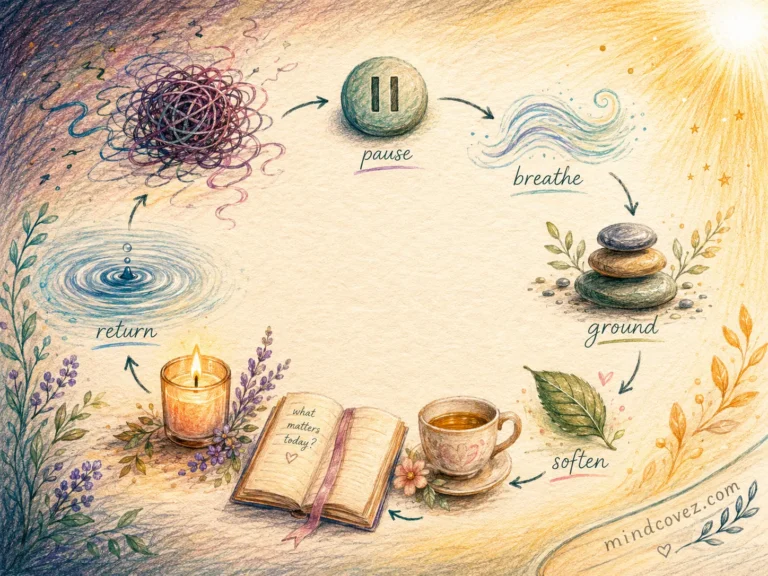
A Gentle Four-Step Pause When You Feel Activated
Here, “activated” simply means stirred up, tense, defensive, frightened, or overwhelmed. This is not a trick for switching a stress response off, and it does not guarantee calm.
If you are in danger, getting help or moving toward safety matters more than completing a regulation exercise correctly.
1. Name What You Notice
Keep it plain. You might think, “I feel defensive,” “I want to get away,” “My mind has gone blank,” or “I agreed before thinking.”
You do not need to decide whether it is definitely fight, flight, freeze or fawn. Description is enough for now.
2. Notice One Body Cue
Maybe it is your jaw, shoulders, hands, stomach, or legs. If paying attention inside your body makes you more uncomfortable, do not force it.
Keep your eyes open, notice an object nearby, or feel the chair underneath you. Skip what does not help.
3. Make Room for a Pause
If you can, delay the reply. Put the phone down, ask for a minute, step into another room, or write down what you want to say.
You do not have to force deep breathing because somebody on the internet told you to. Breathe in a way that feels comfortable. The aim is simply a little more room before the next action.
If you want a broader practice for these moments, the gentle nervous system reset routine goes further into grounding, movement, rest, and safe connection without treating “reset” like a magic switch.
4. Choose One Small, Safer Action
Ask for clarification, lower your volume, delay the commitment, or write the answer. If you take space from a safe conversation, suggest a realistic time to return.
Choose something you can actually manage now rather than expecting yourself to become a completely different person in the middle of one difficult moment.
Simple Scripts for Each Response
Sometimes one usable sentence is more helpful than another paragraph of psychology.
- Fight: “I feel defensive. I need a moment before I answer.”
- Flight: “I need a break. Can we come back to this at seven?”
- Freeze: “My words aren’t coming. Please give me time.”
- Fawn: “Let me think before I agree.”
You may only manage part of a sentence, and you can come back later. These are options for situations where speaking is safe, not obligations.
How to Repair After a Stress Response
Often, awareness comes late. The conversation has already happened, the message has already been sent, and you understand the pattern at 11:30 that night while replaying something you said at four in the afternoon. That late understanding can still be useful.
Once you have enough space to reflect, separate what you felt from what you did. You may have felt frightened or misunderstood and still spoken hurtfully. Both things can be true.
A useful repair names what happened, recognises the impact, and gives a realistic next step: “I interrupted you and raised my voice. I’m sorry. I want to hear the rest. Next time, I’ll ask for a break sooner.”
Depending on what happened:
- After fight: “I spoke harshly. I’m sorry. I want to try again more calmly.”
- After flight: “I pulled away because I felt overwhelmed. I do want to come back to this.”
- After freeze: “I went quiet because I felt stuck, not because I didn’t care.”
- After fawn: “I agreed too quickly. I need to be honest and revisit my answer.”
Not every explanation needs an apology. You do not owe one because you needed time, had a limit, could not speak, or did what you needed to do to stay safe.
When the same harm keeps happening, though, repair takes more than finding nicer words. Behaviour has to change somewhere, and support may be needed. You also do not have to reopen contact with someone who threatens or controls you simply to prove that you know how to repair a relationship.
What Can Make a Difficult Moment Harder
One thing that makes this framework less useful is turning it into identity. “I reacted defensively” gives you something to look at, while “I am a difficult person” closes the discussion before you have learned much from it.
The same goes for “I avoided that conversation” versus “I’m a flight type.” The more specific description is usually more useful.
Be careful about assigning motives to other people too. A smile, silence, delayed reply, or abrupt exit does not give you enough information to confidently explain what happened inside them.
Another common trap is forcing calm. Not everyone finds body scanning helpful, not everyone feels better closing their eyes, and deep breathing can be calming for some people but irritating for others, especially when they already feel trapped or highly activated. You can stop and try something else.
Nervous-system language should not be used to excuse repeated harm either. A stress response can help explain why something happened, but it does not erase intimidation, threats, aggression, or responsibility.
The reverse matters too. Pushing yourself into confrontation when disagreement might trigger retaliation is not automatically “healthy boundary setting.” Sometimes the safer decision is quieter.
Let Your Limits Make Room for an Honest Response
A boundary does not have to sound like a speech. Usually it works better when it does not.
You might say:
- “I can discuss this, but I’ll pause if the insults continue.”
- “I can help for an hour. I can’t take on the whole task.”
- “I need to check my plans before I commit.”
- “I need some time before I answer.”
A useful boundary says what you can do, what you cannot do, or what you will do if the interaction continues in a certain way. It does not require the other person to like it, and it cannot guarantee that they will respect it.
If caring for people regularly leaves very little room for your own needs, boundaries for highly empathic people takes that problem further. The goal is not to become colder. It is to stop disappearing from your own decisions while trying to take care of everyone else’s feelings.
When retaliation is a real possibility, safety and support come before getting the wording perfect.
Practise When the Moment Is Small Enough
Emotional regulation is easier to practise in a manageable moment than in the hardest argument of your life. You might pause before answering a small request, ask one clarifying question, notice your shoulders tightening, delay one automatic yes, or return to one conversation after taking some space. The point is to practise where you have enough room to notice what you are doing.
Another part that gets missed in self-regulation advice is that people do not regulate entirely alone. Sometimes a calm friend who does not rush you helps. A partner who can tolerate a pause helps. Someone who does not demand an answer immediately can change the whole feel of the interaction.
This is an area where research has moved quite a bit. In 2025, Karen Niven and Belén López-Pérez reviewed the growing field of interpersonal emotion regulation, which looks at how people regulate their own and other people’s emotions through social interaction. Research in this area has expanded rapidly because emotion regulation does not happen only inside one person’s head.
Psychology sometimes uses co-regulation for related processes, but the term matters less than what it looks like in real life. Another person stays steady enough that you do not have to spend quite so much energy defending, explaining, or holding everything together by yourself.
Which Response Shows Up Most for You?
Choose a recent moment that feels manageable rather than the worst thing that ever happened to you. Ask yourself:
- Did I push back, move away, go quiet, or try to keep the other person happy?
- What happened just before that?
- What did I notice in my body, thoughts, and words?
- Does this happen with everyone, or mainly with certain people?
- What did I need?
- What might make a similar moment safer or easier?
For a short journal entry:
“When ___ happened, I noticed ___.”
“I needed ___.”
“One thing I could try next time is ___.”
There is no score, and you may not even decide which label fits. “I need time before I answer” can be more useful than knowing whether you technically froze.
Stop the reflection if it starts becoming too distressing. Choose one skill to revisit instead of expecting everything to work at once.
Simple emotional regulation skills for responding instead of reacting may help you test what actually fits your life rather than collecting more techniques.
Basic support matters too: enough food, sleep where possible, movement you can manage, recovery time, and contact with people who help rather than add another layer of pressure.
The National Institute of Mental Health includes many of these in its stress guidance, along with journaling, reducing excess caffeine, questioning unhelpful thoughts, and reaching out to supportive people. None of that replaces care when you need it, and one calming technique was never meant to carry an entire overloaded life.
You Are More Than Your Stress Response
A difficult moment can tell you something worth noticing, but it cannot tell you everything about who you are. You may have needed time, been hurt, crossed a line that now needs repair, or found yourself in a situation that needs a firmer boundary. More than one of those things can be true at the same time.
You can be gentle with yourself and still be honest about what needs to change.
Maham Zaffar
You do not have to become perfectly calm first. Notice the urge to interrupt, delay one automatic yes, ask for time when the words disappear, or return when you can.
If you miss the moment and only understand it afterward, there is still information there. Fight, flight, freeze and fawn can give you a starting language. They do not need to become a final verdict about your character.
When It May Help to Talk to Someone
Consider speaking with a qualified mental health professional if these reactions are repeatedly intense, hard to understand, or begin affecting relationships, work, school, sleep, or everyday functioning.
The National Institute of Mental Health recommends professional support when stress or anxiety persists, becomes difficult to manage, or starts interfering with daily life.
You do not need to know the diagnosis before you go. You can start with something ordinary: “I keep going blank during conflict,” “I get defensive very quickly,” “I keep avoiding conversations I actually want to have,” or “I agree to things and then feel trapped by my own answer.”
That is enough to begin.
If a relationship involves threats, coercion, control, or violence, communication tips are not enough. Consider contacting someone you trust or an appropriate local support service in a way that is safe for you. If there is immediate danger, seek local emergency assistance.
The point of support is not to find the perfect label. It is to understand what is happening in your particular situation and work out what comes next.
Frequently Asked Questions
Fight, flight, freeze and fawn are labels used to describe different protective patterns. Fight pushes against perceived threat, flight creates distance, freeze involves stillness or difficulty responding, and fawn describes appeasing another person in an attempt to feel safer.
Fawn comes from clinical writing, and the four labels together are not a diagnostic system or a complete description of human defensive responding.
No. Similar reactions can occur during ordinary stress and can have several explanations.
Recognising one of these patterns does not establish that you have experienced trauma or have PTSD. Personal history, present circumstances, safety, and the effect on daily life all need to be considered.
Yes. You may respond differently with different people or move between several reactions during one situation. You do not need to identify one permanent type. The circumstances that bring out a response often tell you more than the label itself.
Threat-related freezing can be involuntary, but silence alone does not tell you whether someone is freezing, thinking, overwhelmed, disengaged, or choosing not to answer. Where possible, reduce pressure and give the person time rather than demanding an immediate explanation.
No. Kindness can include generosity, honest preferences, and boundaries. Fawning describes appeasement associated with perceived threat or safety. Rather than treating one polite or reluctant agreement as evidence of fawning, look at how much genuine choice the person has in the situation.
That is completely possible. These terms are a framework, not a complete map of human stress responses.
You may experience stress differently, move between reactions, or find that another explanation fits better. You do not need to identify a type for reflection to be useful.
Look gently for patterns over time. Notice what happened, who was there, what you felt, what you did, and what happened immediately beforehand. You do not need a score or permanent label. Knowing what you tend to need in those moments is usually more useful.
Consider professional support when distress persists, reactions repeatedly interfere with everyday life, or you feel unsafe or unable to manage the pattern alone. A qualified professional can help you explore what is happening without requiring you to diagnose yourself first.
Keep Exploring What You Noticed
If you want something practical to return to between difficult moments, a gentle nervous system reset routine can help you choose a few grounding or regulation practices that feel manageable. “Reset” here does not mean flipping a biological switch. Sometimes it simply means creating enough steadiness to decide what you want to do next.
If withdrawing from people is what brought you here, the difference between avoidant attachment and emotional detachment is worth reading before assigning yourself an attachment style. A stress response, a relationship pattern, and emotional disconnection are not interchangeable.
Kozlowska, K., Walker, P., McLean, L., & Carrive, P. (2015). Fear and the Defense Cascade: Clinical Implications and Management. Harvard Review of Psychiatry, 23(4), 263-287.
Borkar, C. D., & Fadok, J. P. (2024). Distributed Circuits Regulating Defensive State Transitions: Freezing, Flight and Fight. Neuropsychopharmacology, 50(1), 320-321.
Coimbra, B. M., Hoeboer, C. M., van Zuiden, M., Williamson, R. E., D’Elia, A. T., Mello, A. F., Mello, M. F., & Olff, M. (2023). The Relationship Between Tonic Immobility and the Development, Severity, and Course of Posttraumatic Stress Disorder: Systematic and Meta-Analytic Literature Review. Journal of Anxiety Disorders, 97, 102730.
Walker, P. (2003). Codependency, Trauma and the Fawn Response. The East Bay Therapist, January/February. Original clinical account of the term rather than a validated self-assessment.
Algarin, A. B., Lee, J.-Y., & Zhan, X. (2026). Fight, Flight, Fawn, Freeze: Rethinking Substance Use Through a Stress Response Lens. Current Addiction Reports, 13(1), 21.
McCrory, C., McLoughlin, S., Layte, R., NiCheallaigh, C., O’Halloran, A. M., et al. (2023). Towards a Consensus Definition of Allostatic Load: A Multi-Cohort, Multi-System, Multi-Biomarker Individual Participant Data Meta-Analysis. Psychoneuroendocrinology, 153, 106117.
Langer, K., Wolf, O. T., Merz, C. J., & Jentsch, V. L. (2025). The Effects of Stress Hormones on Cognitive Emotion Regulation: A Systematic Review and Integrative Model. Neuroscience & Biobehavioral Reviews, 170, 106040.
Niven, K., & López-Pérez, B. (2025). Interpersonal Emotion Regulation: Reflecting on Progress and Charting the Path Forward. Emotion, 25(2), 277-286.
National Institute of Mental Health. I’m So Stressed Out! Guidance on stress, anxiety, everyday coping, and seeking professional help.
NHS. Dissociative Disorders. Guidance on dissociative experiences, assessment, and treatment.