

Some days, your body seems to know you are stressed before your mind can explain why. You wake up already tired. A simple message feels like pressure. A small sound feels too sharp. Someone asks a normal question, and suddenly your chest tightens, your thoughts rush, or you feel strangely blank inside.
Then another feeling arrives on top of the first one: “Why am I reacting like this?” That question can feel heavier than the stress itself. It turns a human response into something that feels embarrassing. It makes you wonder if you are weak, too sensitive, dramatic, or somehow failing at being calm.
But what if the reaction is not proof that something is wrong with you? What if it is a signal? A nervous system reset routine can help in moments like this, not because you are broken, not because your emotions are wrong, and not because calm is something you should be able to perform on command. It can help because sometimes the mind and body need small, repeated signals of safety: a pause, a softer breath, a moment of grounding, a kinder sentence, and a reminder that you are here, and you do not have to carry everything at once.
A Gentle Note Before We Go Further
This article is for education and self-reflection. It cannot diagnose anyone, treat a medical condition, or replace support from a qualified mental health or medical professional.
Here, the phrase “nervous system reset” is used as a gentle metaphor. It does not mean flipping a biological switch or medically repairing the nervous system. It means using simple psychological regulation practices to help the mind and body move from stress, overwhelm, or emotional activation toward steadiness, safety, and presence.
If distress feels intense, persistent, unsafe, or difficult to manage in daily life, seeking support is a caring and valid step. There is no shame in needing help.
What a Nervous System Reset Routine Really Means
A nervous system reset routine is a gentle way of helping yourself return from stress. Not into perfect calm. Not always into happiness. Not always into complete clarity. Sometimes it simply helps you find enough steadiness to breathe, notice what is happening, and choose what comes next with a little more care.
It may include slow breathing, grounding through the senses, gentle movement, body awareness, self-compassion, journaling, or safe connection with another person. But the routine itself is not the whole story. The deeper message is this: “I am allowed to slow down. I am allowed to notice what I am carrying. I am allowed to return to myself without shame.”
That is why this topic belongs in psychology. Not as a diagnosis. Not as a medical promise. As a way of understanding emotional regulation, stress recovery, self-awareness, and the body’s need for safety.
The phrase “nervous system reset routine” can sound more mechanical than it really is. It may make you imagine a hidden switch inside the body. One moment you are overwhelmed, and the next moment everything is calm. But humans do not work like machines. We do not simply turn stress off because we tell ourselves to calm down. Most people already know this from experience. Being told “just relax” rarely helps. Sometimes it makes the body feel even more misunderstood.
In a psychology-based sense, a nervous system reset routine is better understood as a return to regulation. Regulation means you can feel something without being completely taken over by it. You may still feel sad, stressed, irritated, tired, uncertain, or tender, but there is a little more room around the feeling. You can notice it. You can pause. You can choose the next small step with more care.
Gross’s 1998 process model of emotion regulation is useful here because it reminds us that regulation is not only something we do after emotions become intense. It can also happen earlier, through noticing, shifting attention, changing the meaning of a moment, or choosing a different response when we have enough space to do so.
That is the heart of this routine. It is not about becoming numb, pretending everything is fine, or forcing yourself to stay calm so other people feel comfortable. A reset means finding your way back when stress has pulled you too far from yourself.
It is also important to say this clearly: a reset is not escape. It is not avoiding every hard feeling, hard message, or hard conversation. It is a pause that helps you return with more choice. Sometimes we need to step away because the body is too activated to respond clearly. That pause can protect the conversation instead of damaging it. It gives the mind a little room to ask, “What is actually happening here, and what response would protect my dignity?”
Why Rest Can Feel Difficult at First
One thing worth saying gently is this: calm does not always feel natural at first. If your body has been used to rushing, bracing, scanning, pleasing, or staying alert, slowing down may feel strange. Some people even feel uncomfortable when everything becomes quiet. Not because quiet is wrong, but because the body has become used to pressure as its normal rhythm.
A person may finally sit down after a long day and still feel unable to rest. The room is quiet, but the mind keeps moving. The body is still, but something inside stays alert. This can feel confusing because nothing is “happening” anymore, yet the body has not fully received the message that the pressure has passed.
That is why a nervous system reset routine should never feel like a demand. It is not, “Calm down right now.” It is more like, “Let us create one small moment where your system does not have to work so hard.” Sometimes the first sign of regulation is not peace. Sometimes it is noticing that you were tense. Sometimes it is realizing you need a pause. Sometimes it is catching the reaction a few seconds earlier than usual. That still counts.
Why Your Body May Feel Stuck on Alert
Stress is not only about obvious danger. Your body can respond to a difficult conversation, too many responsibilities, a loud home, family tension, financial worry, emotional pressure, lack of sleep, too much screen time, or the feeling that you cannot stop.
Harvard Health Publishing, 2020, describes the stress response through the sympathetic nervous system, which works like a gas pedal, and the parasympathetic nervous system, which helps the body return toward rest after pressure has passed. That image is useful because many people do not first notice stress as a thought. They notice it as speed. They feel rushed inside, tight, braced, or ready for something, even when nothing obvious is happening.
Lazarus and Folkman’s 1984 work on stress and coping is also helpful here. Their stress appraisal framework reminds us that stress is not only about what happens. It is also about how demanding a situation feels and whether we feel we have enough resources to meet it. That is why the same message, task, or conversation can feel manageable one day and overwhelming on another.
Sometimes the pressure is one big event. Other times, it is the slow pile-up of ordinary life: unread messages, a tense tone in someone’s voice, a child needing you, a deadline, a parent expecting something, a task left unfinished, a room full of noise, another night of poor sleep, or another day of saying “I am fine” when you are not. The body can keep collecting these moments before the mind has time to name them.
That is why one small thing can suddenly feel like too much. It is not always about the small thing in front of you. Sometimes it is about everything your system was already holding.
In psychology, people often talk about emotional regulation as if it is only a skill. And yes, it is a skill. But it is also a relationship with pressure, safety, memory, habit, and meaning. Linehan’s 2015 work on emotion regulation is helpful here because it frames regulation as something people practice, not something they either have or do not have. Some people learned early to rush through feelings. Some learned to hide them. Some learned to please others before noticing themselves. Some learned that rest was only allowed after everything was done.
So when the body becomes overwhelmed, it is not always being dramatic. Sometimes it is repeating the rhythm it learned.
How It Feels When You Need a Reset
A person who needs a nervous system reset routine does not always look distressed. Someone may look calm while their mind is racing. Someone may keep replying politely while their body is already rehearsing how to leave the conversation. Someone may become quiet because speaking feels too heavy. Someone may become extra productive because stopping would mean feeling what has been ignored for too long.
In daily life, this may sound like, “I do not know why I am so irritated today,” or “I should be resting, but I cannot settle.” It may sound like, “I feel tired, but also restless,” “I keep replaying the conversation,” “I want to cry, but nothing really happened,” or “I know I am safe, but my body does not feel safe.”
You might feel tension in your jaw, shoulders, stomach, chest, hands, or forehead. You might feel wired but tired. You might struggle to focus. You might feel foggy, numb, sensitive, tearful, impatient, or overstimulated by normal sounds and messages. Some people feel the urge to escape. Some freeze. Some over-explain. Some people-please. Some shut down and then feel guilty afterward.
This pattern often shows up in everyday conversations when someone says, “I was fine all day, and then suddenly I could not handle one more thing.” The “one more thing” may be a message, a messy room, a child calling again, a partner’s tone, or a work email arriving after hours. From the outside, it may look small. Inside, it may feel like the last drop.
None of this means you are weak. It may mean your mind and body need space, support, and recovery. A kinder question is not, “What is wrong with me?” A kinder question is, “What is my system trying to tell me?”
Why It Can Feel Embarrassing, Even When It Is Human
Many people feel shame after a stress response. They snap and then feel guilty. They cry and then feel exposed. They go silent and then wonder why they could not speak. They avoid a message and then call themselves lazy. They feel overwhelmed and then blame themselves for being too sensitive.
But emotional responses are not moral failures. They are information. They may tell you that you are tired, that a boundary is missing, that a conversation feels unsafe, or that your body has been living in urgency for too long.
The American Psychological Association Dictionary of Psychology, n.d., describes mindfulness as awareness of internal states and surroundings. This matters because awareness gives us a little space between what we feel and how we respond. Without awareness, stress becomes the driver. With awareness, even a small pause can return some choice.
There is nothing embarrassing about needing to return to yourself. That is not weakness. That is being human in a body that has limits.
A composite example might look like a parent who stays patient all day. They answer questions, prepare food, manage noise, reply to messages, handle small demands, and keep going. Then, near evening, one spilled cup feels unbearable. The shame comes quickly: “Why did I react like that?” But the spilled cup was not the whole story. It was the moment the body finally said, “I am full.”
That does not excuse hurtful behavior. It simply helps us understand the pattern without turning the person into a failure. Understanding is not the same as avoiding responsibility. It is the first step toward responding with more care next time.
Once we understand that stress is not always weakness, the next question becomes gentler: what does returning actually look like in an ordinary day?
What a Reset Can Look Like in Real Life
A nervous system reset routine does not need to look aesthetic. It does not need candles, perfect silence, a yoga mat, or a long morning ritual. Sometimes it happens in the kitchen while water boils. Sometimes it happens in the bathroom after a hard conversation. Sometimes it happens in the car before going inside. Sometimes it happens while sitting on the edge of the bed, realizing you have been holding your breath.
A composite example might look like this. You are sitting with your phone in your hand. A message comes in. It is not rude. It is not even long. But your stomach tightens anyway. You read it twice. You begin preparing a reply, then deleting it, then writing it again. Suddenly the message is not just a message. It feels like pressure, expectation, judgment, and urgency all at once.
A reset in that moment may not look like closing your eyes and becoming calm. It may look like putting the phone down for one minute. It may sound like, “I am activated right now.” It may feel like noticing your feet on the floor before deciding whether this message needs an answer immediately. That small pause matters because it interrupts the feeling that every emotional signal must be answered right away.
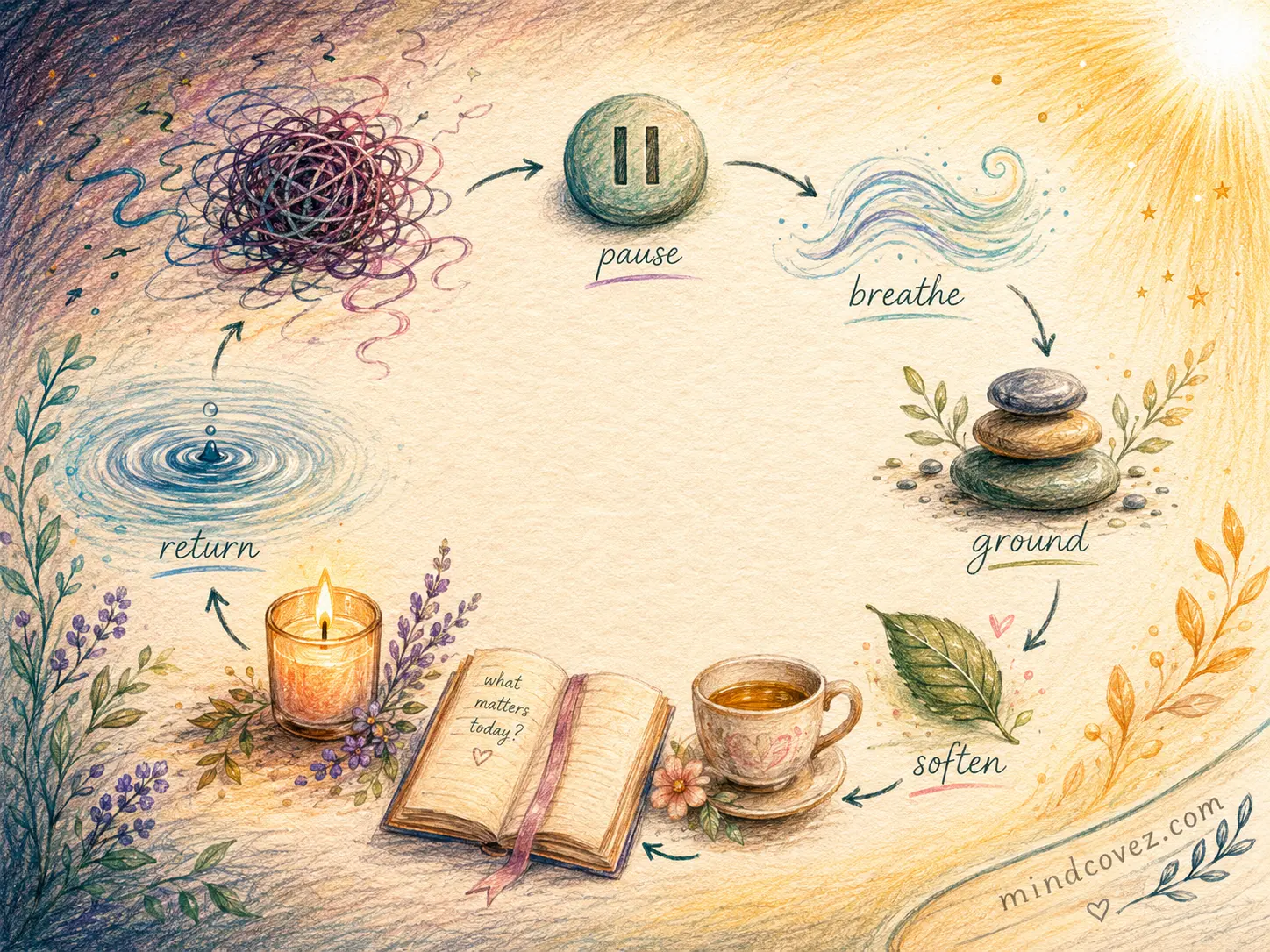
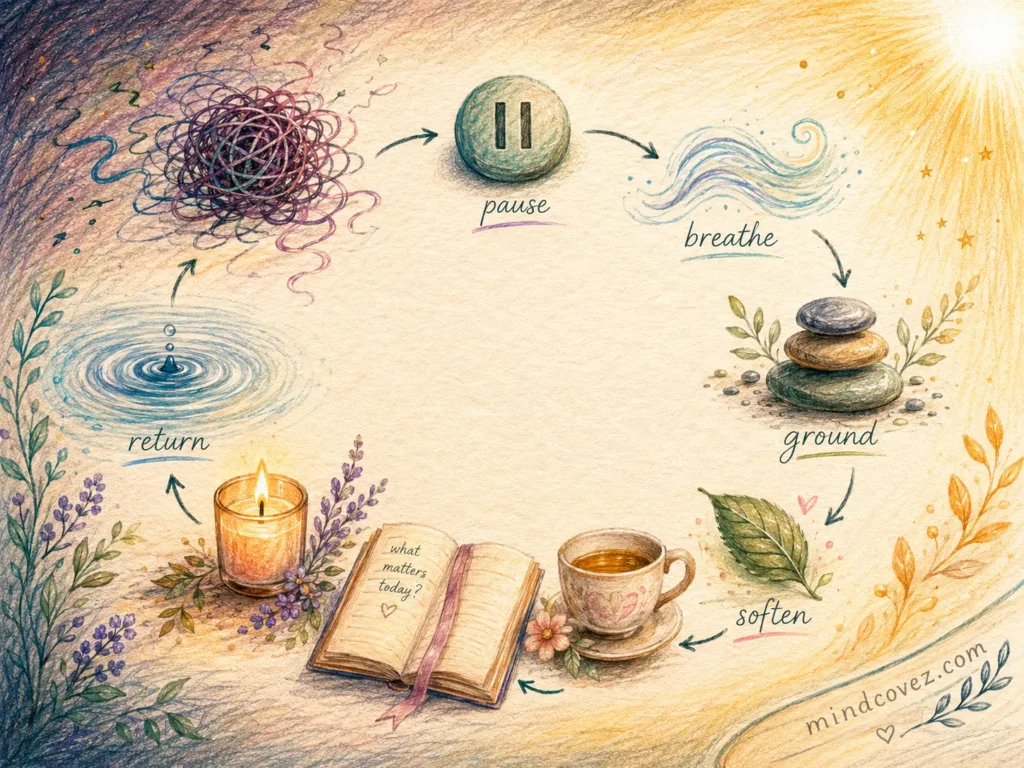
The first part of a reset is usually not fixing anything. It is noticing. You might quietly say, “My body is carrying stress,” or simply, “This is a lot.” That small sentence matters because it names the state without shaming the person.
After that, breath can become one possible doorway. Not a forced deep breath. Not a perfect breathing exercise. Just a slightly longer exhale, a soft inhale, and a slower release. Enough to tell the body, “There is no need to rush this exact moment.” For some people, breath is not the right starting point. Breath focus can feel uncomfortable when someone is already tense or panicky. In that case, grounding may feel safer.
Grounding is very ordinary, which is part of why it helps. You look around the room. You notice the color of the wall. You feel your feet. You touch the fabric of your sleeve. You listen for one sound. You let your eyes land on something real: a cup, a chair, a window, a plant, a patch of light. Grounding is not childish. It is a way of reminding the mind, “I am not only inside the thought. I am also here, in this room, in this moment.”
The body may need attention too. Stress often asks the body to brace. The jaw tightens. The shoulders lift. The stomach grips. The hands curl. The forehead holds a frown without permission. You do not have to relax your whole body at once. You can notice one place. Let the jaw soften a little. Drop the shoulders. Open the hands. Press your feet into the floor and then release. A quiet sentence may help: “I do not have to hold this so tightly.”
Some days, stillness will help. Other days, movement will help more. A slow walk, shoulder rolls, stretching your arms, stepping outside, changing posture, or shaking out your hands can help when the body feels trapped in activation. The goal is not exercise. It is rhythm. It is giving stress somewhere to move.
Then comes the part people often skip: the way you speak to yourself. During stress, the inner voice can become harsh. It may say, “Why am I like this?” or “I should be over this,” or “This is embarrassing.” That voice may feel familiar, but it does not create safety.
A softer sentence may not solve the moment, but it can stop you from becoming another threat to yourself. You might say, “This is a stress response, not a personal failure.” You might say, “My body is trying to protect me.” You might say, “I can slow down one breath at a time.” You might say, “I do not need to solve everything right now.” The words do not have to sound poetic. They only need to be less punishing than the ones you usually use.
A reset often ends with one small next step. Maybe you drink water. Maybe you reply later. Maybe you sit somewhere quiet. Maybe you write one line. Maybe you take a short walk. Maybe you ask for support. Maybe you put the phone down. Maybe you continue one task slowly. Regulation often returns through what is small enough to do, not through fixing your whole life in one moment.

When the Day Only Gives You Five Minutes
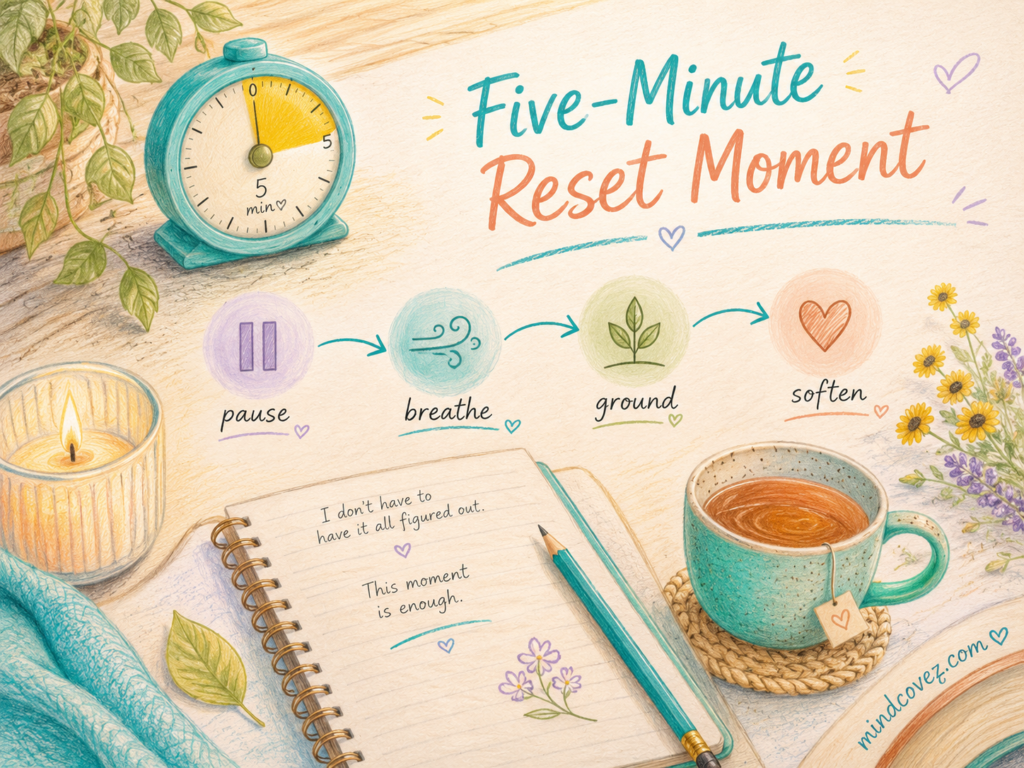
Some days do not give you a full quiet hour. They give you five minutes between tasks, five minutes before the children call you again, five minutes in the car, five minutes before you answer the message, or five minutes before you walk into the room. That can still matter.
In the first minute, you might simply notice what state you are in: “I feel rushed,” “I feel numb,” “I feel tense,” or “I feel overloaded.” Then you may let your exhale become a little longer than your inhale, not dramatically, just enough to slow the pace inside you.
After that, you might look around and name what is present: the floor, the light, the sound of a fan, your hands, the room, and the ordinary things that remind your mind where you are. Then you might release one place in the body that has been holding tension, such as the jaw, shoulders, hands, stomach, or forehead. Before returning to the day, you might ask one gentle question: “What is one kind next step?”
Five minutes may not solve everything. But it can interrupt the spiral before it becomes the whole day.
The research by Toussaint and colleagues, 2021, is useful here because it looked at relaxation practices such as progressive muscle relaxation, deep breathing, and guided imagery. The lesson for a general reader is not that one practice fixes everything. It is that simple relaxation practices can support a relaxation state when they are practiced gently and realistically. That is the key word: gently, not perfectly.
Why Different Times of Day Ask for Different Kinds of Support
A morning reset is not about becoming a perfect morning person. It is about entering the day before the world enters you. This may be as simple as sitting up slowly, placing your feet on the floor, taking a few gentle breaths, and asking, “What pace does my body need today?” Some mornings need focus. Some need softness. Some need patience. Some need honesty. You do not need a perfect morning routine. You need a moment where your mind meets the day with a little awareness.
A midday reset is different. By midday, stress has often collected in small ways. The screen has been too close. The messages have been too many. The body has been sitting too long. The mind has been jumping from one demand to another. This is where stepping away from the screen, relaxing the jaw, looking at something far away, and asking, “What is urgent, and what can wait?” can bring back a little clarity.
An evening reset is often about permission. The body asks, “Can I finally stop carrying everything?” You might write down unfinished thoughts so they do not keep circling in your head. You might dim stimulation. You might stretch gently. You might put the phone away for a short window. You might tell yourself, “This can wait until tomorrow.” That sentence can be powerful, not because everything is solved, but because rest should not have to wait until every problem disappears.
Mayo Clinic, 2024, includes relaxation practices such as deep breathing, meditation, movement-based practices, music, and art among stress management tools. In a MindCovez sense, that reminds us that regulation does not have only one doorway. Some people return through quiet. Some through movement. Some through words. Some through creativity. Some through being held by a safe rhythm again.
Sometimes Calm Comes Through Another Person
Not every reset happens alone. This matters because modern self-help often makes regulation sound like a private project. Breathe alone. Journal alone. Fix your reaction alone. Calm yourself alone. But humans are relational beings.
Sometimes your body softens because someone speaks gently. Sometimes you feel steadier after one honest message. Sometimes sitting near a safe person, a pet, or even a quiet community space helps you remember that you do not have to hold everything by yourself.
This is often called co-regulation. In simple words, it means another safe presence can help your system settle. Not because they rescue you. Not because you become dependent. But because safety is sometimes easier to feel when it is shared.
This may look like saying, “Can you sit with me for a few minutes?” Or, “I do not need advice right now. I just need a calm voice.” Or, “This feels too heavy to sort through alone.” There is no shame in needing support. Self-regulation matters. But so does safe connection.
What If You Cannot Calm Down?
Sometimes a nervous system reset routine does not work quickly. That does not mean you failed. It may mean your system needs more time, more safety, more sleep, more connection, or more support.
Some people do not settle through breathing. Some feel worse when they sit still. Some need movement before stillness. Some need another person’s calm voice. Some need food, water, sleep, or fewer demands. Some need a real-life boundary, not another self-soothing technique. This matters because not every stress response is only an inner problem.
Sometimes the workload is too much. Sometimes the relationship feels unsafe. Sometimes the environment is overstimulating. Sometimes grief needs space. Sometimes the body is exhausted. Sometimes the mind has been trying to cope alone for too long.
If calm does not come quickly, your body may simply need a gentler doorway. Maybe grounding will help more than breathing. Maybe walking will help more than sitting. Maybe warmth will help more than pressure. Maybe connection will help more than isolation. Maybe help will help more than self-blame.
There is also another honest part of this conversation. Sometimes you only realize you needed a reset after you have already reacted. Maybe you snapped, shut down, over-explained, sent the message too quickly, or cried and then felt exposed. That moment can bring shame, but it can also become information.
You can still return. A reset after a reaction may sound like, “I was overwhelmed, and I want to slow down now.” It may sound like, “I need a little time before I speak clearly.” It may sound like, “I do not want to shame myself for having a stress response, but I do want to understand it.”
This is important because emotional regulation is not only what happens before a reaction. It is also how gently you come back afterward.
What a Nervous System Reset Is Not
A nervous system reset routine is not a cure. It is not a diagnosis. It is not a treatment plan. It is not a replacement for therapy. It is not a way to suppress feelings or tolerate harmful situations. It is also not a productivity trick.
You are not resetting yourself so you can keep ignoring your limits. You are not calming yourself so other people can stay comfortable while you stay overwhelmed. You are not using emotional regulation to silence pain that needs attention.
A healthy reset helps you listen to yourself more clearly. It does not ask you to abandon yourself politely. This is important because wellness language can sometimes become another pressure. Breathe better. Heal faster. Stay calm. Be mindful. Regulate perfectly.
But real regulation is not perfect. Sometimes it is messy and quiet. Sometimes it is noticing the pattern after you already reacted. Sometimes it is apologizing without shaming yourself. Sometimes it is choosing rest before your body forces you to stop.
The goal is not to become someone who never reacts. The goal is to become someone who can return with more kindness and awareness.
Gentle Words for the Moment You Feel Activated
Sometimes the body is too activated for long reflection. A few simple sentences can help you slow down without making the moment more dramatic.
You might say to yourself, “I am having a stress response,” or “This feeling is uncomfortable, but I am not broken.” You might say, “I can pause before I respond,” “I do not have to solve everything right now,” or “I can take care of the next small thing.”
If another person is involved, the words may need to stay simple too. You might say, “I want to answer, but I need a moment to think.” Or, “I care about this conversation, but I need us to slow down.” Or, “I am not blaming you. I am trying to name what is happening inside me.” Or, “I feel overwhelmed, and I need a short pause before we continue.” Or, “This is starting to feel too heavy for me to handle alone. I think I need support.”
These scripts are not magic phrases. They may not change another person’s behavior. But they can help you protect the space between feeling and reacting. That space matters. It is where dignity often returns.
The Longer Work Is Learning Your Patterns
A nervous system reset routine is helpful in the moment, but the deeper work is learning what your body keeps trying to tell you. You may notice that your shoulders tense when someone’s tone changes. You may freeze when there is conflict. You may over-explain when you feel misunderstood. You may stay busy because rest makes feelings rise. You may become numb when life asks too much of you.
These patterns are not there to shame you. They are there to be understood. Linehan’s 2015 work on emotion regulation comes to mind here because emotional regulation is not something people simply have or do not have. It is something people learn, practice, and return to, especially when emotions feel intense.
Journaling can help, but it does not need to become another heavy task. You might write about what was happening before you felt overwhelmed. You might notice what your body did first. You might ask what you needed but did not ask for. You might write down what helped, even a little. You might also notice what made things worse.
A person might write only one sentence: “I felt tense before I even replied.” That one sentence can be enough for today. Another day, the sentence may be, “I needed rest, but I kept pushing,” or “I felt dismissed, and my body reacted before I had words.” This is how self-awareness often grows. Not through dramatic breakthroughs every day, but through small moments of honest noticing.
What makes a nervous system reset routine work is not intensity. It is repetition. The body learns through repeated cues of safety. A slower breath once may help a little. A grounding moment once may create a pause. But when these small returns happen again and again, the mind begins to recognize a new possibility.
Stress may still come. Life may still feel demanding. But you may begin to notice earlier, pause sooner, recover with less shame, and stop treating every overwhelmed moment as proof that you are failing. That is quiet progress. Not dramatic, but real.
Over time, the reset becomes less about one routine and more about a relationship with yourself. You begin to notice earlier. You recover more gently. You stop treating every stress response like a personal flaw. That is where real steadiness begins to grow.

.When It Is a Good Idea to Seek Support
Self-help can be meaningful, but it does not have to carry everything alone. A nervous system reset routine can support awareness, grounding, emotional regulation, and small moments of steadiness. Still, there may be times when the distress feels too heavy, too repeated, or too difficult to sort through by yourself. That does not mean you have failed. It means support may be needed.
This article is for education and self-reflection. It cannot diagnose anyone or replace care from a qualified mental health professional. But if this pattern feels unsafe, overwhelming, or starts affecting your sleep, focus, appetite, mood, relationships, work, study, parenting, or daily responsibilities, it may be a good time to talk to someone trained to help.
The National Institute of Mental Health, n.d., also notes that support can be important when distressing symptoms begin to affect daily functioning, concentration, mood, sleep, appetite, or the ability to manage usual tasks. In simple words, help is not a punishment. It is care.
If you feel in immediate danger, or you may hurt yourself or someone else, please contact local emergency services or a trusted crisis support service in your area right now.
Getting help does not mean your nervous system is broken. It means you deserve support while learning how to feel safe again. Sometimes the bravest reset is not doing another routine alone. Sometimes it is letting someone qualified help you carry what has become too heavy.
Step Inside the Story
Questions People Ask
What is a nervous system reset routine?
A nervous system reset routine is a gentle emotional regulation practice that helps you move from stress, overwhelm, or activation toward a steadier state. It may include breathing, grounding, movement, body awareness, self-compassion, journaling, or safe connection.
Is “nervous system reset” a real psychology term?
It is best understood as a reader-friendly metaphor, not a formal diagnosis or literal reset button. In a psychology-based blog, it can safely describe the process of returning to emotional regulation after stress.
Why do I feel wired but tired?
Feeling wired but tired can happen when your body feels activated while your energy is already low. It may show up during stress, burnout, overstimulation, poor rest, or emotional overload. This article cannot diagnose the cause, but it can help you notice the pattern with more kindness.
Why do I feel worse when I try to slow down?
Sometimes slowing down makes you notice feelings that were hidden under busyness, pressure, or distraction. This does not mean the routine is wrong. It may mean your system needs a gentler pace, more grounding, movement instead of stillness, or support from someone safe. If slowing down brings intense distress, professional support can help you explore it safely.
What can help in the moment when I feel overwhelmed?
A gentle starting point is to pause, name what you feel, lengthen your exhale, notice your surroundings, release one tense area, and choose one small next step. If breathing feels uncomfortable, grounding through the senses or gentle movement may feel safer.
What if calming techniques do not work for me?
That does not mean you are doing it wrong. Some people need movement, connection, rest, food, sleep, boundaries, or professional support before calm becomes possible. Regulation should feel supportive, not forced.
When should I talk to a mental health professional?
Consider support if distress feels intense, persistent, unsafe, or hard to manage in daily life. It is also worth seeking help if sleep, appetite, focus, relationships, work, study, parenting, or basic functioning are being affected. Asking for help is not weakness.
You are not broken because stress reaches your body. You are not embarrassing because your emotions sometimes arrive loudly. You are not weak because you need grounding, rest, support, or help.
You do not have to become perfectly calm to be worthy of care. A nervous system reset routine is simply a way of saying, “I am allowed to return to myself.”
One breath. One pause. One softer sentence. One small next step. One moment of not abandoning yourself.
That is where steadiness begins.
References
American Psychological Association. n.d. APA Dictionary of Psychology: Mindfulness.
Gross, J. J. 1998. The Emerging Field of Emotion Regulation: An Integrative Review.
Harvard Health Publishing. 2020. Understanding the Stress Response.
Lazarus, R. S., and Folkman, S. 1984. Stress, Appraisal, and Coping.
Linehan, M. M. 2015. DBT Skills Training Manual.
Mayo Clinic. 2024. Relaxation Techniques: Try These Steps to Lower Stress.
National Institute of Mental Health. n.d. Caring for Your Mental Health.
Toussaint, L., Nguyen, Q. A., Roettger, C., Dixon, K., Offenbächer, M., Kohls, N., Hirsch, J., and Sirois, F. 2021. Effectiveness of Progressive Muscle Relaxation, Deep Breathing, and Guided Imagery in Promoting Psychological and Physiological States of Relaxation.