

The reaction can arrive before the sentence is even formed.
You hear a tone in someone’s voice, and your body tightens before you know what bothered you. A message appears on your phone, and your mind starts building ten possible meanings around it. A child calls your name again after a long, noisy day, and the irritation rises so quickly that you barely recognize yourself in the moment.
This is where emotional regulation skills matter. Not because emotions are wrong. Not because you should always stay calm. But because strong feelings can move faster than reflection, especially when the body is already tired.
Then, when the moment passes, another feeling often appears.
Shame.
You may think, “Why did I react like that?” or “Why can’t I just stay calm?” or “Why am I so sensitive over small things?”
But many emotional reactions are not small when they arrive inside an already loaded body. They may be carrying poor sleep, repeated pressure, old patterns, unspoken needs, too much noise, or too many moments where you kept saying, “I’m fine,” when you were not fine at all.
Emotional regulation skills are not about becoming emotionless.
They are not about swallowing anger, hiding sadness, pretending everything is fine, or becoming the calmest person in the room while your insides are shaking.
They are about learning how to stay with yourself when emotions become loud.
The question at the center of this article is simple:
How can I feel strong emotions without suppressing them or reacting in ways I regret?
Not perfectly.
Not always.
But more gently, more honestly, and with a little more choice.
Quick Answer: What Are Emotional Regulation Skills?
Emotional regulation skills are simple practices that help you notice, name, understand, and respond to emotions without suppressing them or being controlled by them.
These emotion regulation techniques include pausing before reacting, naming the emotion, noticing body signals, grounding through the senses, checking the story behind the feeling, checking the facts before acting, using opposite action carefully, self-soothing without avoiding, repairing after a reaction, and choosing one small next step.
The goal is not to stop feeling.
The goal is to create enough space between the emotion and the reaction so you can respond with more care.
A Gentle Note Before We Go Further
This article is for education and self-reflection. It is not a diagnosis, treatment plan, or replacement for support from a qualified mental health professional.
If your emotions feel unsafe, intense, persistent, or difficult to manage in daily life, reaching out for professional support is a caring and valid step.
There is no shame in needing help.
What Emotional Regulation Really Means
Emotional regulation means working with emotions instead of being completely ruled by them or completely disconnected from them.
It does not mean controlling every feeling.
It does not mean staying calm all the time.
It does not mean becoming pleasant so other people never feel uncomfortable.
A healthier definition is this:
Emotional regulation is the process of noticing, understanding, allowing, and guiding emotional responses in a way that supports your well-being, relationships, and choices.
In daily life, this may look ordinary.
It may look like putting the phone down before sending the message.
It may look like saying, “I need a moment,” instead of forcing yourself to speak while your chest is tight.
It may look like noticing that you are not actually angry at the spilled cup. You are exhausted from a whole day of noise, demands, and invisible work.
It may look like repairing after you reacted, not because you are a bad person, but because you want to return with more honesty.
Psychologist James Gross’s process model of emotion regulation is useful here because it shows that regulation can happen at different points. We may regulate before an emotion becomes intense, while it is unfolding, or after we have already reacted.
That last part matters.
Many people think emotional regulation only counts if they catch the feeling before they react. But real life is not always that neat. The reaction may happen first. The lesson may come later. Growth may sound like, “I want to understand what happened, and I want to try again.”
That still counts.
Emotional regulation is not the absence of feeling. It is the moment you stop treating your feelings like enemies and start listening with steadier hands.
What Emotional Regulation Is Not
Emotional regulation is not becoming emotionless.
It is not tolerating disrespect.
It is not pretending something did not hurt.
It is not staying calm so other people never feel uncomfortable.
It is not spiritual bypassing, toxic positivity, or forcing yourself to forgive before you are ready.
It is not using self-soothing to avoid a truth that needs attention.
It is not blaming yourself for every strong feeling.
It is not staying silent when a boundary has been crossed.
It is also not a way to make yourself more productive while ignoring exhaustion.
This matters because wellness language can become another pressure. Be calm. Breathe better. Heal faster. Respond perfectly. Do not be triggered. Do not be messy.
But emotional regulation is not a performance.
It is a relationship with your inner life.
Healthy emotional regulation helps you listen to your feelings with steadier hands. It does not ask you to abandon yourself politely.
Emotional Regulation Skills at a Glance
Before we go deeper, it may help to name the main emotional regulation skills.
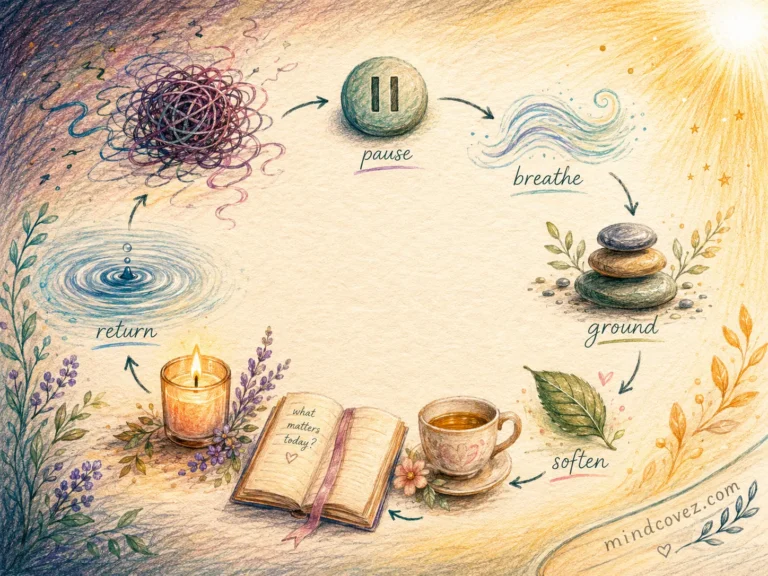
You can think of emotional regulation as a set of small returns:
- Pause before responding
- Name the emotion
- Notice the body signal
- Ground through the senses
- Check the story you are telling yourself
- Check the facts before acting
- Use opposite action carefully
- Self-soothe without avoiding
- Repair after a reaction
- Choose one small next step
These skills do not remove emotions.
They help you meet emotions with more awareness.
Suppression vs Emotional Regulation
Many people confuse emotional regulation with suppression.
But they are not the same.
Suppression says, “Do not feel this.”
Regulation says, “This feeling is here, and I can listen before I act.”
Suppression says, “Push it down.”
Regulation says, “Let me understand what this emotion may be asking for.”
Suppression says, “Stay quiet so no one gets upset.”
Regulation says, “I can choose my words without erasing my truth.”
Imagine someone receives a short reply from a friend. Just one line. Nothing openly rude. But something inside tightens.
Suppression may sound like, “It is fine. I should not care.”
But the body may still carry the hurt. Later, it may come out as distance, sarcasm, resentment, or a long message that says more than the moment required.
Regulation may sound like, “I feel hurt and uncertain. I do not know the full story yet. I can wait before I respond.”
That is a different kind of emotional self-control.
Not harsh control.
Caring control.
| Suppression | Emotional Regulation |
| Pushes the feeling away | Notices the feeling |
| Says “I should not feel this” | Says “This feeling is here” |
| Hides emotion to avoid discomfort | Creates space before responding |
| Can lead to resentment or emotional leakage | Supports awareness and choice |
| Disconnects you from yourself | Helps you stay connected with yourself |
| Focuses on looking calm | Focuses on responding wisely |
| Avoids emotional truth | Listens to emotional information |
| Silences the feeling | Guides the response |
Suppression disconnects.
Regulation creates space.
That space is where wisdom begins.
Why Emotions Can Feel Hard to Control
Strong emotions can feel hard to control because they often arrive before reflection.
You may know logically that a situation is not an emergency, but your body may still react as if something important is at risk. This happens because emotions are not only thoughts. They include body sensations, memories, meanings, urges, and learned patterns.
Anger may carry the urge to defend.
Fear may carry the urge to escape.
Shame may carry the urge to hide.
Sadness may carry the urge to withdraw.
Anxiety may carry the urge to overthink.
Overwhelm may carry the urge to shut down.
A parent may stay patient through breakfast, school bags, noise, questions, laundry, work messages, and a child asking the same thing again and again. Then, near evening, one spilled cup feels unbearable.
From the outside, it may look like the cup caused the reaction.
Inside, the cup was only the final drop.
This is why “just calm down” rarely helps.
People do not need to be ordered into calm. They need a bridge back to awareness.
Emotional regulation skills are that bridge.
Emotional Regulation Skills for Adults
Emotional regulation skills for adults need to be realistic.
Adults are often regulating emotions while answering messages, parenting children, managing work, dealing with family pressure, carrying financial stress, handling relationship tension, and trying to stay kind while tired.
That is why emotional regulation cannot only be a quiet journal exercise.
It has to work in real moments.
It may look like pausing before replying to a difficult message.
It may look like saying, “I need ten minutes before I answer.”
It may look like noticing that your anger is partly exhaustion.
It may look like choosing not to make a serious decision when you are hungry, sleep-deprived, or emotionally flooded.
It may look like realizing that a small irritation is not really about the cup left on the table. It may be about feeling unsupported for weeks.
Adult emotional regulation is not about perfect calm.
It is about protecting your response when life is already asking too much.
Skill 1: Pause Before Responding
The pause is one of the simplest emotional regulation skills, but it is also one of the most powerful.
A pause does not mean silence forever.
It does not mean avoidance.
It does not mean weakness.
It means you are giving your mind and body one small moment to catch up before your reaction becomes your response.
In real life, this pause is often ordinary.
You put the phone face down.
You drink water before speaking.
You walk to the window.
You unclench your jaw.
You say, “I need a moment.”
You leave the room briefly because the conversation is getting too heated.
You wait ten minutes before sending the message that your nervous fingers already typed.
This pause is especially helpful when you feel the urge to snap, defend, send a long emotional message, over-explain, shut down, blame yourself, make a sudden decision, or say “yes” when you mean “no.”
A simple pause sentence may be:
“I want to respond clearly, so I need a moment.”
Or:
“I am feeling activated. I do not want to react from that place.”
Or:
“I care about this conversation, but I need to slow down.”
The goal is not to become perfect.
The goal is to interrupt automatic reaction long enough for choice to return.
Skill 2: Name the Emotion
Emotion labeling means putting feelings into words.
This sounds simple, but many people skip it.
They say:
“I feel bad.”
“I feel weird.”
“I feel off.”
“I feel too much.”
These are real starting points, but they are not always specific enough to guide a response.
A person overthinking a message may assume they are angry. Underneath the anger, there may be fear of being ignored. Someone who keeps saying, “I am fine,” may actually feel disappointed, embarrassed, lonely, or afraid of needing too much.
Naming the emotion helps you understand what kind of care the moment may need.
Anger may need a boundary.
Sadness may need comfort.
Fear may need reassurance.
Shame may need compassion.
Overwhelm may need simplification.
Loneliness may need connection.
Guilt may need repair.
Disappointment may need honesty.
You can use simple sentences:
“I feel dismissed.”
“I feel overstimulated.”
“I feel afraid of disappointing someone.”
“I feel tired, not lazy.”
“I feel pressured, not dramatic.”
“I feel hurt, but I am showing it as anger.”
“I feel ashamed, and I want to hide.”
A helpful practice is to separate the emotion from your identity.
Instead of saying, “I am angry,” you might say, “Anger is here.”
Instead of saying, “I am anxious,” you might say, “Anxiety is showing up.”
Instead of saying, “I am a mess,” you might say, “I am having a hard emotional moment.”
This small shift helps you remember that a feeling is something passing through you.
It is not the whole of who you are.
Skill 3: Notice the Body Signal
Before emotions become words, they often become body signals.
A tight jaw.
A heavy chest.
A fast heartbeat.
Tense shoulders.
A restless stomach.
A hot face.
Hands that want to move.
A forehead that feels tight.
Shallow breathing.
Numbness.
Fatigue.
The feeling of being frozen.
These signals are not random. They are often the body’s way of saying, “Something needs attention.”
A person may look calm in a family conversation while their body is already rehearsing how to leave. Someone may keep replying politely while their hands are tense and their stomach is turning. Someone may say, “It is okay,” while their shoulders have already lifted toward their ears.
A body check can be very simple.
Where do I feel this emotion?
Is it tight, heavy, hot, shaky, numb, or restless?
What is my body trying to do?
Does it want to run, fight, hide, freeze, please, explain, or collapse?
What would help my body feel one degree safer right now?
You do not have to relax your entire body.
Start with one place.
Soften the jaw.
Lower the shoulders.
Open the hands.
Place both feet on the floor.
Let the forehead relax.
Take one slower exhale.
At times, emotional regulation begins with one muscle realizing it does not have to hold everything.
Skill 4: Ground Through the Senses
Grounding helps bring attention back to the present moment.
This is useful when the mind is racing, replaying, imagining, fearing, or spiraling.
Grounding does not erase the emotion. It reminds you that the emotion is happening in this moment, not everywhere and forever.
A simple grounding exercise is the 5-4-3-2-1 method:
Name 5 things you can see.
Name 4 things you can feel.
Name 3 things you can hear.
Name 2 things you can smell.
Name 1 thing you can taste, or take one slow breath.
But grounding does not have to sound like an exercise.
It can be as ordinary as feeling the cup in your hand, noticing the floor under your feet, touching the fabric of your sleeve, looking at sunlight on the wall, hearing the sound of a fan, or noticing the shape of a chair.
The point is not to perform calm.
The point is to remind the mind:
“I am here.”
“This is this room.”
“This is this moment.”
“I can come back to what is real.”
Skill 5: Check the Story You Are Telling Yourself
Emotions are shaped not only by what happens, but also by what the moment means to us.
A delayed reply may mean, “They are busy.”
Or it may mean, “They are ignoring me.”
A short answer may mean, “They are tired.”
Or it may mean, “They are angry at me.”
A mistake may mean, “I need to correct this.”
Or it may mean, “I ruin everything.”
The story matters because the body often responds to the meaning, not only the event.
This is where gentle reappraisal can help.
Reappraisal means looking at the situation again and asking whether there is another possible meaning.
This does not mean lying to yourself.
It does not mean making excuses for hurtful behavior.
It means widening the frame before your first interpretation becomes the whole truth.
You might ask:
What else could be true?
Am I reacting to facts or assumptions?
Is this about now, or does it remind me of something older?
What evidence do I have?
What would I tell someone I love?
Is my mind trying to protect me by expecting the worst?
What is a kinder and more balanced way to understand this?
For example:
First story:
“She did not reply. She does not care.”
Balanced story:
“She has not replied yet. I feel anxious, but I do not know the full reason.”
First story:
“I made a mistake. I ruin everything.”
Balanced story:
“I made a mistake. I can repair it.”
First story:
“I feel overwhelmed because I am weak.”
Balanced story:
“I feel overwhelmed because I have been carrying too much.”
That shift does not erase the feeling.
It softens the meaning around it.
Skill 6: Check the Facts Before You Act
Before you act on an emotion, pause and ask what is actually happening.
This is especially important before using opposite action.
Emotions are real, but they do not always tell the whole story. They may be responding to the present moment. They may also be responding to an old pattern, an assumption, a fear, or an unmet need.
Checking the facts does not dismiss the emotion.
It helps you understand it more clearly.
A person may feel ignored because a message was not answered. That feeling may be real. But the fact may be that the other person is busy, asleep, overwhelmed, or unaware of how the silence feels. The emotion deserves attention. The conclusion may still need checking.
Ask:
What actually happened?
What am I assuming?
What emotion am I feeling?
What does this emotion want me to do?
Would that action help or harm me later?
Is there a real boundary here?
Is this feeling about the present moment, or does it remind me of an older pattern?
What information do I still need?
Anger may be protecting a real boundary.
Fear may be warning you about something unsafe.
Shame may be asking for compassion.
Anxiety may be predicting danger that has not happened yet.
Checking the facts helps you ask:
“Is this emotion guiding me, protecting me, or pulling me into an old reaction?”
That question can change the next step.
Skill 7: Use Opposite Action Carefully
Every emotion often comes with an action urge.
Anger may urge you to attack.
Fear may urge you to avoid.
Shame may urge you to hide.
Sadness may urge you to withdraw.
Anxiety may urge you to over-check.
Guilt may urge you to repair.
At times, the urge is helpful.
If someone is crossing a real boundary, anger may help you protect yourself.
If something is truly unsafe, fear may help you leave.
If you hurt someone, guilt may help you make repair.
But at other times, the urge does not fit the full facts, or acting on it may make things worse. That is where opposite action can help.
Opposite action means gently choosing a behavior that moves against an unhelpful emotional urge.
When shame says, “Hide from everyone,” opposite action may be sending one message to a safe person.
When anger says, “Attack,” opposite action may be lowering your voice and asking for a pause.
When anxiety says, “Avoid everything,” opposite action may be taking one small safe step.
When sadness says, “Stay in bed all day,” opposite action may be sitting near a window or washing your face.
When overwhelm says, “Rush harder,” opposite action may be doing one task slowly.
This skill needs care.
Opposite action should never be used to force yourself into unsafe situations, ignore real danger, tolerate harm, or silence a valid boundary.
A good question is:
“Is this emotion protecting me from something real, or is it pulling me into a pattern that will hurt me later?”
If the emotion is protecting a real boundary, listen.
If the emotion is pushing you toward a harmful reaction, pause and choose differently.
Skill 8: Self-Soothe Without Avoiding
Self-soothing is the practice of offering your body and mind a cue of comfort.
A warm cup of tea.
Soft music.
A slow walk.
Prayer or reflection.
A calming scent.
A blanket.
A journal.
Quiet lighting.
Deep breathing.
Art.
Reading.
Sitting near someone safe.
Touching a comforting texture.
Self-soothing is healthy when it helps you return to yourself.
But it can become avoidance when it helps you disappear from what needs care.
The difference is important.
Self-soothing says, “I need support before I face this.”
Avoidance says, “I will never face this.”
Self-soothing says, “I am calming my body so I can respond better.”
Avoidance says, “I am numbing myself so I do not have to feel anything.”
Self-soothing says, “This is hard, and I deserve gentleness.”
Avoidance says, “If I distract myself long enough, maybe it will go away.”
This can happen quietly.
Someone may scroll for hours after a difficult message and call it rest, but the message is still waiting. Someone may avoid every conversation that feels uncomfortable and call it peace, but the relationship keeps carrying the same pain. Someone may say, “I just need calm,” when what they really need is a boundary, an apology, or an honest answer.
The goal is not to remove comfort.
The goal is to use comfort as a doorway back to honesty.
Skill 9: Repair After a Reaction
Emotional regulation does not end when you react.
You may notice the pattern after you snapped, shut down, over-explained, sent the message too quickly, or became distant.
That moment can become shame.
Or it can become information.
A parent may raise their voice after a long day of noise and then sit in the kitchen feeling guilty. A partner may send a defensive message and regret it minutes later. A student may go silent in a conversation and later wish they had explained what they felt.
Repair does not mean blaming yourself harshly.
It does not mean ignoring what hurt you.
It does not mean taking responsibility for everything.
It means noticing your part clearly enough to return with care.
Repair may sound like:
“I reacted strongly. I want to slow down now.”
“I am sorry for my tone. I still want to talk about what happened.”
“I felt overwhelmed, but I do not want to make this worse.”
“I need a moment, but I am not ignoring the conversation.”
“Can we restart this more calmly?”
“I do not want to shame myself, but I do want to understand what happened.”
Repair is not self-attack.
It is responsibility without cruelty.
This is one of the most human emotional regulation skills because real life does not always give us the pause before the reaction. We often learn from the return.
Skill 10: Choose One Small Next Step
Strong emotions often make life feel huge.
Everything feels urgent.
Everything feels connected.
Everything feels impossible.
That is why emotional regulation often works best when the next step is small.
Not life-changing.
Just possible.
Drink water.
Put the phone down.
Reply later.
Write one sentence.
Ask for ten minutes.
Step outside.
Apologize for tone.
Clarify what you meant.
Say no.
Ask for help.
Do one task.
Rest for five minutes.
Eat something simple.
Open the window.
The next step should be small enough that your body can believe it.
Emotional regulation is not always a dramatic breakthrough.
Sometimes it is one doable thing.
How to Regulate Emotions in the Moment and Calm Strong Emotions
When emotions feel strong, keep the process simple.
You do not need a perfect routine. You need a way back to yourself.
First, stop for one moment.
Then name the emotion.
Notice the body signal.
Check the story.
Ground through one sense.
Ask what the emotion needs.
Choose one small response.
A real-life example may sound like this:
“I feel angry. My chest is tight. I am assuming they do not respect me. I need to check the facts before I respond. I can pause, soften my voice, and say what boundary matters.”
Another example:
“I feel anxious. My stomach is tense. My mind is predicting something bad. I can put my feet on the floor, look around the room, and take one small step instead of solving everything right now.”
The goal is not instant calm.
The goal is a little more choice.
People often try one emotional regulation skill and feel discouraged when it does not work for every feeling.
But anger does not always need the same support as sadness. Anxiety does not always need the same response as shame. Overwhelm may need simplification before reflection. Numbness may need gentle reconnection before words.
This is why emotional regulation becomes easier when you stop asking, “Which skill is best?” and start asking, “What does this emotion need right now?”
Which Skill Helps Which Emotion?
Different emotions ask for different kinds of support.
| Emotion | What It May Need | Helpful Skill |
| Anger | Boundary, respect, repair | Pause, check facts, clear words |
| Anxiety | Safety, certainty, grounding | Grounding, fact-checking, one small step |
| Sadness | Comfort, expression, connection | Self-soothing, reaching out, gentle routine |
| Shame | Compassion, repair, belonging | Emotion labeling, safe connection, repair |
| Overwhelm | Less demand, simplicity | Prioritize, pause, reduce stimulation |
| Numbness | Gentle reconnection | Sensory grounding, warmth, movement |
| Guilt | Responsibility, correction | Apology, repair, values-based action |
| Disappointment | Honesty, grief, adjustment | Reflection, expression, next step |
This map is not a rulebook.
It is a starting point.
The same emotion may need different support on different days.
Emotion-Specific Examples
Emotional regulation becomes easier when you stop treating every emotion the same way.
Different emotions ask for different responses.
When you feel angry, ask what boundary feels crossed. Ask what value feels disrespected. Ask whether the anger is covering hurt underneath.
A regulated response may sound like:
“I feel angry, and I do not want to speak harshly. I need a moment.”
When you feel anxious, ask what your mind is predicting. Ask what you know for sure. Ask what one safe step you can take.
A regulated response may sound like:
“My mind is predicting danger. I can slow down and check the facts.”
When you feel sad, ask what loss, disappointment, or need is here. Sadness may need comfort, expression, rest, or connection.
A regulated response may sound like:
“This sadness does not make me weak. It may be asking for tenderness.”
When you feel shame, ask whether you are judging yourself as a whole person. Did you do something wrong, or do you feel like you are wrong?
A regulated response may sound like:
“I feel shame, but shame is not the full truth of who I am.”
When you feel overwhelmed, ask what is too much right now. Ask what can wait. Ask what can be removed, delayed, or simplified.
A regulated response may sound like:
“I do not need to solve everything. I need the next small step.”
When you feel numb, ask whether you have been carrying too much for too long. Numbness may be a form of protection from overload.
A regulated response may sound like:
“I may not feel much right now, but I can still care for myself gently.”
Common Emotional Regulation Mistakes
A few common mistakes can make emotional regulation feel harder.
One mistake is trying to calm down before naming the feeling.
The body may not settle because the emotion has not been understood yet. A name gives the feeling a shape. “I feel hurt” is different from “I feel bad.” “I feel pressured” is different from “I am dramatic.”
Another mistake is using breathing when the body needs movement.
Breathing helps many people, but not everyone feels better by sitting still. Some people need a short walk, a shoulder roll, a stretch, a posture change, or a moment of movement before stillness feels possible.
A third mistake is confusing avoidance with peace.
Avoidance may feel calm at first, but it often leaves the emotion waiting underneath. A pause that helps you return is regulation. A pause that keeps you from ever facing the issue may become avoidance.
Another mistake is using opposite action in unsafe situations.
Opposite action should not be used to ignore danger, tolerate harm, or silence a valid boundary. If something is unsafe, the priority is safety and support.
Another mistake is judging the emotion.
Shame makes emotions heavier. Curiosity usually helps more than self-attack.
Instead of asking, “Why am I like this?”
Try asking, “What is this feeling trying to show me?”
The last common mistake is expecting one skill to work every time.
Different emotions need different kinds of support. Anger may need a boundary. Anxiety may need grounding. Sadness may need comfort. Shame may need compassion. Overwhelm may need simplification.
No single skill works for every feeling.
Simple Scripts for Emotional Regulation
Scripts can help when emotions are too loud for perfect words.
They do not need to sound polished.
They only need to help you slow down and stay respectful.
When you need a pause:
“I want to respond clearly, so I need a moment.”
When you feel overwhelmed:
“This feels like a lot right now. I need to slow down before I answer.”
When you feel angry:
“I feel angry, and I do not want to speak harshly. I need a short pause.”
When you need support:
“I do not need advice right now. I just need someone calm to listen.”
When you need a boundary:
“I can talk about this, but I cannot continue if my feelings are mocked.”
When you need repair:
“I reacted from overwhelm. I am sorry for my tone, and I want to try again.”
When you are not ready to reply:
“I have seen your message. I need some time before I respond properly.”
When you want to name the pattern:
“I am not blaming you. I am trying to name what keeps happening inside me.”
These are not magic lines.
They are starting points for staying connected to yourself while staying respectful.
Reflection Questions for Emotional Regulation
Reflection helps you learn your patterns without shaming yourself.
You do not need to answer every question at once. Choose one or two.
What emotion did I feel first?
What did my body do before I reacted?
What urge came with the emotion?
Did I want to attack, run, hide, please, freeze, explain, or withdraw?
What story was I telling myself?
Was I responding to facts, assumptions, or an old pattern?
What did I need but not ask for?
Did I need rest, food, reassurance, space, support, or a boundary?
What helped even a little?
What made the emotion stronger?
Did I suppress the feeling or regulate it?
Do I need to repair anything?
What can I try next time with more kindness?
A one-line reflection is enough.
“I felt dismissed, and my body wanted to defend.”
Or:
“I was not lazy. I was overwhelmed.”
Or:
“I needed a pause before I replied.”
Small awareness builds emotional skill.
A Gentle 7-Day Emotional Regulation Practice Plan
This plan is not about perfection.
It is about practicing one small skill each day.
On the first day, simply notice one emotion. At the end of the day, name one feeling you experienced. Instead of “bad,” try “hurt,” “tense,” “lonely,” “pressured,” “sad,” “angry,” or “overwhelmed.”
You might write:
“Today I noticed ______.”
On the second day, pause once before responding. Choose one moment where you usually react quickly. Take one breath. Relax one part of your body. Let the pause be small.
You might say:
“I can take one moment before I respond.”
On the third day, track one body signal. Notice where emotion appears in your body. Jaw, chest, shoulders, stomach, hands, breath, or forehead.
You might write:
“My body showed me stress through ______.”
On the fourth day, try 5-senses grounding. Practice it when you are calm, not only when you are overwhelmed. Practicing during calm moments makes the skill easier to use during hard ones.
You might say:
“I can return to this room, this moment, this breath.”
On the fifth day, use one softer sentence. Notice harsh self-talk and replace one sentence with something less punishing.
Instead of:
“Why am I like this?”
Try:
“This is a hard moment, and I can respond with care.”
On the sixth day, practice one opposite action. Notice one emotional urge. Ask whether the urge fits the facts and whether acting on it will help. If the urge is not helpful, try one small opposite action.
You might say:
“My emotion is real, but I can still choose my action.”
On the seventh day, reflect without shame.
Write three lines:
What emotion showed up most this week?
What helped me regulate even a little?
What skill do I want to keep practicing?
You might end with:
“I am learning how to return to myself.”
What If Emotional Regulation Skills Do Not Work Right Away?
A skill may not work immediately.
That does not mean you failed.
It may mean the emotion is too intense. It may mean the environment is still stressful. It may mean you are exhausted, hungry, overstimulated, unsupported, or dealing with something that needs more than self-help.
Emotional regulation skills are supportive tools.
They are not magic switches.
They are not meant to help you tolerate harm, ignore your limits, or stay in situations that keep wounding you.
At times, the most regulated response is not breathing through it.
It is setting a boundary.
It is leaving the room.
It is asking for help.
It is resting.
It is saying, “I cannot carry this alone.”
When emotions feel physically overwhelming, body-based grounding may help before deeper reflection. That may look like sitting down, feeling your feet, touching something textured, softening one muscle, or taking a short pause before trying to explain yourself.
When It May Be Time to Seek Support
Self-help can be meaningful, but it does not have to carry everything.
If emotions feel intense, unsafe, persistent, or hard to manage in daily life, it may help to speak with a qualified mental health professional.
Support may also be useful if emotional overwhelm is affecting your sleep, appetite, focus, relationships, work, study, parenting, or daily responsibilities.
This article is for education and self-reflection. It cannot diagnose anyone or replace mental health support.
There is no shame in seeking help.
Asking for support does not mean you have failed.
Sometimes it is the first honest step toward understanding what has become too heavy to carry alone.
If you feel in immediate danger, or you may hurt yourself or someone else, please contact local emergency services or a trusted crisis support service in your area right now.
Emotional Regulation FAQs
Emotional regulation skills are tools that help you notice, name, understand, and respond to emotions without suppressing them or being ruled by them. They include pausing, grounding, emotion labeling, self-soothing, reflection, repair, and choosing one small next step.
Yes. Emotional regulation can be practiced over time. The goal is not to become calm all the time, but to build more awareness, choice, and recovery.
Not exactly. Self-control often focuses on behavior. Emotional regulation includes understanding the emotion, calming the body, choosing a response, and caring for what the feeling may be trying to communicate.
Suppression pushes feelings away. Emotional regulation notices the feeling and helps you choose what to do with it. Suppression disconnects, while regulation creates space.
Pause, name the emotion, notice your body, ground through one sense, check the story, and choose one small next step. The goal is not instant calm. The goal is a little more choice.
Simple emotional regulation techniques include pausing before responding, naming the emotion, grounding through the senses, checking the facts, self-soothing, using opposite action carefully, journaling, and repairing after a reaction.
Pause before speaking, check the facts, notice the boundary underneath the anger, and use clear words instead of attack. Anger often carries information, but it still needs direction.
Grounding, fact-checking, reducing stimulation, and taking one small safe step can help with anxious emotions. Anxiety often pulls the mind into future possibilities, so regulation gently brings attention back to what is known and what can be done now.
No. Self-soothing helps you return to yourself. Avoidance helps you escape the feeling without understanding or facing what needs care.
Opposite action means choosing a behavior that goes against an unhelpful emotional urge. For example, if shame tells you to hide, a gentle opposite action may be reaching out to someone safe. It should never be used to ignore danger or silence a real boundary.
Strong emotions can rise quickly. The body may respond before the mind has words. This does not mean you are broken. It means you may need more practice creating a pause between the feeling and the response.
Why These Skills Are Research-Informed
Emotional regulation has been widely discussed in psychology, especially in James Gross’s work on how people influence which emotions they have, when they have them, and how those emotions are experienced or expressed.
The APA Dictionary of Psychology describes emotion regulation as connected to modulating the intensity or duration of emotional responses. In simple words, regulation is not about deleting emotion. It is about changing how strongly, how long, or how automatically an emotional response takes over.
McRae and Gross, 2020, also describe emotion regulation as attempts to influence emotions in ourselves or others. That fits the heart of this article: emotional regulation skills are not one single technique. They are many small ways of creating more awareness, flexibility, and choice.
Linehan’s skills-based work is also useful here because it treats emotion regulation as something people practice, not something people simply possess or lack.
Research on affect labeling, including work by Lieberman and colleagues, supports the value of putting feelings into words. Naming an emotion can help create a little distance from it, which is why “I feel hurt” often gives more clarity than “I feel bad.”
Other research, including Aldao, Nolen-Hoeksema, and Schweizer, 2010, and Webb, Miles, and Sheeran, 2012, reminds us that not all regulation strategies work the same way. Avoidance, suppression, rumination, acceptance, problem-solving, and reappraisal are different strategies with different effects.
This is why emotional regulation should not be reduced to “calm down.”
The human point is simple:
Emotions need understanding, not force.
Closing Reflection
You do not need to become emotionless to be emotionally mature. You do not need to stay calm every second to be healing. You do not need to shame every reaction before you are allowed to learn from it. Emotional regulation skills are not about abandoning your feelings. They are about learning how to stay with yourself when feelings become loud.
One pause, one name for the feeling, one softer sentence, one grounded breath, one honest boundary, one repair, and one small next step can be enough to begin. Not as perfection. As return.
Aldao, A., Nolen-Hoeksema, S., and Schweizer, S. 2010. Emotion-regulation strategies across psychopathology: A meta-analytic review. Clinical Psychology Review.
American Psychological Association. n.d. APA Dictionary of Psychology: Emotion Regulation.
Gross, J. J. 1998. The Emerging Field of Emotion Regulation: An Integrative Review. Review of General Psychology.
Gross, J. J. 2015. Emotion Regulation: Current Status and Future Prospects. Psychological Inquiry.
Lieberman, M. D., et al. 2007. Putting Feelings Into Words: Affect Labeling Disrupts Amygdala Activity in Response to Affective Stimuli. Psychological Science.
Linehan, M. M. 2015. DBT Skills Training Manual.
McRae, K., and Gross, J. J. 2020. Emotion Regulation. Emotion.
National Institute of Mental Health. n.d. Caring for Your Mental Health.
Webb, T. L., Miles, E., and Sheeran, P. 2012. Dealing With Feeling: A Meta-Analysis of the Effectiveness of Strategies Derived From the Process Model of Emotion Regulation.