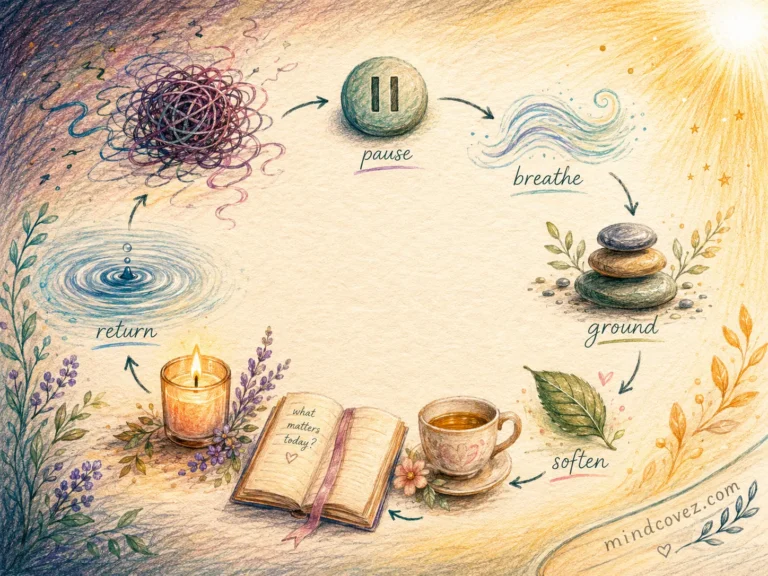


Sometimes you do the thing you were told to do. You pause, breathe, name the emotion, try to ground yourself, and remind yourself not to react.
And still, the feeling does not move.
The chest stays tight. The thoughts keep circling. The anger still has heat. The sadness still sits heavily in the room. The body does not suddenly soften just because the mind remembered a technique.
Then another feeling quietly enters.
Frustration.
You may think, “Why are my emotional regulation skills not working?” Or worse, “Maybe I am the problem.”
This is the part people do not always talk about. Not just the emotion itself, but the moment after you tried to help yourself and it still did not feel better.
A parent may sit in a noisy room after a long day, trying to breathe while the children argue, the dishes wait, and one more sound feels like too much. Someone may reread a message five times, type a calm reply, delete it, type it again, and still feel their stomach twist. Someone else may snap during a conversation, regret it almost immediately, and then spend the rest of the night feeling ashamed for not being “more regulated.”
These moments can make emotional regulation feel like something other people know how to do.
But emotional regulation skills are not magic buttons. They are not meant to erase emotion in one clean moment. They are skills. And like all skills, they can feel awkward, slow, weak, or even useless before they become reliable.
This does not mean you are failing. It may simply mean your emotion is stronger than the skill you chose. Or the skill came too late. Or your body needed safety before reflection. Or the feeling was asking to be understood, not silenced.
Emotional regulation is not about becoming calm on command. It is about learning how to stay with yourself without making the moment worse.
Quick Answer: What If Emotional Regulation Skills Do Not Work Right Away?
If emotional regulation skills do not work right away, it does not mean they are useless or that you are doing them wrong. More often, it means something in the moment needs adjustment.
The skill may not match the emotion. The emotion may be too intense. The timing may be too late. Your body may need grounding before reflection. Or the feeling may be pointing to a real need, not just something to calm down.
The first goal is not always peace. Sometimes the first goal is to pause, reduce harm, delay a reaction, stop the message from being sent, and let the emotional wave pass through the body without letting it make every decision.
A skill can be working even if you still feel upset. If you did not explode, shut down completely, punish yourself, send the message, or make the moment worse, that may already be emotional regulation beginning quietly.
What Emotional Regulation Skills Are Really Supposed to Do
Emotional regulation means noticing, understanding, and responding to emotions in a healthier way. It does not mean you never feel angry. It does not mean you stop crying quickly. It does not mean you become peaceful in every difficult moment.
A regulated person still feels deeply. The difference is that the emotion does not always get to drive the whole car.
In psychology, emotion regulation is often described as the way people influence the emotions they have, when they have them, and how they experience or express them. That sounds neat on paper. In real life, it is much messier.
It may not look like a soft smile, perfect breathing, or a calm voice. Sometimes it looks like someone walking into another room before they say something cruel. Sometimes it looks like a mother putting her hand on the kitchen counter and whispering, “I need one minute,” before answering a child. Sometimes it looks like a person reading a hurtful message and deciding not to reply until morning.
That small space matters.
Emotional regulation helps you create a small space between the feeling and the reaction. Sometimes that space is only one breath wide. Sometimes it is just enough to stop yourself from slamming the door, sending the message, shutting down completely, or saying something you will later regret.
Sometimes regulation sounds like, “I am still upset, but I did not explode.” Or, “I still cried, but I did not shame myself for crying.” Or, “I still felt anxious, but I stayed present for five more minutes.” Or, “I still wanted to withdraw, but I sent one honest message instead.”
That is not failure. That is regulation beginning quietly.
When Emotional Regulation Skills Feel Like They Are Not Working
The first sign is often disappointment. You try a coping skill and wait for relief. When relief does not come, your mind turns on you. It starts asking why you are still like this, why one breathing exercise did not work, why the feeling came back so quickly.
You may try breathing, but your body still feels tense. You may journal and find that your thoughts become louder instead of clearer. You may ground yourself, feel steady for a few minutes, and then notice the feeling return. You may try to stay calm, but the calm feels fake. You may name the emotion, but it does not disappear. You may use a coping skill, then feel angry that it did not work fast enough.
This can also happen when you know exactly what to do, but cannot access it in the moment.
A person may read about emotional regulation at night and understand it clearly. Then the next day, one sharp comment from a family member makes their whole body react before the skill even comes to mind.
That does not mean they learned nothing. It means emotional regulation is not only intellectual. It is bodily, relational, practiced, and deeply affected by timing.
You are not broken because a skill did not work instantly. The skill may need better timing, a better match, more practice, or more support.
Why Emotional Regulation Skills May Not Work Right Away
When emotional regulation skills do not work immediately, there is usually a reason. The reason is not weakness. It is often mismatch.
You may be using a skill that is too gentle for the intensity of the emotion. You may be trying to think clearly when your body is still in threat mode. You may be using a calming tool when the real need is action, connection, rest, food, sleep, or boundaries.
Psychology gives us language for this, but daily life gives us the proof. A person does not become overwhelmed in a vacuum. They become overwhelmed after too many demands, too little rest, too much noise, a repeated emotional wound, an unresolved conversation, or a long pattern of holding themselves together.
So when emotional regulation skills are not working, the better question is not, “What is wrong with me?” A better question is, “What does this moment need that I have not understood yet?”
When the Emotion Is Bigger Than the Skill
Deep breathing can help many people. But if you are already shaking, panicking, furious, or flooded, one breathing exercise may feel like throwing a cup of water on a house fire.
That does not mean breathing is useless. It means the emotion may be too intense for breathing alone.
Think of a parent after hours of noise. The television is loud. One child is crying. Another is asking the same question again and again. The phone keeps buzzing. Someone spills water. The parent knows they should breathe before reacting, but the body is already at the edge.
In that moment, breathing may not feel soothing. It may feel impossible.
The parent may not need a perfect mindfulness moment first. They may need to lower stimulation. Turn off the sound. Step into the bathroom. Put both feet on the floor. Splash water on the face. Take one minute without answering anyone unless there is danger.
Strong emotions often need body-based regulation first. Your body may need to release some energy before your mind can reflect.
Instead of forcing calm, try asking what level the emotion is from 1 to 10. If it is 1 to 4, reflection may help. If it is 5 to 7, grounding plus movement may help. If it is 8 to 10, you may need distress-tolerance skills first.
At high intensity, the first goal is not deep insight. The first goal is safety.
That might mean splashing cold water on your face, stepping outside and walking, pressing your feet firmly into the floor, holding something textured, naming five things you can see, moving your body for two minutes, delaying any major decision, or telling yourself, “I do not have to solve this while I am flooded.”
Regulation often begins by lowering the volume, not by solving the whole feeling.
When the Timing Is Off
Some emotional regulation techniques work best before the emotion peaks. This is why a skill can be good and still feel useless in a specific moment.
Journaling can be powerful when you are sad, confused, or reflective. But if you are in the middle of a full emotional storm, journaling may turn into rumination. Instead of helping you understand the feeling, it may give your mind more space to repeat the same painful story.
Breathing can help when anxiety is rising. But if anxiety has already turned into panic, stillness may feel unbearable. Talking to someone can help when you need connection. But if you are too activated, you may need to calm your body first so the conversation does not become an argument.
This happens often with messages.
Someone receives a short reply: “Okay.”
That is all.
Their mind fills in the silence. They wonder if the person is angry. They reread the previous conversation. They type a careful message, then delete it. They try to calm themselves by thinking logically, but the body has already entered a state of urgency.
At that point, the first skill may not be analysis. It may be delay. Put the phone down. Drink water. Walk for three minutes. Come back when the body is not begging for immediate reassurance.
Timing matters.
A skill that fails during the storm may still work before or after the storm. So instead of asking, “Why did this not work?” ask whether this was a before-skill, during-skill, or after-skill.
Before-skills prevent emotional build-up. During-skills help you survive the wave. After-skills help you understand what happened. Many people try to use after-skills during the peak. That is why they feel impossible.
When You Are Trying to Remove the Feeling
This is one of the biggest hidden reasons emotional regulation skills feel like they are not working. Sometimes we use skills with a secret demand: “Make this feeling go away now.”
But emotions often become louder when they feel rejected. If you use grounding, breathing, or journaling only to force the emotion to disappear, the skill can start to feel like emotional suppression. The feeling may push back.
Regulation says, “I can feel this without letting it control everything.” Suppression says, “I should not be feeling this at all.”
That difference matters.
A person may feel hurt after a friend forgets something important. They may tell themselves, “I should not be so sensitive.” So they breathe, distract themselves, and try to act normal. But the hurt returns later, stronger than before.
The problem may not be that the breathing failed. The problem may be that the hurt was never allowed to be honest.
A regulated response may sound like, “This anger is here. I do not have to act it out.” Or, “This sadness is here. I can let it move through me gently.” Or, “This anxiety is here. I can support my body while it passes.” Or, “This shame is here. I do not have to believe everything it says.”
You are not trying to delete the emotion. You are changing your relationship with it.
Sometimes the skill does not fail because it is weak. Sometimes it feels weak because we are asking it to erase something that first needs to be heard.
When the Skill Does Not Match the Emotion
Not every emotional regulation skill works for every emotion.
This is where many people quietly give up. They try one popular technique, often breathing or journaling, and when it does not work, they assume emotional regulation itself does not work for them.
But one tool was never meant to do every job.
Anger often needs space, movement, cooling, and boundary clarity. Anxiety often needs grounding, pacing, facts, and reassurance. Sadness often needs comfort, expression, connection, or rest. Shame often needs compassion and safe contact. Numbness often needs gentle sensory awareness, not pressure.
If you use the wrong tool, you may feel worse.
If you are angry and you try to journal immediately, you may only build a stronger case against the other person. If you are anxious and you try to sit completely still, your body may feel trapped. If you are ashamed and you isolate, the shame may grow heavier.
The gentler question is, “What is this emotion asking for?”
If anger is present, try space before speaking. Move your body. Cool your face. Write the message but do not send it. Then ask, “What boundary is this anger pointing to?”
If anxiety is present, name the facts. Reduce stimulation. Break the next step into something small. Then ask, “What is one thing I can do in the next five minutes?”
If sadness is present, let the body soften. Cry if tears come. Listen to gentle music. Text someone safe. Then ask, “What kind of comfort do I need?”
If shame is present, use a kinder voice. Put a hand on your heart. Speak to yourself as you would speak to a child. Then ask, “What would I say to someone I love if they felt this?”
If numbness is present, do not force emotion. Notice temperature, texture, sound, light, and breath. Then ask, “What is one small sensation I can notice right now?”
The goal is not to collect many skills. The goal is to choose the right one for the moment.
When You Only Practice During Crisis
Emotional regulation skills are harder to use when you are already overwhelmed. This is normal.
A skill practiced only during crisis may feel unfamiliar when you need it most. Your body has not learned to trust it yet.
Think of emotional regulation like learning to swim. You do not want your first swimming lesson to happen during a storm. You practice in calmer water first. The same is true for breathing, grounding, emotion labeling, opposite action, and self-soothing.
This can feel unfair because many people only reach for these skills when they are desperate. They are already crying, already furious, already anxious, already ashamed. Then the skill does not work, and they blame themselves.
But the skill had no quiet practice.
Try practicing when you are only mildly uncomfortable. When you feel slightly irritated, notice your jaw. When you feel a little worried, name the thought. When you feel tired, say, “My body is asking for care.” When you feel tense, breathe out slowly before the tension becomes a storm.
Even one minute a day can matter. You might quietly say, “I feel tense. My shoulders are tight. I am having a worried thought. I can breathe out slowly. I can stay with myself.”
This may feel too small to count, but small practice builds emotional memory. Then, when a bigger wave comes, the skill is not brand new. Your body has met it before.
When Calm Is Not the First Win
Sometimes emotional regulation skills are working, but not in the way you expected.
You may still feel upset, but you did not scream. You may still feel anxious, but you stayed in the room. You may still feel hurt, but you did not send ten messages. You may still feel sad, but you ate something and took a shower.
That counts.
Regulation does not always feel like peace. Sometimes it feels like choosing not to make the pain bigger.
This is important because many people quit too early. They think, “I still feel bad, so this did not work.”
But the first sign of emotional regulation is not always feeling better. Sometimes the first sign is behaving differently while the feeling is still there.
A person may react sharply, then pause and repair instead of disappearing into shame. That is also regulation. A person may cry and still speak respectfully. That is regulation. A person may feel anxious and still choose one small useful step. That is regulation too.
The feeling may stay for a while. But your relationship with it can change.
When the Feeling Is Pointing to a Real Problem
Not every emotion needs to be calmed down immediately. Some emotions are signals.
Anger may be pointing to a crossed boundary. Sadness may be pointing to loss. Anxiety may be pointing to uncertainty or overload. Resentment may be pointing to repeated self-abandonment. Numbness may be pointing to exhaustion.
If you only soothe the feeling but never listen to the message, the emotion may keep returning.
This does not mean every emotion tells the full truth. Feelings are real, but they are not always accurate facts. Still, they often carry information.
A person may keep trying to regulate before every family gathering, but the real issue may be that they are constantly dismissed there. Someone may keep breathing through work stress, but the real issue may be overload. Someone may keep journaling about resentment, but the real issue may be saying yes when they mean no.
After the intensity lowers, ask what the emotion is trying to protect, what it wants you to notice, whether there is a real problem that needs action, and whether you need comfort, clarity, repair, rest, or a boundary.
Sometimes regulation is not the end of the process. It is the beginning of a wiser response.
Why It Feels So Personal When Coping Skills Do Not Work
When coping skills do not work, the pain is not only emotional. It can become personal.
You may start judging yourself. “I should be calmer by now.” “I know better than this.” “Why can everyone else regulate, but I cannot?” “I tried everything. Nothing works for me.”
This is where emotional regulation becomes emotionally loaded.
The skill itself is no longer the only issue. Now there is shame around the skill. There is disappointment. There may even be fear that you are somehow too much, too reactive, too sensitive, or too broken to change.
That shame makes regulation harder. Because now you are not only holding anger, anxiety, sadness, or overwhelm. You are holding a story about yourself.
A gentler reframe may help. This may not be failure. It may be a skill that needs better timing. This may not be weakness. It may be emotional intensity. This may not mean nothing works. It may mean this tool does not fit this moment. This may not mean you are broken. It may mean you need support, practice, or a different approach.
The goal is not to excuse harmful reactions. The goal is to understand them clearly enough to choose differently next time.
A Daily-Life Scene: When Breathing Does Not Calm You Down
Imagine someone has a difficult conversation with a family member. The other person says something dismissive. Maybe nothing dramatic. Just one small sentence that lands in an old place.
Their chest tightens. Their jaw locks. Their thoughts speed up. They remember what they have read about emotional regulation, so they try to breathe.
But the breathing does not help. In fact, it makes them more aware of how angry they are. Then they feel worse. They think, “Even breathing does not work for me.”
But the problem may not be breathing itself. The problem may be timing and intensity.
At that moment, the person may need to step away, move their body, drink water, cool their face, or delay the conversation. Later, when the body is less activated, breathing may help.
This is why emotional regulation needs flexibility. The question is not, “Why can I not calm down instantly?” A better question is, “What does this moment need first?”
What to Do in the Moment When Nothing Works
When nothing works, stop trying to perform perfect emotional regulation. Come back to the basics.
Say to yourself, “This is a hard moment. I do not have to fix my whole life right now.”
That sentence may not make the feeling disappear. But it can soften the demand that you must immediately become calm, wise, and emotionally perfect.
The first move is to pause the damage. Before trying to feel better, try not to make things worse. Do not send the message yet. Do not make the final decision yet. Do not attack yourself. Do not punish your body. Do not turn one painful moment into a permanent identity.
This may sound simple, but in emotional moments, simple things are often the most protective.
You might say, “I will come back to this in twenty minutes.” Or, “I can respond when I am steadier.” Or, “I do not have to solve this at peak intensity.”
This helps because high emotion often creates urgency. A pause reminds your mind that not everything needs an immediate reaction.
Then regulate the body first. When emotion is high, the body needs care before the mind can cooperate. Drink water. Eat something small if you have not eaten. Loosen your jaw. Drop your shoulders. Step away from the screen. Change rooms. Walk slowly. Wash your hands with cool water. Exhale longer than you inhale.
Do not underestimate physical basics. Sometimes what feels like emotional failure is also hunger, exhaustion, overstimulation, lack of sleep, or too much pressure for too long.
After that, name the emotion simply. Do not overanalyze it yet. You might say, “This is anger,” “This is fear,” “This is sadness,” “This is shame,” “This is overwhelm,” “This is loneliness,” or “This is disappointment.”
Naming an emotion does not make it vanish. But it gives the feeling a shape. A named emotion is often easier to hold than a nameless storm.
Then choose one tiny next action. Do not ask, “How do I fix everything?” Ask, “What is the next kind thing I can do?”
Maybe the answer is to take a shower, put the phone down, sit on the floor, step outside, text one safe person, write three honest lines, rest for ten minutes, make tea, pray, breathe, or wait.
Tiny actions matter because intense emotions often make life feel too big. A small next step brings the moment back to size.
Scripts to Use When You Cannot Regulate Right Away
Scripts are not meant to make you sound perfect. They are starting points. Use the ones that sound natural to you and change the words if you need to. The goal is not to sound polished. The goal is to create a little space before the feeling chooses the response for you.
When you need time before responding, you might say, “I want to answer this properly, but I need a few minutes first.” You could also say, “I am feeling too activated to respond clearly right now. I will come back to this.” Or, “I care about this conversation, but I do not want to react from the worst part of the feeling.”
When you need to step away from conflict, you might say, “I need to pause before this becomes hurtful.” You could also say, “I am not ignoring you. I need a little space so I can speak more calmly.” Or, “I do not want to make this worse. I am going to step away and return when I am steadier.”
When someone dismisses your feelings, you might say, “I am not asking you to agree with everything I feel. I am asking you to listen respectfully.” You could also say, “When my feelings are mocked, I cannot stay open in the conversation.” Or, “I want to talk, but I cannot keep talking if my emotions are treated like a joke.”
When you feel ashamed for not calming down, you might say, “I am having a hard moment, not a failed character.” You could also say, “This feeling is strong. I can still choose one small safe action.” Or, “I do not have to become calm instantly to be trying.”
When you need support, you might say, “This feels too heavy for me to sort through alone.” You could also say, “I do not need you to fix it. I just need someone safe to sit with me for a moment.” Or, “I think I need support with this pattern. I am tired of carrying it quietly.”
Self-Soothing vs Avoidance: How to Tell the Difference
Self-soothing and avoidance can look similar from the outside. Both may involve distraction, rest, or stepping away. The difference is the intention.
Self-soothing says, “I am helping myself become steady enough to return.” Avoidance says, “I am escaping this so I never have to face it.”
Self-soothing gives you strength. Avoidance keeps you stuck.
Watching a comforting show after a painful day may be self-soothing. Watching for seven hours to avoid a necessary conversation may become avoidance. Taking space during conflict may be self-soothing. Disappearing for days without repair may become avoidance. Resting after emotional overload may be self-soothing. Refusing to look at any pattern in your life may become avoidance.
A helpful question is, “Is this helping me return to myself, or helping me disappear from myself?”
No shame. Just information.
When Opposite Action Can Help
Opposite action is useful when the emotion is pushing you toward a behavior that may make things worse.
If sadness tells you to isolate completely, opposite action may be sending one small message. If anger tells you to attack, opposite action may be speaking slowly or taking space. If fear tells you to avoid everything, opposite action may be taking one safe step forward. If shame tells you to hide, opposite action may be telling one trusted person, “I am having a hard moment.”
Opposite action is not about denying the emotion. It is about refusing to let the emotion choose a harmful behavior for you.
Start small. You do not have to become brave all at once. Sometimes opposite action is simply not obeying the first impulse.
What Not to Do When Emotional Regulation Skills Are Not Working
When a skill does not work right away, the next response matters. Try not to turn the moment into proof that you are hopeless.
Do not shame yourself for still feeling. Feeling upset after using a skill does not mean you failed. It may mean the emotion needs more time, more support, or a different skill. Instead of saying, “I should be over this,” try, “This is still here. I can slow down around it.”
Do not keep forcing the same skill. If breathing is making you more tense, pause. Try movement, sensory grounding, cold water, or stepping away. A skill is a tool, not a rule.
Do not make big decisions at peak intensity. Strong emotions can make everything feel urgent. When possible, delay major decisions until your body and mind are steadier. This does not mean you ignore the issue. It means you do not let the peak of the emotion decide everything.
Do not use self-soothing to avoid every hard conversation. Rest is healthy. Avoiding every difficult conversation can keep the pattern alive. After you are calmer, ask, “What still needs to be addressed?”
Do not compare your regulation to someone else’s. Some people look calm because they are regulated. Some people look calm because they are shut down. Some react loudly because they are overwhelmed. Some react quietly and carry the storm inside.
You cannot always measure regulation from the outside. Stay with your own practice.
Boundaries That Help When Skills Are Not Enough
Sometimes emotional regulation is not only an inside job. Sometimes your environment keeps triggering the same wound.
Sometimes the conversation is too fast. The relationship is too dismissive. The workload is too heavy. The noise is too much. The expectation is unfair. The pressure has been building for too long.
In these moments, coping skills may help you survive, but boundaries help you change the pattern.
A boundary may sound like, “I cannot discuss this while we are both upset.” Or, “I need respectful language if we are going to continue.” Or, “I am available to talk, but not to be shouted at.” Or, “I need rest before I can make a clear decision.” Or, “I cannot keep saying yes when I am already overwhelmed.” Or, “I need time to think before I answer.”
Boundaries are not emotional punishment. They are structure. They give your nervous system, your relationships, and your daily life clearer limits.
Long-Term Skills That Make Emotional Regulation Easier
Emotional regulation grows slowly. It becomes easier when you build the life around the skill, not just the skill itself.
Start by noticing your early signals. Most emotions begin quietly before they become loud. Anger may begin as jaw tension. Anxiety may begin as checking. Sadness may begin as heaviness. Shame may begin as wanting to hide. Overwhelm may begin as irritation.
Early signals matter because they give you more choices. Try asking once a day, “What did my body try to tell me before the emotion got big?”
You can also build a personal emotion map. Write down what usually happens when a specific emotion rises. When you feel anxious, maybe you check things repeatedly. When you feel angry, maybe you speak too sharply. When you feel ashamed, maybe you disappear. When you feel overwhelmed, maybe you become numb.
This helps you see the pattern before it takes over.
Practice skills when you are mildly upset, not only when you are already flooded. That may mean doing one slow breath when you are mildly irritated. Or naming anxiety before it becomes panic. Or stepping away from your phone before overstimulation turns into emotional exhaustion.
Practice in small moments makes bigger moments less unfamiliar.
It also helps to create a skill menu. For anger, you may need space, movement, or cooling. For anxiety, you may need grounding, facts, or one small step. For sadness, you may need comfort, tears, or connection. For shame, you may need compassion, a safe person, or gentle self-talk. For numbness, you may need senses, light, movement, and no pressure.
This helps you stop asking one skill to do every job.
Then reflect after the wave. Reflection is best after the peak, not during it. Ask what helped even a little, what made things worse, what you needed but did not ask for, and what you can notice earlier next time.
This turns one difficult moment into emotional learning. That is how regulation grows. Not through perfection. Through reflection.
Reflection Questions for After the Emotion Passes
Do not ask these questions at peak intensity. Ask them later, when you are steadier.
You may want to ask: What emotion was I feeling most strongly? What triggered it? What did my body feel first? What did I want to do immediately? Would that action have helped or harmed me? What skill did I try? Did it fail completely, or did it help a little? Was the skill too soft, too late, or mismatched? What did the emotion need: comfort, action, rest, connection, or boundaries? What can I try earlier next time?
These questions are not meant to shame you. They are meant to help you learn your own emotional pattern with more kindness.
A Gentle 7-Day Practice Rhythm for When Skills Are Not Working Yet
This practice is simple on purpose. Emotional regulation becomes stronger through repetition, not pressure.
On the first day, name without fixing. Three times in the day, pause and name what you feel. “I feel tense.” “I feel irritated.” “I feel tired.” “I feel hopeful.” Do not change it. Just name it.
On the second day, notice the body. Ask, “Where do I feel this emotion in my body?” It may be in your jaw, chest, throat, stomach, shoulders, or hands. This builds body awareness.
On the third day, build a 1 to 10 emotion scale. Choose one emotion you often struggle with and write what it looks like at different levels. Anger at 3 may be irritation. Anger at 6 may be sharp words. Anger at 9 may be shouting or losing control. This helps you catch emotions earlier.
On the fourth day, match one skill to one emotion. For anxiety, try grounding. For anger, try taking space. For sadness, try self-soothing. For shame, try compassionate self-talk. Practice before you need it.
On the fifth day, try a body-based reset. Walk, stretch, use cold water, exhale slowly, press your feet to the floor, or relax your shoulders. Notice whether your emotional intensity changes even slightly.
On the sixth day, practice a delay. When a strong urge appears, delay action for five minutes. You are not forbidding the action forever. You are creating space. Say, “I can choose later. I do not have to react right now.”
On the seventh day, reflect without shame. Write what helped even 5 percent, what did not fit, what emotion needs a different skill, and what you can try earlier next time.
Progress often begins at 5 percent. Do not dismiss it.
When to Get Help
Sometimes emotional regulation skills do not work because the emotional load is too heavy to carry alone.
That is not a personal failure.
Support may be helpful if strong emotions regularly affect your relationships, work, sleep, safety, parenting, studies, or daily functioning. It may also help if you often feel out of control, numb, impulsive, hopeless, or unable to calm down after emotional triggers.
This article is for education and self-reflection. It cannot diagnose anyone or replace support from a qualified mental health professional. If this pattern feels unsafe, overwhelming, or repeated in a way that harms your daily life, seeking mental health support is a valid and stigma-free step.
Reaching out to a mental health professional does not mean you are broken. It means you are allowed to learn with support. Some emotional patterns need more than self-help. They need safety, guidance, and care.
There is no shame in that.
If you feel in immediate danger or may hurt yourself or someone else, please contact local emergency services or a trusted crisis support service in your area right now.
Questions People Ask About Emotional Regulation Skills Not Working
Why are my emotional regulation skills not working?
They may not match the emotion, timing, intensity, or situation. The skill may also need more practice before it feels natural. This does not mean you are failing. It means the approach may need adjustment.
Does emotional regulation mean calming down immediately?
No. Emotional regulation does not always mean instant calm. Sometimes it means delaying a reaction, reducing harm, choosing a safer response, or staying present while the feeling slowly changes.
What should I do if breathing exercises do not help?
Try a body-based skill first. Walk, stretch, splash cold water on your face, press your feet into the floor, or change your environment. Some emotions need movement before stillness. If breathing does help later, use it after your body has become a little steadier.
Is it normal for coping skills to stop working?
Yes, coping skills can stop feeling helpful when your stress level, life situation, emotional intensity, or needs change. A skill that helped in one season may not fit another season. This is a sign to update your toolkit, not shame yourself.
How do I know if I am self-soothing or avoiding?
Self-soothing helps you become steady enough to return to life. Avoidance keeps you away from the issue completely. A helpful question is, “Is this helping me return to myself, or helping me disappear from myself?”
Should I keep trying a skill that does not work?
Try adjusting the timing, intensity, or emotion match first. If the skill still does not help after practice, choose another one. Emotional regulation is personal, and not every tool works for every person in every moment.
When should I seek professional help?
Consider extra support if strong emotions regularly affect your relationships, work, sleep, safety, or daily life. Seeking help is not a stigma. It is a healthy step when self-help does not feel like enough.
Closing
The first time you try to regulate a strong emotion, it may feel unnatural. You may forget the skill. You may use it late. You may use the wrong one. You may still cry, shake, withdraw, overthink, or need time.
That does not mean nothing is changing. Sometimes healing begins not when the feeling disappears, but when you stop abandoning yourself inside it.
References
American Psychological Association. 2018. APA Dictionary of Psychology: Emotion Regulation.
Gross, J. J. 1998. The Emerging Field of Emotion Regulation: An Integrative Review.
Gross, J. J. 2015. The Extended Process Model of Emotion Regulation: Elaborations, Applications, and Future Directions.
Harvard Health Publishing. 2024. Self-regulation for adults: Strategies for getting a handle on emotions and behavior.
Harvard Health Publishing. 2024. Dialectical behavior therapy: What is it and who can it help?
Linehan, M. M. 2015. DBT Skills Training Manual. Second Edition.
Linehan Institute. 2025. DBT Skills Training Manual page.
Mental Health America Screening. My coping skills aren’t working anymore.
Kaiser Permanente. 2020. Distress Tolerance DBT Skills.
Kozubal, M., Szuster, A., and Wielgopolan, A. 2023. Emotional regulation strategies in daily life: The intensity of emotions and regulation choice.
Van Bockstaele, B., et al. 2024. Effects of intensity on emotion regulation strategy preferences are emotion-specific.