

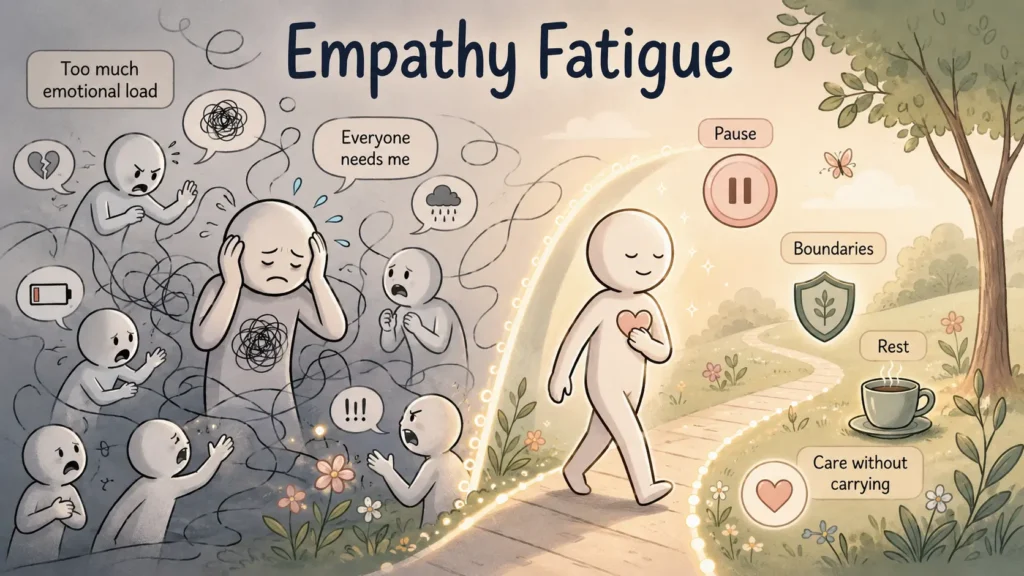
You may still care. That is the part people often miss.
Empathy fatigue does not usually begin with cruelty. It often begins with a quiet thought you do not really want to admit.
“I cannot do another emotional conversation today.”
Or maybe it is not even a thought. Maybe your body goes flat when someone needs you. A message comes in, and instead of concern, you feel irritation. Or dread. Or nothing. Then the guilt comes right after, because you know you are not a cold person.
That is usually the confusing part.
Empathy fatigue can make caring feel heavy, numb, resentful, or strangely mechanical. It can happen when you have spent too long listening, supporting, witnessing pain, managing emotions, or being the person everyone leans on.
You still understand that people are hurting. You may still respond kindly. You may still show up.
But inside, something feels tired in a way sleep does not fully fix.
The main thing to hold onto is this: empathy fatigue does not usually mean you have stopped caring. More often, it means your emotional capacity has been stretched too far for too long.
There is a difference.
A nurse who feels nothing after a difficult shift may still be deeply compassionate. A therapist who notices dread before sessions may not be “bad at the work.” A parent caring for an anxious child may snap over something small and then feel ashamed. A friend who has become everyone’s crisis contact may stop replying, not because they are cruel, but because their system has started to protect itself.
In professional settings, empathy fatigue is often discussed alongside compassion fatigue, caregiving stress, emotional overload, and burnout. SAMHSA, in 2024, described compassion fatigue as involving both burnout and secondary traumatic stress. WHO describes burnout as an occupational phenomenon, not a medical condition.
So no, this is not a diagnosis. It is a practical way to understand what may be happening before exhaustion hardens into detachment.
What Is Empathy Fatigue?
Empathy fatigue is emotional, mental, and sometimes physical exhaustion from repeatedly absorbing, witnessing, or responding to other people’s pain without enough recovery.
It can happen when you listen too much, support too much, carry too much, or feel responsible for too many people’s feelings.
Empathy itself is not one simple thing. It can include:
- Understanding what someone else may be feeling
- Emotionally resonating with their pain
- Responding with care or compassion
When you are depleted, one layer may still work while another one goes quiet.
You may still understand that someone is hurting. You may still know what a kind response would sound like. You may even still show up. But the emotional warmth may feel harder to reach.
That does not automatically mean you have become uncaring.
It may mean your system is tired of feeling with everyone.
In research language, people may talk about secondary traumatic stress, vicarious trauma, empathic distress, allostatic load, or cortisol dysregulation. In real life, people usually say it more simply:
“I know I should care. I just feel done.”
Is Empathy Fatigue a Real Diagnosis?
Empathy fatigue is not usually used as a formal diagnosis.
It is a practical phrase people use when they feel emotionally depleted from caring, listening, supporting, or absorbing too much. That matters because the phrase can help people name what is happening, but it should not be used to label or diagnose someone.
This can look like empathy fatigue if you feel emotionally overloaded, numb, irritable, resentful, or unable to keep responding with your usual care.
It may overlap with compassion fatigue, caregiving stress, emotional overload, burnout, or secondary traumatic stress. But it is not the same as saying, “You have a disorder.”
That distinction matters.
The reader does not need shame. They need clarity.
What Helps Empathy Fatigue?
Empathy fatigue often improves when you reduce emotional overload and stop making yourself the only support person.
What helps most:
- Take recovery time after emotionally heavy conversations
- Set limits around crisis talks and late-night venting
- Stop being everyone’s only emotional container
- Separate caring from carrying
- Use quiet time after caregiving, work, or conflict
- Ask for practical support
- Encourage professional support when needed
- Notice resentment before it turns into shutdown
- Seek help if numbness, hopelessness, or daily dysfunction continues
The goal is not to care less.
The goal is to care without slowly disappearing from your own life.
Empathy Fatigue vs Burnout, Compassion Fatigue, and Depression
These terms overlap, but they are not the same.
| Experience | Main source | Common feeling | What helps most |
| Empathy fatigue | Feeling with, listening to, or absorbing others’ pain too much | “I can’t keep caring like this.” | Emotional limits, recovery time, support, and less over-identification |
| Burnout | Chronic unmanaged workplace stress | “I can’t keep working like this.” | Workload changes, rest, role clarity, organizational support |
| Compassion fatigue | Repeated exposure to suffering, especially in helping or caregiving roles | “Their pain is getting inside me.” | Supervision, trauma-informed support, reduced exposure, and recovery time |
| Caregiver stress | Ongoing responsibility for another person’s health, safety, or needs | “There is no room for me.” | Respite care, shared responsibilities, support groups, and practical help |
| Depression | Many possible causes, not always linked to caregiving | “Nothing matters,” or “I feel hopeless.” | Professional assessment, therapy, medical support, and social support |
A simple way to think about it:
Empathy fatigue is feeling drained from feeling with others too much.
Burnout is depletion linked to chronic, unmanaged workplace stress.
Compassion fatigue is emotional strain from repeated exposure to suffering, especially in helping or caregiving roles.
OSHA notes that compassion fatigue and burnout can involve trouble concentrating, sleep problems, low motivation, irritability, anger, sadness, anxiety, decreased energy, or increased substance use.
The practical question is not, “Which label is perfect?”
The better question is:
What is being depleted, and what kind of support would actually restore it?
Signs of Empathy Fatigue
Empathy fatigue often appears in layers.
One person may feel numb. Another may feel angry. Someone else may look highly functional from the outside while quietly losing patience, sleep, and hope.
This can look like empathy fatigue if several of these feel familiar:
- You feel emotionally drained after supporting others
- You feel numb instead of caring
- You avoid people’s problems
- You feel guilty for needing space
- You become irritable when others need support
- You feel heavy after conversations
- You struggle to separate your emotions from theirs
- You feel resentful, but keep showing up
- You need silence after emotionally intense interactions
- You dread caregiving, client work, family conflict, or hard conversations
- You feel tired even after resting
- You feel relief when someone cancels
- You are becoming cynical or harsh in ways that feel unlike you
- You use scrolling, food, alcohol, work, or sleep to shut down
- You feel like everyone needs something from you, and there is no room left for you
Empathy fatigue can also live in the body.
You may notice:
- Constant tiredness
- Headaches, body tension, or stomach issues
- Sleep changes
- Appetite changes
- Brain fog
- Poor focus
- Feeling jumpy or on edge
- Getting sick more often
- Feeling exhausted even after a break
Mayo Clinic’s 2023 caregiver stress guidance lists signs such as feeling burdened, feeling tired often, sleeping too much or too little, weight changes, anger, sadness, headaches or other physical problems, substance misuse, and missing your own medical appointments.
That last one matters. A lot.
People who care for everyone else often become strangely casual about neglecting themselves.
Main takeaway: Empathy fatigue is not a lack of empathy. It is often what happens when empathy has been running without enough recovery, boundaries, or support.
I used to think of this mostly as a boundary problem. Sometimes it is. But not always.
Over time, after reading more on secondary traumatic stress and watching how helpers actually break down, I changed my mind a little. Some people do not need a lecture about boundaries. They need relief from impossible emotional exposure, chronic responsibility, and systems that keep asking them to absorb more.
Why Empathy Fatigue Happens
Empathy fatigue usually comes from repeated emotional exposure without enough recovery, support, or control.
Some tiredness after caring for others is normal. But when your nervous system stays in a prolonged state of threat, responsibility, or helplessness, the body starts conserving energy. Warmth drops. Patience drops. Access to feeling may narrow.
Not because you are selfish.
Because something in you is trying to survive the load.
Emotional overload
Emotional overload happens when you keep taking in more pain, conflict, fear, or need than your system can process.
This may come from work. Or family. Or parenting. Or being the friend who always listens. Sometimes it comes from all of them at once.
A person can be deeply caring and still have a limit.
That is not failure. That is biology.
Poor boundaries
A boundary is not a wall against care. It is a structure that keeps care from becoming self-erasure.
Empathy fatigue grows faster when you:
- Answer every message immediately
- Feel guilty resting while someone else is struggling
- Believe love means unlimited availability
- Confuse being needed with being useful
- Let other people’s emotions set your whole nervous system on fire
- Keep saying yes when your body is saying no
Many caring people do not lack empathy.
They lack limits around empathy.
Chronic stress and lack of recovery time
Chronic stress changes how much emotional weight a person can carry.
When sleep is poor, work is intense, family needs are constant, or the body never gets a real pause, even normal emotional requests can feel too much.
A small message can feel like a demand.
A normal conversation can feel like another task.
That is often where guilt starts.
Caregiving roles
Caregivers often live with long-term emotional responsibility.
Mayo Clinic’s 2023 caregiver stress guidance describes how caregiving can bring emotional and physical stress, including feeling burdened, tired, angry, sad, physically unwell, or alone.
People in caregiving roles may also miss their own medical appointments, ignore their own needs, or keep functioning while quietly running on empty.
Again, this is not small.
It is a pattern.
People-pleasing
People-pleasing can make empathy fatigue worse because the person does not just care. They feel responsible for preventing disappointment, sadness, conflict, or rejection.
So they keep listening.
They keep replying.
They keep rescuing.
Then they resent it.
Then they feel ashamed for resenting it.
That loop is brutal.
Trauma triggers
Sometimes another person’s pain touches something unresolved in your own story.
A teacher working with neglected children may feel old memories waking up. A therapist may feel unusually activated by a client’s grief. A caregiver may feel trapped because the current situation resembles something they survived before.
This does not mean you cannot help.
It means your own nervous system deserves attention, too.
Constant crisis conversations
Some people become the person everyone calls in a crisis.
At first, it may feel meaningful. You are trusted. You are needed. You know how to stay calm.
But if every conversation becomes heavy, the body starts bracing before the phone even rings.
You may feel irritated before you know what the person wants.
That is information.
Over-identifying with others’ pain
Caring becomes heavier when you start feeling another person’s pain as if it is yours to solve.
You can care about someone’s fear, grief, anxiety, or conflict without taking ownership of their emotions, choices, or outcomes.
That line can be hard to hold. Especially for highly empathic people.
But without it, empathy becomes emotional carrying.
Who Is More Likely to Experience Empathy Fatigue?
Empathy fatigue can happen to anyone, but some people are more exposed to it.
It may be more likely in:
- Highly empathic people
- Caregivers
- Parents
- Therapists
- Helpers
- Healthcare workers
- Teachers
- Social workers
- First responders
- People in emotionally intense families
- People exposed to repeated distress
- People who feel responsible for everyone
- People who are often the “strong ones”
- People who work in emotionally demanding roles
- People who support a partner while losing themselves
- People who absorb work conflict or family conflict
CDC/NIOSH’s 2024 healthcare worker guidance notes that emotionally intense work can involve exposure to human suffering and death, long and unpredictable hours, high administrative burden, and little control over schedules.
Even outside formal helping professions, the same pattern can appear in ordinary life.
You may be the friend who gets the crisis messages. The adult child manages a parent’s appointments. The parent who is always emotionally available. The one everyone assumes can handle it.
Until you cannot.
What Empathy Fatigue Looks Like in Real Life
Empathy fatigue does not always look dramatic. It often shows up in ordinary moments, which is why people miss it.
A friend calls every evening with another crisis. At first, you listen carefully. You ask questions. You help them calm down. After a few weeks, your stomach drops when their name appears on your phone.
You care about them. You really do.
But your body has started associating the call with emotional demand.
Or maybe you are the person everyone calls because you are “good with this stuff.” A sibling vents. A parent complains. A cousin needs advice. Someone is always upset, and somehow you are expected to regulate the room.
After a while, you may stop answering. Or answer with flatness. Or feel angry before the conversation even begins.
In parenting, it may look different. A parent caring for an anxious child may stay patient through the panic, the bedtime fears, the school refusal, and the repeated questions. Then one tiny thing happens, like a spilled drink, a missing shoe, or a sibling argument, and they snap.
The shame afterward can be intense. But the snap may not be the whole story. It may be the last visible piece of a much longer strain.
At work, it can be quieter.
A social worker gets home at 7:40 p.m., still wearing the cardigan she wore through three difficult meetings. Her partner starts talking about a rough day at work. Nothing dramatic. Just office tension, a rude comment, a deadline.
And she cannot listen.
Not because the partner’s problem is unimportant. Because she has spent all day absorbing crisis, grief, urgency, and other people’s nervous systems. Her emotional bandwidth is gone.
That is empathy fatigue in real life. It is not always coldness. Sometimes it is a capacity loss.
It can also show up in relationships. You may love your partner and still feel irritated when they need reassurance again. You may hear yourself thinking, “I cannot do another emotional conversation tonight.”
That thought can feel cruel. But sometimes it is just information. Your emotional bandwidth is low.
It can show up in social anxiety, too, especially when you are constantly monitoring other people’s reactions. Did I upset them? Are they disappointed? Do they need something from me? Am I being selfish?
That kind of vigilance can wear down the nervous system. It is not the same as professional compassion fatigue, but the emotional depletion can feel similar.
And if someone is already sensitive to shame or rejection, other people’s distress can feel like a demand to prove they are good, kind, available, or safe.
So they overextend.
Then they resent it.
Then they feel ashamed for resenting it.
Some people are also treated like an emotional emergency room. Everyone comes in distressed. Everyone expects space. Everyone leaves lighter.
You are the one who stays full.
That is not sustainable.
What to Do When You Feel Emotionally Drained
Start small. Not because the problem is small, but because exhausted people need doable steps.
If you feel overloaded, pause new emotional input where possible. That may mean delaying a reply, ending a conversation gently, turning off notifications, or choosing not to open a heavy message right before sleep.
You are allowed to protect timing.
When empathy fatigue hits, the body often needs something simple before the mind can think clearly.
Try this:
- Put both feet on the floor
- Unclench your jaw
- Take one slower breath than usual
- Look around and name five things you can see
- Drink water
- Step outside for a few minutes
- Sit somewhere quiet without more input
Not elegant. But useful.
Then ask:
- Does this need to happen now?
- Am I the only person who can hold this?
- Am I helping, or am I just absorbing?
- What would happen if I responded later?
Sometimes the most compassionate thing is not immediate availability. It is a response you can give without resentment.
Another question helps too:
“What is mine to carry right now, and what is not?”
Your care may be yours.
Your response may be yours.
But another person’s emotions, choices, healing, reactions, and outcomes are not fully yours.
Rest can feel selfish when someone else is struggling. But exhaustion does not make you more loving. It usually makes you more brittle.
Rest is not proof that you do not care.
It is part of how care stays possible.
If you are always the support person, it may feel strange to need support yourself. Still, ask. Not everyone. Just one safe person.
You might say:
“I am emotionally overloaded, and I do not need advice right now. I just need someone to know.”
That alone can soften the pressure.
After a hard call, caregiving task, therapy session, family conflict, or emotionally loaded conversation, give yourself a small transition. Even five minutes. No phone. No next crisis. No immediate fixing.
Just a pause where your system can come back to itself.
How to Care Without Carrying Everyone’s Pain
You can care, listen, and respond without taking ownership of another person’s emotions, choices, or outcomes.
This is easy to say and hard to practice.
Caring sounds like:
“I am here with you.”
Carrying sounds like:
“I must fix this, or I have failed you.”
Caring allows connection.
Carrying creates pressure, control, guilt, and exhaustion.
When people over-identify with someone else’s pain, they may start living inside the other person’s crisis. Their mood rises and falls with someone else’s messages. Their body stays tense until the other person feels better.
That is too much power to give to someone else’s emotional weather.
A helpful question is:
“Can I be kind without becoming responsible for the outcome?”
Sometimes yes.
Sometimes you will need practice.
Scripts for Emotional Space
Sometimes people need words before they can set a boundary.
You can say:
- “I care, but I do not have the emotional capacity right now.”
- “Can we talk about this later when I can be more present?”
- “I want to support you, but I also need rest.”
- “I cannot be your only support person.”
- “I need a quiet evening to reset.”
- “I am not ignoring you. I am protecting my capacity.”
- “I can listen for a little while, but I cannot stay in this conversation all night.”
- “This sounds important, and I think it may need more support than I can give alone.”
- “I love you, and I also need space before I respond.”
The tone matters.
A boundary does not have to be cold to be real.
What Not to Do When You Have Empathy Fatigue
When empathy fatigue shows up, people often push harder. That usually makes it worse.
Try not to:
- Shame yourself for feeling tired
- Force yourself to keep absorbing pain
- Confuse numbness with being heartless
- Ignore resentment
- Keep saying yes when your body is saying no
- Become everyone’s emotional emergency room
- Treat rest as something you must earn
- Use guilt as proof that you should keep going
- Wait until you collapse before changing anything
Resentment is not always a moral failure.
Sometimes it is a late signal that a boundary should have been there earlier.
Boundaries That Protect Compassion
Boundaries are not punishment. They are protection for the part of you that still wants to care.
Helpful boundaries may include:
- Time limits for heavy conversations
- No crisis conversations when exhausted
- Shared support systems
- Emotional check-ins before helping
- Less rescuing
- More recovery time
- Not being available 24/7
- Encouraging professional support when needed
- Not answering heavy messages right before sleep
- Asking whether someone wants to listen, advice, or practical help
- Refusing to be the only person holding a repeated crisis
Try this before you enter a heavy conversation:
“Do I have the capacity for this right now?”
If the honest answer is no, you can still be kind.
You can respond later.
When Empathy Fatigue Affects Relationships
Empathy fatigue can change how people show up in relationships.
It may cause:
- Withdrawal
- Irritability
- Numbness
- Resentment
- Guilt
- Shutdown
- Less affection
- Less patience
- Avoiding hard conversations
- Feeling trapped by someone else’s needs
This is where people often misread each other.
One person thinks, “They do not care about me anymore.”
The other person thinks, “I care, but I cannot keep being needed like this.”
Both may be hurting.
Honest communication helps more than silent overextension.
You might say:
“I care about you, but I am emotionally depleted. I want to talk about this when I can be more present.”
That is different from disappearing.
It gives the relationship information.
Daily Habits and Long-Term Prevention
Long-term prevention is not about becoming less empathic.
It is about becoming less fused with everyone else’s pain.
Small habits matter because empathy fatigue often builds gradually.
Daily habits that protect emotional energy include:
- Quiet time
- Sleep
- Movement
- Journaling
- Limiting emotional overload
- Grounding after intense conversations
- Naming personal feelings first
- Transition rituals after caregiving or work
- Scheduled non-helping time
- Eating regularly
- Reducing distress-heavy media at night
- Taking breaks from group chats or crisis threads
- Spending time in roles where you are not the helper
Mayo Clinic recommends that caregivers ask for and accept help, set reachable goals, connect with resources, join support groups, seek social support, protect sleep, move their bodies, eat well, and keep up with their own health care.
The key is specificity.
“I need self-care” is vague.
“I do not answer non-urgent emotional messages after 8 p.m.” is usable.
Recovery has to be scheduled before you are desperate.
That might mean:
- Ten quiet minutes after emotionally intense work
- A no-crisis-call window in the evening
- One protected morning each week
- A walk without podcasts, news, or messages
- A debrief with a colleague
- A therapy session
- Respite care
- Turning off distress-heavy media at night
Helpful long-term skills include:
- Stronger boundaries
- Compassion instead of over-identification
- Self-trust
- Support networks
- Therapy or supervision for helping roles
- Tolerating others’ distress without rushing to fix it
- Noticing early resentment or numbness
- Asking for help before collapse
- Letting other adults carry their own responsibilities
- Learning that discomfort is not always danger
- Making recovery part of the routine, not a reward after breakdown
Long-term support may include:
- Therapy for burnout, trauma exposure, grief, or chronic stress
- Clinical supervision or peer consultation if you work in a helping role
- Journaling about what is yours to carry and what is not
- Respite care if you are a family caregiver
- Support groups for caregivers, healthcare workers, or trauma-exposed professionals
- Nervous system regulation habits such as sleep routines, movement, quiet time, and reduced crisis exposure
Meaning helps too. It can remind you why the work, relationship, or caregiving role matters.
But meaning can also be misused.
“You chose this work.”
“They need you.”
“You’re so strong.”
“No one else can do it like you.”
Those statements may be partly true and still harmful if they keep you trapped in overextension.
A healthier version is:
“This matters, and I also matter.”
Compassion satisfaction, the sense that caring work is meaningful, can buffer emotional strain. But it cannot replace sleep, staffing, boundaries, supervision, medical care, or practical support.
When to Get Help
Some tiredness is expected after intense caregiving or helping at work. But it is time to take empathy fatigue more seriously if:
- It lasts for weeks and does not improve with rest
- You feel emotionally numb most of the time
- You are becoming harsh, careless, or unsafe in your role
- You are using alcohol, drugs, food, work, or isolation to cope
- You feel hopeless or trapped
- You feel constantly exhausted
- You feel resentful, detached, or unable to function in daily life
- Your relationships are suffering
- You cannot sleep or function normally
- You are having panic symptoms, intrusive memories, or nightmares
- You are thinking about harming yourself or not wanting to live
NIMH lists warning signs of suicide that include talking about wanting to die, feeling hopeless or trapped, unbearable pain, withdrawing, giving away important items, extreme mood swings, sleep or eating changes, and increased substance use. It recommends getting help as soon as possible when these signs appear, especially if they are new or increasing.
If you may hurt yourself or someone else, seek urgent help now through local emergency services. In the U.S., call or text 988. Outside the U.S., Find A Helpline lists verified crisis and emotional support services by country.
FAQ
Empathy fatigue is emotional, mental, and sometimes physical exhaustion from repeatedly caring for, supporting, or absorbing the distress of others. It can make a caring person feel numb, irritable, detached, resentful, or unable to respond with their usual warmth.
Empathy fatigue is not usually a formal diagnosis. It is a practical phrase for emotional depletion from caring, listening, supporting, or absorbing too much. It may overlap with compassion fatigue, caregiving stress, burnout, or secondary traumatic stress.
They are closely related, but not identical. Empathy fatigue is a reader-friendly phrase for feeling emotionally drained from feeling with others too much. Compassion fatigue is more often used in professional and research contexts, especially for people exposed to repeated suffering or trauma in helping and caregiving roles.
No. Empathy fatigue usually means your emotional capacity has been strained for too long. Feeling numb, irritable, or detached can be a sign that you need recovery, boundaries, support, or a change in workload.
Yes. It can happen to family caregivers, parents, teachers, social workers, first responders, managers, friends who provide constant emotional support, and people in emotionally intense families. It can also happen to people repeatedly exposed to distressing stories, crises, or conflict.
Take it seriously if it lasts for weeks, affects your sleep or work, makes you emotionally numb most of the time, increases substance use, damages relationships, or includes hopelessness, panic symptoms, intrusive memories, or thoughts of self-harm.
Final Thought
Empathy fatigue is not proof that you have lost your humanity.
It may be proof that your humanity has been working without enough protection.
The goal is not to care less. The goal is to care in a way that does not slowly remove you from your own life.
Disclaimer
This article is for education only and is not a diagnosis or replacement for therapy, medical care, or emergency support. If your symptoms feel persistent, impairing, or unsafe, consider reaching out to a qualified mental health professional or local emergency support service.
American Psychological Association. Compassion fatigue resources and discussion of recognition among clinicians.
Centers for Disease Control and Prevention, National Institute for Occupational Safety and Health. 2024. Risk Factors for Stress and Burnout: Healthcare Workers.
Cleveland Clinic. 2023. Caregiver Burnout: What It Is, Symptoms, and Prevention.
Find A Helpline. Global crisis and emotional support directory.
Mayo Clinic. 2023. Caregiver Stress: Tips for Taking Care of Yourself.
National Institute of Mental Health. 2025. Warning Signs of Suicide.
Occupational Safety and Health Administration. Workplace Stress: Healthcare and Other Frontline Workers.
Substance Abuse and Mental Health Services Administration. 2024. Compassion Fatigue and Self-Care Resources.
World Health Organization. 2019.Burnout: An Occupational Phenomenon: International Classification of Diseases.