

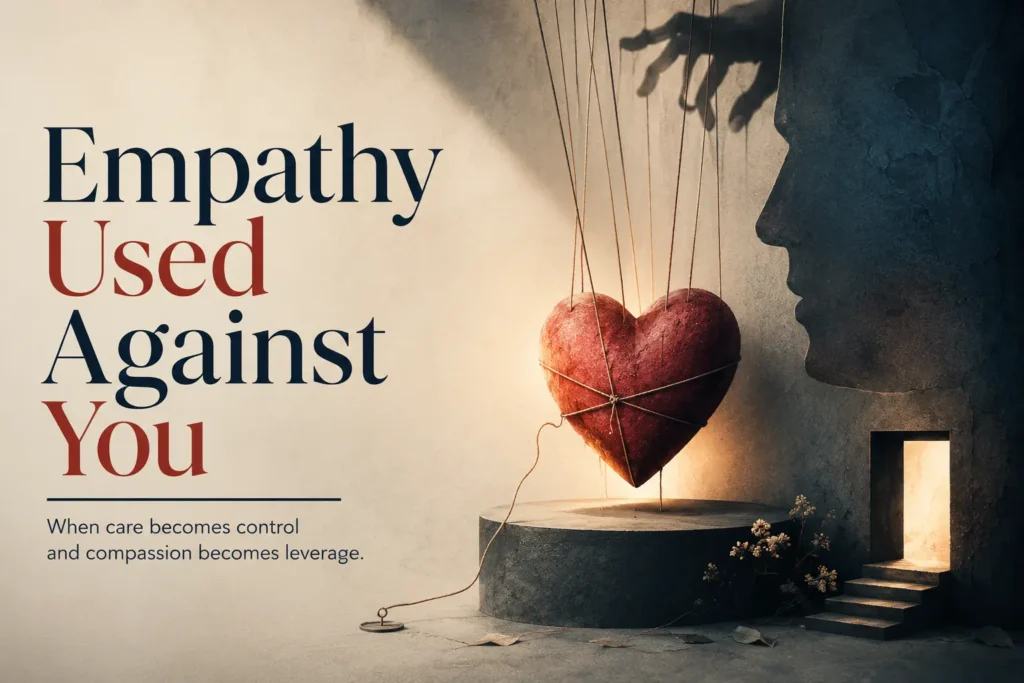
Empathy is usually treated as a virtue, and most of the time, it is. It helps people repair, soften, listen, and stay human with each other. But there is a quieter pattern I have seen over time: the same sensitivity that helps someone care deeply can also make them easier to guilt, pressure, or emotionally corner. Not because they are weak. Usually, because they are trying very hard not to become careless.
That is where this gets complicated. A person may know, logically, that they are allowed to say no. Still, the bodies react as if they have done something cruel. Someone else’s pain starts to feel like a moral emergency. A disappointed text, a long silence, a look across the room, suddenly the whole nervous system is negotiating.
This article is about that moment. How do you stay compassionate without becoming responsible for someone else’s emotions?
A lot of writing about emotional manipulation jumps straight to “set boundaries.” Fine. That advice has its place. But it often skips the part people actually struggle with: why boundaries feel so wrong when empathy has been trained to respond to guilt, pity, loyalty, fear, or shame. This is where empathy used against you stops being an abstract idea and starts becoming a real relationship pattern.
The central idea is simple, but not small: empathy is not the problem. The problem is when someone treats your empathy like a handle they can pull.
Carl Rogers wrote about empathy in 1957 as one of the conditions that helps people feel understood enough to change. Daniel Goleman wrote about empathy in 1995 as part of emotional intelligence, along with self-awareness and self-regulation. C. Daniel Batson, Jim Fultz, and Patricia Schoenrade wrote in 1987 about the difference between empathy and personal distress. That distinction matters more than people think. Sometimes you do not calmly understand another person. Sometimes you are flooded, guilty, anxious, and trying to make your feelings stop.
That can feel like compassion.
It can also be panic wearing a very kind face.
The healthy version of empathy connects. It softens conflict. It helps people repair.
But in unhealthy dynamics, empathy can get separated from self-trust. You still feel for the other person, but you stop listening to yourself. That is usually where compassion turns into compliance.
Emotional Leverage: When Empathy Becomes Pressure
Emotional leverage happens when someone uses what you care about to pressure you into doing what they want.
It often sounds soft. That is why it works.
They may not shout. They may not threaten you directly. They may say things like:
- “I thought you were the kind of person who understood.”
- “After everything I’ve been through, I can’t believe you would do this.”
- “You’re the only one I can count on.”
- “I guess I just care more than you do.”
- “Fine. Do whatever you want. I’m used to being abandoned.”
None of these lines automatically proves someone is manipulating you. People say messy things when they are hurt. I would be careful about turning every emotional sentence into evidence. That gets unfair very quickly.
What I pay attention to is the pattern around the sentence.
Are you allowed to pause?
Are you allowed to disagree?
Are you allowed to care about someone and still say no?
That is usually where the truth shows up.
Emotional leverage is the repeated use of guilt, pity, loyalty, fear, or shame to override someone’s boundaries.
A person can be genuinely upset and still be unfair. Someone can have real pain and still use that pain to control the room. This is the gentle reframe I wish more people had earlier: another person’s distress deserves compassion, but it does not automatically deserve access to your choices.
The key question is not, “Are they upset?”
The better question is, “Am I allowed to care about their feelings without surrendering my own boundaries?”
In healthy relationships, someone can be disappointed and still respect your no. In unhealthy ones, your no becomes proof that you are selfish, cold, disloyal, ungrateful, or cruel.
That is where empathy starts to turn against you. You are no longer responding freely. You are trying to escape the role they have assigned you.
Maybe the role is rescuer. Maybe it is a peacemaker. Maybe it is the person who always understands, always forgives, always absorbs the discomfort so nobody else has to change.
At first, this can feel like closeness. You feel needed. Trusted. Important.
Then it starts to feel like a trap.
I have seen this most clearly in the small after-moments. Someone agrees to something they do not want to do, then says, “It was easier than dealing with their reaction.” Or they apologize just to end the tension. Or they spend the whole night explaining their boundary in softer and softer language, hoping the other person will finally approve of it.
That is not peace.
That is emotional negotiation under pressure.
A 19-year-old cancels a weekend plan because she has an exam on Monday. Her friend replies, “Wow, I guess I know where I stand.” Nothing huge. No screaming. But now she is not thinking about the exam. She is thinking about whether she is a bad friend. She sends three paragraphs. Then she offers to come for just an hour. Then she feels resentful the whole time.
That is how empathy used against you can work. Not always through cruelty. Sometimes, through just enough guilt to make you abandon yourself.
A healthier question sounds like this:
“Would I still choose this if I were not afraid of their reaction?”
That question brings your agency back into the room.
Triangulation: When Other People Are Used as Pressure
Triangulation is when someone pulls a third person, group, or outside comparison into a conflict instead of dealing with you directly.
It often sounds like:
- “Everyone agrees with me.”
- “Even your friend said you were being unfair.”
- “My ex never treated me like this.”
- “I told my family what happened, and they think you’re wrong.”
- “Other people would be grateful for what I do.”
The purpose is not always obvious. Sometimes triangulation is used to create pressure. Sometimes it is used to make you doubt your own reading of the situation. Sometimes it is used to make the other person seem more reasonable because they appear to have backup.
And to be fair, people do talk to others when they are upset. That is normal. Sometimes it is healthy. We all reality-check ourselves.
The problem is different. The problem is when outside people become weapons inside the conversation.
What makes triangulation powerful is that it targets your social instincts. Most people do not want to be seen as unreasonable, selfish, or difficult. If someone tells you that “everyone” sees you a certain way, you may start defending yourself before you even ask whether the claim is true.
That is the emotional hook.
Instead of asking, “What actually happened between us?” you start asking, “How do I prove I’m not the bad one?”
A common version shows up in families. One person complains to another relative instead of speaking directly to the person involved. Soon, the issue is no longer the original problem. It becomes a messy emotional courtroom, with people taking sides, carrying messages, and pressuring someone to “just apologize” so things can calm down.
In romantic relationships, triangulation may involve exes, friends, coworkers, children, or vague groups of people. The goal is often the same: to make you feel outnumbered.
In workplaces, it can look more polished. A manager says, “Several people have noticed your attitude,” but will not name the behavior, the context, or the person involved. A friend says, “People are worried about you,” when what they really mean is, “I want you to do what I think is right.” A partner says, “My therapist thinks you’re avoidant,” even though you were not there, the therapist did not assess you, and the comment is being used as a weapon instead of a reflection.
This is why triangulation can feel so destabilizing. The conversation stops being about what happened. It becomes about your reputation.
A grounded response is simple, though not always easy:
“I’m willing to talk about what happened between us. I’m not going to argue with unnamed opinions or people who are not here.”
That sentence keeps the conversation direct. It also refuses the fog.
You are not being difficult by asking for a direct conversation. You are refusing to let other people’s supposed opinions replace facts, accountability, and repair.
Forced Caretaking: When Their Feelings Become Your Job
Forced caretaking happens when someone makes you responsible for regulating their emotions, choices, or consequences.
This is hard to spot because caring for people is not wrong. In close relationships, we do support each other. We listen. We adjust. We help.
But support becomes forced caretaking when someone repeatedly hands you responsibility that belongs to them.
You may notice it in small ways first.
They have a bad day, and suddenly, your plans are selfish. They are anxious, so you must answer immediately. They are lonely, so you are not allowed to rest. They are angry, so everyone has to walk carefully until they feel better.
Over time, you may start organizing your life around preventing their reactions.
You think before you speak.
You soften every boundary.
You delay your own decisions because you know they will have feelings about them.
You stop asking, “What do I need?” and start asking, “What will keep them from falling apart?”
That is not empathy anymore. That is emotional management.
Batson, Fultz, and Schoenrade’s 1987 work is useful here because they separated other-focused empathy from personal distress. Other-focused empathy lets you notice someone else’s pain while still staying grounded in yourself. Personal distress pulls you into urgency. You may rescue, agree, apologize, or over-function just to make the emotional pressure stop.
Again, it can feel loving.
Sometimes it is not love. Sometimes it is the fear of what happens if you stop managing the room.
One sign of forced caretaking is that your care is never enough. You can listen for hours, reassure them repeatedly, forgive the same behavior, and still be told you are not supportive. The goalposts keep moving because the real issue is not your lack of care. They expect that your care should remove discomfort, accountability, or consequence.
Someone might say, “If you really cared, you would stay.”
But care does not always mean staying. Sometimes care means being honest. Sometimes it means letting someone face the result of their choices. Sometimes it means refusing to become the emotional container for everything they refuse to process.
A healthier version sounds like:
“I care about you, but I can’t be responsible for calming you down every time I have a boundary.”
That is not cold. It is clear.
The unspoken fear is usually this: “If I stop caretaking, does that mean I am abandoning them?”
No. Abandonment is leaving someone without care, warning, or humanity. A boundary is different. A boundary says, “I can care about you and still not become the place where all your pain lands.”
That difference can change the entire relationship you have with your empathy.
Reclaiming Agency: How to Stay Kind Without Giving Yourself Away
Reclaiming agency does not mean becoming less empathetic. It means becoming more honest about what empathy can and cannot require from you.
Empathy can help you understand why someone is hurt.
It does not require you to agree with their version of events.
Empathy can help you speak with care.
It does not require you to abandon your limits.
Empathy can help you notice someone’s pain.
It does not make you responsible for fixing their life.
This is the transformation the whole article is circling: you do not have to choose between being compassionate and being self-protective. You can become a person whose empathy has boundaries.
A useful way to separate compassion from control is to slow the moment down. When you feel guilt, panic, or pressure rising, pause before responding.
Ask yourself:
- What am I being asked to do?
- What feeling is being used to push me?
- Would I choose this freely if I were not afraid of their reaction?
- Is this a request, or is it a test of my loyalty?
- Am I allowed to say no without being punished?
The pause matters because emotional manipulation often works through speed. Someone wants an answer now. An apology now. A promise now. A rescue now.
You are allowed to take time.
Try saying:
- “I need to think before I answer.”
- “I hear that you’re upset. I’m not ready to agree to that.”
- “I care, but I’m not comfortable being pressured.”
- “I’m willing to talk when we can both stay respectful.”
- “No, I can’t do that.”
Notice that these responses do not over-explain. Over-explaining can become another trap. The more you explain, the more material the other person has to argue with.
Clear is often better than convincing.
You do not need to prove that your boundary is morally perfect. You need to know whether it is honest, reasonable, and necessary.
That shift can feel uncomfortable at first, especially if you are used to being praised for being understanding. Some people may not like your boundaries because they benefited from your lack of them.
That does not mean the boundary is wrong.
It may mean the pattern is finally visible.
One practical test I have found useful is the “after-feeling” test. After you show empathy, do you feel connected, clear, and respected? Or do you feel drained, guilty, confused, and smaller?
Your body often notices the difference before your mind has language for it.
I have seen people realize it in very ordinary moments. They finish a phone call, put the phone down, and notice their shoulders are tight. Nothing “big” happened. They were just slowly talked out of themselves again.
Healthy empathy usually leaves room for both people.
Manipulated empathy leaves room for only one.
Red Flags: Signs Your Empathy Is Being Used Against You
A single uncomfortable conversation does not mean someone is using your empathy against you. People can be hurt, defensive, immature, or overwhelmed without being deliberately manipulative.
Look for patterns.
Here are red flags that your empathy may be getting used as a tool against you:
| Red flag | What it may sound like | What to notice |
| Your no becomes a character flaw | “You’re selfish.” | They attack who you are instead of accepting your limit. |
| Their pain cancels your boundary | “But I’m struggling.” | Their distress becomes a reason you must comply. |
| You feel responsible for their reactions | “Look what you made me do.” | They hand you ownership of their behavior. |
| They use outsiders as pressure | “Everyone thinks you’re wrong.” | The conflict becomes social pressure instead of a direct repair. |
| You are punished for needing space | “You always abandon me.” | Normal distance is framed as cruelty. |
| Care is treated like obedience | “If you cared, you would…” | Love becomes something you prove by giving in. |
| You feel guilty before you know why | “Wow. I didn’t expect that from you.” | Shame is used before the actual issue is clear. |
The clearest red flag is not one sentence. It is the emotional pattern you live inside.
Do you feel smaller after trying to explain yourself?
Do you edit your needs before sharing them?
Do you feel relief when they are in a good mood because it means you can finally breathe?
Do you apologize just to end the tension?
Do you keep giving care but feel less and less like a person?
Those are not small signals.
They are information.
The National Domestic Violence Hotline describes emotional abuse as nonphysical behavior meant to control, isolate, or frighten someone. It includes threats, insults, monitoring, jealousy, manipulation, humiliation, intimidation, and dismissiveness. The Hotline also reported in its 2020 data that 95% of contacts said they were experiencing emotional abuse.
That does not mean every guilt-heavy relationship is abuse. It does mean repeated control, fear, isolation, intimidation, or punishment should be taken seriously.
The CDC wrote in 2026 that psychological aggression can include verbal and non-verbal communication meant to harm a partner mentally or emotionally, or to exert control over a partner. Mayo Clinic Staff wrote in 2025 that domestic violence can include emotional, sexual, and physical abuse, along with stalking and threats of abuse. I think that matters because people often wait for something “serious enough” before they trust themselves. Sometimes the emotional pattern has already been serious for a long time.
If this is happening in a relationship where there is intimidation, threats, stalking, physical violence, sexual pressure, financial control, or fear of what the person might do if you leave, treat it as a safety issue, not just a communication issue. Consider speaking with a trusted person, a qualified professional, or a local domestic violence service. If you are in immediate danger, contact emergency services in your area.
For many readers, the decision is not “Do I care or not?”
The decision is: Can I keep offering empathy in this relationship without losing access to myself?
If the answer is yes, the next step may be clearer boundaries, slower replies, direct conversations, or refusing triangulation.
If the answer is no, the next step may be distance, support, documentation, therapy, safety planning, or ending the relationship carefully.
Empathy is one of the best parts of being human. It lets you understand pain that is not yours. It helps repair relationships. It softens hard conversations.
But empathy needs boundaries to stay healthy.
Without boundaries, empathy becomes a doorway other people can walk through whenever they want access to your guilt, your loyalty, your fear, or your need to be good.
You do not have to become cold to protect yourself.
You only have to stop confusing someone else’s emotional reaction with your moral obligation.
FAQ
Yes. Empathy can be used against you when someone learns which feelings make you easier to pressure, such as guilt, pity, loyalty, or fear of disappointing them. The issue is not that you are empathetic. The issue is that someone may use your empathy to bypass your boundaries.
Look for a repeated pattern. If your no becomes a character flaw, your care is treated like obedience, or someone’s pain always cancels your boundary, your empathy may be turning into emotional leverage. The clearest sign is that you feel guilty, responsible, or afraid before you have even had space to think.
Not always. Some people use emotional leverage because they learned it in their family, past relationships, or survival patterns. But whether it is intentional or not, the effect still matters. You are allowed to set boundaries even when the other person does not see themselves as manipulative.
Support is freely given and respects both people’s limits. Forced caretaking makes you responsible for another person’s emotions, choices, or reactions. In support, your care is appreciated. In forced caretaking, your care is demanded and still never feels like enough.
Slow the conversation down. Name your limit without over-explaining. You might say, “I understand you’re upset, but I’m not going to make this decision out of guilt.” If the person keeps escalating, it may be better to pause the conversation than keep defending yourself.
No. Boundaries do not mean you lack empathy. They mean your empathy has structure. You can care about someone’s feelings without agreeing to every request, absorbing every reaction, or giving up your own needs.
If setting boundaries could lead to threats, stalking, violence, financial control, or punishment, treat the situation as a safety issue. Speak with a trusted person, a qualified professional, or a local domestic violence service. If you are in immediate danger, contact emergency services in your area.
American Psychological Association. “Empathy.” APA Dictionary of Psychology. Updated November 15, 2023. The APA describes empathy as understanding another person from their frame of reference or vicariously experiencing that person’s feelings.
Rogers, Carl R. “The Necessary and Sufficient Conditions of Therapeutic Personality Change.” Journal of Consulting Psychology, 1957. Rogers identified empathic understanding as one of the core conditions for therapeutic change.
Goleman, Daniel. Emotional Intelligence. Bantam Books, 1995. Goleman helped popularize emotional intelligence, including empathy, self-awareness, and self-regulation.
Batson, C. Daniel, Fultz, Jim, and Schoenrade, Patricia A. “Distress and Empathy: Two Qualitatively Distinct Vicarious Emotions with Different Motivational Consequences.” Journal of Personality, 1987.
National Domestic Violence Hotline. “What Is Emotional Abuse?” The Hotline describes emotional abuse as nonphysical behavior meant to control, isolate, or frighten, and reports 2020 data on emotional abuse contacts.
National Domestic Violence Hotline. “Understand Relationship Abuse.” Power and control framework.
Centers for Disease Control and Prevention. “About Intimate Partner Violence.” Updated February 11, 2026. The CDC describes psychological aggression as verbal and non-verbal communication meant to harm a partner mentally or emotionally, or to exert control.
Mayo Clinic Staff. “Domestic violence against women: Recognize patterns, seek help.” Updated February 4, 2025. Mayo Clinic explains that domestic violence can include emotional, sexual, and physical abuse, stalking, and threats of abuse.