


A person can leave a conversation with a yes in their mouth and a quiet no in their body. That is often where the confusion starts. Nothing obvious happened. No one shouted. No one made a direct threat. Still, something feels off. The agreement does not feel clean. It feels managed.
That is why the difference between healthy influence and manipulation matters. It gives language to a pattern that often stays vague: the moment a conversation stops helping someone think and starts making it harder to choose freely. The useful question becomes less about whether the other person sounded “nice” or “reasonable,” and more about whether there was real room to decide.
Many discussions about emotional manipulation focus on red flags. Those lists can help. I use them too, sometimes. But they often miss the part that matters most in real life. The question is not only, “Was this person rude?” or “Did they say something controlling?” The better question is: what happened to my freedom in that conversation?
That is the spine of this whole piece.
Healthy influence leaves your agency intact. Manipulation tries to get the outcome while making your agency harder to use.
That sounds simple. It is not always simple in real life.
Because manipulation does not always arrive as a threat. Sometimes it arrives as sadness. Or disappointment. Or “I’m just being honest.” Or “I thought you cared.” That is why people miss it. They listen to the words and ignore the cost attached to disagreeing.
The question to keep nearby is this:
Am I being invited to choose, or am I being pressured to comply?
Once you start asking that, you stop judging only the sentence. You start noticing the room around the sentence. Whether there is space to think. Whether a no can survive. Whether your needs are still allowed to matter.

Persuasion vs Coercion: The Pressure Around the Choice
Persuasion is not the enemy here.
A friend can persuade you to apply for a job you keep talking yourself out of. A partner can explain why they want more time with you. A parent can push a teenager to think through a risky decision. A therapist, teacher, manager, coach, older sibling, or friend can influence someone in a way that is genuinely helpful.
That is just part of being around other people.
We influence each other all the time. We explain. We encourage. We challenge. We negotiate. We say, “Have you thought about this another way?” Sometimes that is care. Sometimes it is leadership. Sometimes it is love with better timing than ours.
Robert Cialdini wrote about persuasion in Influence: The Psychology of Persuasion in 1984. His work is often remembered for why people say yes, especially around authority, social proof, scarcity, liking, commitment, and reciprocity. What I keep coming back to, though, is not simply that people can be persuaded. Of course they can. The more important question is whether persuasion is being used with respect for the other person’s autonomy.
Healthy influence is an attempt to guide, encourage, or persuade while still respecting the other person’s right to think, question, disagree, and choose.
Manipulation is different.
Manipulation is influence that uses guilt, fear, confusion, selective truth, emotional pressure, or hidden consequences to control the outcome.
The American Psychological Association described coercive power in 2018 as the capacity to compel compliance through force, punishment, or threat of punishment. The APA also describes coercive behavior as behavior designed to force someone else to do one’s bidding, sometimes while appearing like devotion, concern, or care. A newer APA Dictionary entry from 2026 on toxic relationships also names emotional manipulation, coercive control, gaslighting, disrespect, and lack of support as harmful relational patterns.
That last part matters.
Because punishment is not always dramatic. It can be silent. Coldness. Sulking. Withdrawal. A sudden change in affection. A long sigh. A look across the room that says, “You know what you did.”
Persuasion says, “Here is what I think, and here is why.”
Coercion says, “You can technically choose, but I will make it painful if you choose differently.”
That pain can be obvious. Someone may threaten to leave, punish, embarrass, withhold money, withdraw affection, or damage your reputation. But it can also be quieter. A person may sigh for hours, become cold, imply you are selfish, bring up old mistakes, or make you feel responsible for their emotional state until saying yes feels easier than dealing with the fallout.
That is the part I have seen people miss most often. They ask, “Did this person threaten me?” when the better question is, “What happens when I do not give them the answer they want?”
The difference is not only in the words. It is in the pressure around the words.
A healthy request gives you room to think.
Manipulation narrows the room.
There is a big difference between:
“I really want you to come with me. It would mean a lot, but I understand if you need to rest.”
And:
“Fine. Do whatever you want. I guess I should be used to not mattering.”
Both people want the same outcome. Only one is respecting the other person’s choice.
| Healthy influence | Manipulation |
| Gives reasons | Creates pressure |
| Allows questions | Treats questions as disloyalty |
| Respects a no | Punishes a no |
| Shares relevant information | Hides or distorts information |
| Wants agreement | Wants compliance |
| Leaves your dignity intact | Makes you feel trapped, guilty, or afraid |
Coercion often hides behind emotional intensity. The person may say, “I’m just telling you how I feel.” Sometimes that is true. Feelings are allowed. Disappointment is allowed. But using disappointment as a lever to control someone else’s decision is different.
A feeling is information.
It should not become a weapon.
Jack W. Brehm introduced psychological reactance theory in 1966. The rough idea is that when people feel their freedom is being threatened, they often become motivated to restore it. Not always calmly. Sometimes they resist. Sometimes they shut down. Sometimes they do the opposite of what they were pushed to do, even if the advice was not completely wrong.
I have seen this play out in ordinary ways. Someone is told, “You have to forgive them now.” Instead of softening, they harden. Someone is told, “You are not allowed to be upset about this.” Instead of calming down, they feel even more alone. Someone is told, “If you cared, you would agree.” Instead of feeling close, they feel cornered.
A healthy influence does not need to corner someone.
It can tolerate thought.
This can look small from the outside: a 19-year-old is about to skip a family dinner because she has an exam the next morning. Her mother says, “I get it. Your grandmother will miss you, but your exam matters. Call her after dinner if you can.” That is influence. There is care, context, and room.
A different version sounds like, “Your grandmother may not be around forever, but sure, study.” Same dinner. Same wish. Different pressure. Now the young person is no longer deciding between dinner and studying. She is deciding whether she can survive the guilt of not going.
That is the line.
Consent: Can a Real No Survive?
Consent is not only about major life decisions or sexual boundaries. It also matters in everyday life.
Can the other person say no without being punished?
That question tells you more than almost anything else.
Healthy influence allows a real no. The person may feel disappointed, but they do not retaliate. They do not make you pay for having a boundary. They do not keep pushing until you are too tired to resist.
Manipulation often keeps asking after the answer has already been given.
It may sound like:
- “Are you sure?”
- “But you said no last time, too.”
- “You always do this.”
- “I guess I just care more than you do.”
- “You would do it if you really loved me.”
Sometimes one follow-up question is reasonable. People clarify. They negotiate. They check whether they understood correctly. That is normal conversation.
But repeated pressure after a clear no is no longer a conversation.
It is a campaign.
And yes, the question that comes up here is usually, “What if I am just being difficult?” Fair question. Sometimes people do use boundaries to avoid discomfort. Sometimes a no is not thoughtful. Sometimes we protect ourselves from the wrong thing. I do not think every refusal is automatically wise.
But a healthy conversation can explore that without making you afraid.
A respectful person might say:
“Can I ask what makes this hard for you?”
A pressuring person might say:
“You always have an excuse.”
Those are not the same conversation.
Consent also requires enough space to decide.
If someone demands an answer immediately when there is no real urgency, that can be a sign they do not want you to think. They want momentum. They want emotion. They want the moment to carry you past your own judgment.
A healthy influence can tolerate a pause.
Manipulation often cannot.
Edward Deci and Richard Ryan developed self-determination theory in 1985. Ryan and Deci also reviewed the theory again in 2020, connecting autonomy, competence, and relatedness with motivation and psychological wellness. In plain language, people tend to do better when they feel they have a real choice, some ability to act, and some sense of connection.
Manipulation often squeezes all three.
It reduces choice. It makes the person doubt their judgment. And it threatens the connection if they do not comply.
You might notice this in relationships, sales conversations, family dynamics, workplace situations, or even friendships that have become a little too one-sided. Someone gives you a choice, but the choice is loaded. You can say no, technically. But you know there will be sulking, guilt, gossip, punishment, or hours of emotional cleanup afterward.
That is not full consent.
That is compliance under pressure.
A useful test is this:
Would my answer still be respected if it were not the answer they wanted?
If the answer is no, the influence may not be as healthy as it first appears.
This is where the shift begins. You stop asking, “Did I technically have a choice?” and start asking, “Was my choice emotionally safe enough to be real?”
It is a small shift.
It changes a lot.
Transparency: Are You Being Given Enough Truth to Choose?
A healthy influence is clear about its motive.
Manipulation hides the motive, disguises the pressure, or gives you only part of the truth.
Transparency does not mean someone has to explain every private feeling before making a request. Nobody communicates that cleanly all the time. But the basic purpose of the conversation should be honest enough that the other person understands what is happening.
A transparent person might say:
“I want to talk about our plans because I’m hoping we can spend more time together this weekend.”
A manipulative person may say:
“No, it’s fine. I was just asking.”
Then, later, they punish you for not reading the hidden expectation.
This is where many people get confused. Manipulation is not always loud. Often, it is indirect. The person does not clearly ask for what they want, but they still expect you to comply. Then, if you do not, they act hurt, offended, or betrayed.
That creates a strange trap.
You are made responsible for a request that was never honestly made.
I have watched this happen in small moments. A person says, “Do whatever you want,” but their tone says, “Choose carefully.” A family member says, “I do not need anything from you,” but later brings up how abandoned they felt. A partner says, “I was only joking,” after making a comment that was clearly meant to sting.
The problem is not that people communicate imperfectly. Everyone does. The problem is when indirectness becomes a way to avoid responsibility while still demanding compliance.
Leon Festinger introduced cognitive dissonance theory in 1957. His work focused on the discomfort people feel when thoughts, beliefs, and behavior conflict. In manipulation, dissonance often shows up in the person being pressured. You may think, “I do not want this,” while also thinking, “But maybe I am selfish if I say no.”
That inner conflict can make you easier to steer.
A manipulative conversation often increases confusion.
A healthy conversation reduces it.
Transparency also matters when someone selectively shares information.
Picture someone asking you to join a project. They call it “a small commitment,” but they already know it will probably take ten hours a week. Or someone asks for a favor without telling you that several other people already said no. Or a partner says, “Everyone thinks you’re being unreasonable,” when really they only spoke to one friend who heard a very one-sided version.
The goal is not understanding.
The goal is steering.
A healthy influence gives enough truth for the other person to make a real decision. Manipulation manages the facts so the decision goes in a preferred direction.
A transparent conversation may still be uncomfortable. It may involve disagreement. It may involve strong feelings. But the person is not hiding the ball.
They are not making you solve a puzzle to protect yourself.
A clean way to ask this is:
Do I understand what this person wants, why they want it, and what it would cost me to agree?
If you cannot answer that, pause before saying yes.
Not forever. Just long enough to let your mind catch up with the pressure.
Reciprocity: Are Both People’s Needs Allowed to Matter?
Healthy influence has reciprocity. There is some concern for both people’s needs.
Manipulation is usually one-directional. One person’s needs become urgent, central, and morally important. The other person’s needs become inconvenient, selfish, or invisible.
You can often spot this by looking at what happens when roles reverse.
If they ask for reassurance, you are expected to provide it. But when you need reassurance, you are “too sensitive.”
If they need space, you are supposed to understand. But when you need space, you are “cold.”
If they make a mistake, they want grace. But when you make a mistake, they keep it available as evidence.
This imbalance does not always appear in one conversation. It often shows up as a pattern.
Healthy influence can sound like:
“I know this affects you, too. Can we find a solution that works for both of us?”
Manipulation sounds more like:
“After everything I’ve done, you owe me this.”
Reciprocity does not mean every relationship is perfectly equal in every moment. Sometimes one person needs more support. A grieving friend may need more care than they can give back. A child depends on a parent. A sick partner may need temporary help. Real life is not always balanced.
The issue is whether the imbalance is acknowledged and handled with care, or exploited.
Manipulation often uses past generosity as debt.
Someone does something kind, but later the kindness becomes a receipt. They bring it back whenever they want compliance. This can make the other person feel trapped by gratitude.
Healthcare does not keep a hidden invoice.
A useful question is:
Is this person asking for a connection, or are they collecting leverage?
That question may sound blunt. Still useful.
One lived example is the friend who helps you during a hard month, then later uses that help to override your boundaries. Another is the partner who says, “I supported you when you were struggling,” every time you disagree. The original support may have been real. The later use of it as leverage is the problem.
In healthy relationships, past care builds trust.
In manipulative relationships, past care becomes a debt system.
That shift matters because it changes the emotional climate. You no longer feel loved. You feel managed.
And people can feel that before they can explain it.
Checklist: Healthy Influence or Manipulation?
Use this checklist when you are unsure whether a conversation is a healthy influence or manipulation. The point is not to label someone instantly. Labels can be too easy. The point is to slow down and see the pattern more clearly.
Signs of Healthy Influence
Healthy influence usually includes:
- A clear request or point of view
- Honest reasoning
- Room to ask questions
- Room to say no
- Respect for your pace
- Concern for both people’s needs
- No punishment for disagreeing
- No hidden consequences
- No distortion of facts
- A willingness to revisit the conversation later
Healthy influence may still feel uncomfortable. You may be challenged. You may realize the other person has a fair point. You may even change your mind.
But you still feel like you were allowed to think.
Signs of Manipulation
Manipulation often includes:
- Guilt used as pressure
- Affection withdrawn when you disagree
- Repeated pushing after you say no
- Urgency without a real reason
- Selective or distorted information
- Indirect requests followed by punishment
- Threats, even subtle ones
- Making you responsible for their emotions
- Using past kindness as a debt
- Framing your boundary as cruelty
One sign by itself does not always prove manipulation. People communicate poorly sometimes. They get scared, defensive, clumsy, tired. I try to leave room for that.
But repeated patterns matter.
The pattern is the evidence.
A Simple Test
Ask yourself five questions:
- Do I have enough honest information to decide?
- Can I say no without being punished?
- Is there real room for my needs in this conversation?
- Is the person asking directly, or making me guess?
- Do I feel invited to choose, or pressured to comply?
If the conversation gives you information, space, and respect, it is probably closer to a healthy influence.
If it creates guilt, confusion, urgency, or fear, it may be closer to manipulation.
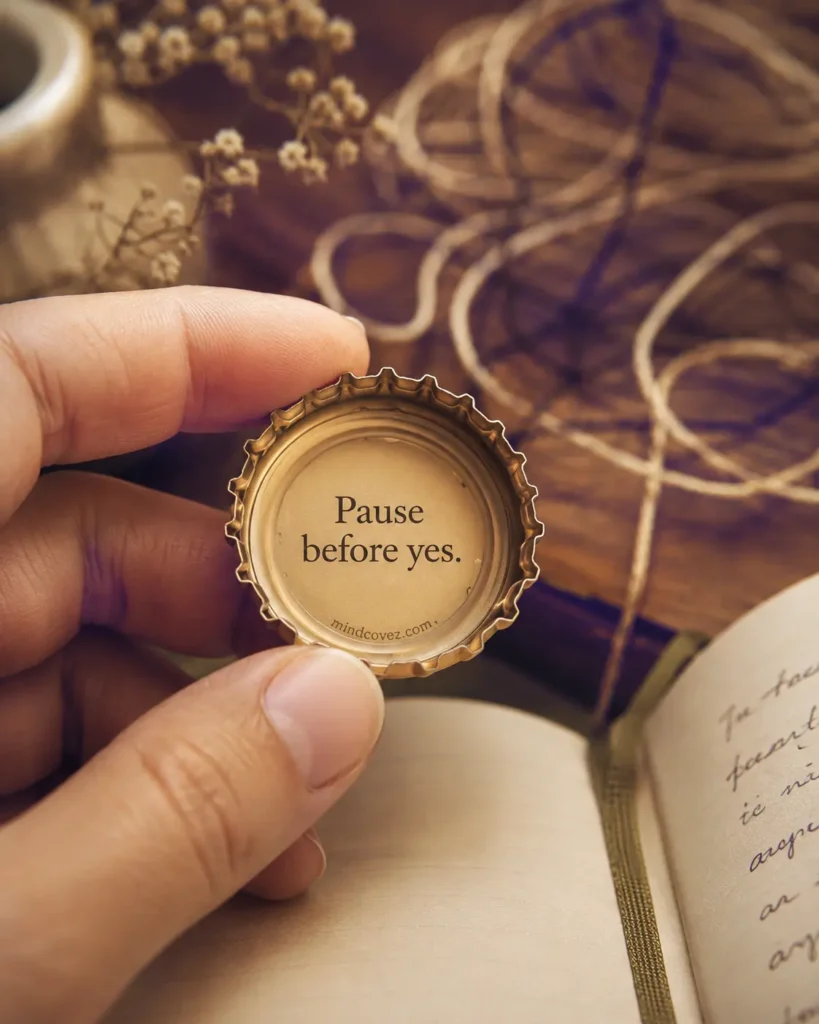
When to Pause Before Saying Yes
Pause before agreeing if:
- The request feels urgent, but the urgency is unclear.
- You feel afraid of the person’s reaction.
- You are saying yes mainly to avoid guilt.
- You do not understand the full cost of agreeing.
- The person keeps changing the reason until one works.
- Your no has already been ignored.
A pause is not an attack. It is a way to protect your judgment.
Even a sentence can help.
“I need to think before I answer.”
That one sentence tells you a lot about the other person. Not everything. But enough to pay attention.
The Line Most People Miss
The line between healthy influence and manipulation is not simply whether someone wants something from you.
People are allowed to want things. They are allowed to ask. They are allowed to explain why something matters. They are allowed to feel disappointed if you say no.
The line is whether your freedom remains real.
Healthy influence respects your ability to think, question, disagree, and choose.
Manipulation tries to shape the outcome by making those things harder.
That is why manipulation can be so confusing. It may not sound cruel. It may not include obvious threats. It may come wrapped in sadness, concern, romance, loyalty, or moral language.
But underneath, the message is the same:
Choose what I want, or there will be a cost.
A healthier message sounds different:
Here is what I want. Here is why it matters. And your choice still belongs to you.
That difference changes everything.
It changes how you hear guilt.
It changes how you understand silence.
It changes how you interpret pressure that is dressed up as love, loyalty, concern, or disappointment.
Most of all, it gives you a decision point. You can ask for clarity. You can ask for time. You can name the pressure. You can choose not to keep participating in conversations where your freedom exists only on paper.
That is the transformation: from doubting your discomfort to understanding what it is telling you.
FAQs
No. Persuasion becomes manipulation when it removes, distorts, or pressures the other person’s ability to choose freely. Healthy persuasion gives information and reasoning. Manipulation uses guilt, fear, confusion, or hidden pressure to control the outcome.
Persuasion tries to change someone’s mind without removing their freedom to choose. Coercion uses pressure, punishment, threats, or emotional consequences to push compliance.
Yes. Some people learn manipulative communication patterns early and repeat them without naming them. That does not make the behavior harmless. Impact still matters. A person can be responsible for changing a pattern even if they did not originally mean to cause harm.
Ask whether you can say no without punishment, whether you have enough honest information, and whether your needs are allowed to matter. If you feel trapped, guilty, confused, rushed, or afraid to disagree, the conversation may involve manipulation.
Start by slowing the conversation down. Ask for time. Name the specific behavior if it feels safe to do so. You might say, “I’m open to talking about this, but I do not want to be guilted into a decision.” If the pattern continues, stronger boundaries may be needed.
That realization can be uncomfortable, but it is also useful. Practice making direct requests, giving people time to answer, and respecting no without punishment. You can still want what you want. The change is learning not to pressure someone else into carrying it for you.
Influence is healthy when both people can be honest, ask for what they need, disagree without punishment, and change their minds without fear. It should support connection, not control.
Final Thought
The safest influence is the kind that does not need to trap anyone.
It can ask clearly. It can be explained honestly. It can handle disappointment. It can leave the other person with their dignity and their choice.
That is the difference between trying to be understood and trying to take control.
And sometimes the body notices it before the mind has words for it. That tight feeling. The sudden urge to explain yourself too much. The quiet sense that the answer is already being chosen for you.
I would pay attention there.
American Psychological Association. (2018). APA Dictionary of Psychology. Entries on coercive power and coercive behavior.
American Psychological Association. (2026). APA Dictionary of Psychology. Entry on toxic relationship.
Brehm, J. W. (1966). A Theory of Psychological Reactance. Academic Press.
Cialdini, R. B. (1984). Influence: The Psychology of Persuasion. William Morrow.
Deci, E. L., & Ryan, R. M. (1985). Intrinsic Motivation and Self-Determination in Human Behavior. Plenum.
Festinger, L. (1957). A Theory of Cognitive Dissonance. Stanford University Press.
Ryan, R. M., & Deci, E. L. (2020). Intrinsic and extrinsic motivation from a self-determination theory perspective: Definitions, theory, practices, and future directions. Contemporary Educational Psychology, 61, 101860.