


The hardest part about emotional numbness is not just the flatness. It is what the flatness starts to mean in your head. Maybe I’m burned out. Maybe I’m depressed. Maybe I’ve stopped caring. Maybe this is just who I am now. Read on if you want a cleaner way to make sense of that. The point here is to help you sort out whether what you’re feeling is emotional numbness, actual calm, stress shutdown, or something that needs more attention, so you can stop circling the same fear and get clearer on what really needs to change.
A lot of writing on emotional numbness starts off useful, then gets vague right when people need something more solid. Journal. Rest. Feel your feelings. Fine. Sometimes that does help. But the real struggle is usually not, “How do I feel more?” It is this: What is this numbness actually pointing to, and do I need rest, reconnection, or real support right now? That is usually the question sitting underneath everything else. Because people often build huge conclusions out of a temporary state. About their relationships. About their personality. About whether something is fundamentally wrong with them.
The idea is simple, but it changes the whole thing once you really take it in. Emotional numbness is often not a lack of feeling. It is blocked access to feeling. A protective shift. Sometimes from overload. Sometimes from chronic stress. Sometimes from grief, disappointment, trauma, emotional detachment in relationships, or just too much repetition for too long. So the way out is usually not to force a breakthrough. It is to rebuild the conditions that let feelings come back.
I did not always think about it this way. I used to lean hard on insight. Find the wound. Name the pattern. Trace the feeling. That should do it. Nice theory. It did not hold up often enough in real life. Too many people were sleeping five hours, running on caffeine, carrying too much, and wondering why even the good parts of life barely landed. Bruce McEwen wrote in 2006 about how chronic stress reshapes the system, not just the mood. Lisa Feldman Barrett argued in 2017 that what we call emotion depends partly on how the brain organizes internal signals. Stephen Porges in 2011 pushed things further with nervous system states and shutdown. That matched what I kept seeing. Sometimes the feeling is not hidden somewhere deep and symbolic. Sometimes the whole system is just blunted.

Main takeaway: if you want to stop feeling emotionally numb, do not start by trying to manufacture bigger feelings. Start by reducing overload, restoring body awareness, getting more honest about what is draining you, and noticing whether this is calm, burnout, grief, emotional detachment, or numbness that has started to interfere with your life in a bigger way.
Numbness vs Calm
This sounds obvious until it isn’t. A lot of people mistake numbness for calm because both can look quiet from the outside. But they do not feel the same from the inside.
Calm still has life in it. You can feel relief, affection, irritation, sadness, gratitude, curiosity. The feelings are there. They are just not running the whole show.
Emotional numbness feels flatter than that. More absent. More far away. Good news lands with almost nothing. Conflict lands with almost nothing. Even things you know should matter feel strangely muted. A sentence I hear a lot is, “I know I should feel something, but I don’t.” That line usually tells me this is not peace. It is disconnection.
I’ve had people tell me they thought they were finally doing better because they’d stopped crying every day. Then, two minutes later, they’d say they also couldn’t laugh, couldn’t get excited, couldn’t feel much when their partner hugged them. That is not the same thing as calm. It is flatter than calm. More cut off.
This gets misread in relationships all the time. Emotional detachment in relationships gets translated into “I must not love them anymore,” when sometimes it is exhaustion, resentment, chronic stress, grief, or nervous system shutdown wearing a relationship-shaped mask. Not always. But often enough that it is worth slowing down before turning numbness into a life verdict. That same pattern shows up in it, which fits naturally here if you want to trace the relational side of it more closely.
What is emotional numbness?
Emotional numbness is a reduced ability to feel, notice, or respond to emotions in the way you normally would. It can show up as detachment, blankness, emotional shutdown, low motivation, low pleasure, low emotional range, or a sense that life feels far away.
What is the difference between emotional numbness and calm?
Calm means your emotions are present but regulated. Emotional numbness means your emotions feel muted, distant, hard to access, or absent.
When is emotional detachment normal vs concerning?
Some emotional detachment is normal after stress, grief, burnout, conflict, caregiving strain, a breakup, a major deadline, or too much emotional demand for too long. It becomes more concerning when the numbness lasts for weeks, spills into relationships, changes how you function at work, wipes out pleasure almost entirely, or shows up with panic, dissociation, hopelessness, or a sense that you are not fully here.
One check that helps is this: Do I feel peaceful, or do I feel unreachable? Peace has some aliveness in it. Numbness usually does not.
Lifestyle Drivers
This part gets dismissed because it sounds too basic. Sleep. Stress. Screens. Food. Movement. Sunlight. Fine. A lot of people want a deeper explanation than that. I get it. But some of the deepest explanations are hiding in the everyday conditions that quietly flatten emotional range.
Chronic stress and allostatic load
When stress becomes the default setting, the body adapts. Not beautifully. Just efficiently. Bruce McEwen wrote in 2006 about allostatic load, the wear and tear that builds up from chronic stress. In real life, that can look like irritability, exhaustion, emotional detachment, low frustration tolerance, or complete flattening. The system gets tired of staying switched on. One response is to go dull.
I have seen this in people who still look high-functioning from the outside. They answer messages, show up for work, get the shopping done, handle family logistics, and keep things moving. Everyone assumes they are coping. Meanwhile they feel less and less reachable. No joy. No clean sadness either. Just distance.
I have also seen teenagers call this “having no personality anymore” when what was really happening was sleep debt, pressure, and constant stimulation. And older adults call it aging when it was grief, plus isolation, plus a routine that had gone emotionally thin. Different ages. Same pattern, really.
When that flatness starts looking less like a bad week and more like a full-body burnout pattern, it overlaps with both, sitting close to what people are often actually describing here.
Poor sleep and cortisol dysregulation
Poor sleep narrows emotional range fast. It does not just make people tired. It makes them less flexible, less patient, less emotionally available, and more likely to feel robotic. A lot of people overinterpret that. They assume emotional numbness must mean something huge when sometimes the body is simply under-recovered.
I have watched this shift in one or two weeks when sleep improves. Nothing dramatic. Just ordinary signs that the system is thawing. Music sounds better. Food tastes better. Their partner seems less irritating. They stop feeling like they are walking through glue. Cortisol dysregulation is not the whole story, but it is often part of it. When sleep is clearly tangled up in the whole thing, it belongs here without feeling forced.
Overstimulation and low interoception
Too much input makes internal signals harder to hear. Constant scrolling. Background noise all day. Podcasts while showering. Videos while eating. Notifications every few minutes. Open tabs in your head before breakfast. Then people say, “I don’t know what I feel anymore.” Right. Because every subtle signal has been drowned out.
Lisa Feldman Barrett argued in 2017 that emotional experience depends partly on how the brain predicts and organizes internal signals. That fits. When interoception drops, emotional clarity usually drops with it. You are not always feeling less. Sometimes you are sensing less accurately.
I keep seeing this with people who swear they feel nothing all day. Then they mention the only quiet moment they had was sitting in the parked car before going upstairs. Ten minutes there. No screen. No one is asking anything. And suddenly the tears are right there. Not because the feeling appeared out of nowhere. Because the noise finally dropped.
Isolation, repetition, and low reward
Numbness also grows in emotionally thin routines. Same desk. Same road. Same grocery store. Same polite conversations where nobody says what they actually mean. Same week, repeated until it starts feeling like personality instead of circumstance.
Edward Deci, Anja Olafsen, and Richard Ryan wrote in 2017 about motivation, autonomy, and human functioning in ways that fit this better than people expect. When life keeps losing connection, agency, and vitality, people flatten out. Sometimes quickly. Sometimes, so slowly they do not notice until someone asks, “Are you okay?” and the answer gets stuck.
Someone I worked with, Mariam, was 34 and convinced she “couldn’t feel love anymore.” That sentence scared her. Her week looked like this:
- six hours of sleep on a good night
- back-to-back Zoom calls
- lunch at 4 p.m.
- wine to come down
- scrolling until 1 a.m.
- waking up already braced
She had not taken a walk without headphones in months. She thought the problem was that she had become cold. The problem was that her whole system was saturated.
I don’t dismiss that kind of sentence anymore. Emotional numbness often feels like identity when it is really accumulation. And when that drained, flattened state keeps hanging around, it often looks a lot like what is usually the next distinction people need.
Journaling Prompts
Journaling helps when you stop trying to sound insightful and start trying to notice what is true. That is usually the shift. You are not writing to impress yourself. You are collecting evidence from your own life before your defenses tidy it up.
The prompts that work best for emotional numbness are the ones that reveal friction. Not the ones that pressure you to sound emotionally articulate when that is the exact thing you are struggling with.
Journaling prompts for emotional numbness
- What did I feel today, even briefly?
- What am I pretending does not bother me?
- What has felt flat lately?
- When did I last feel genuinely moved, relieved, angry, excited, or comforted?
- What am I tired of carrying?
- What do I need more of right now: rest, novelty, comfort, structure, or connection?
- What am I avoiding because I do not want to feel what comes with it?
- What do I miss feeling?
- Where in my body do I go numb first?
- What has started to feel like a chore that used to feel easy or warm?
These questions work because they answer the unspoken parts too. What if I am only numb around certain people. What if I am not detached, just disappointed. What if I only feel flat after work. What if the numbness is protecting me from something I do not want to look at yet. Good questions. Better than trying to force some clean breakthrough.
You can also rate your emotional awareness from 1 to 10 at the end of each day and write one honest sentence about why. Patterns show up fast. The same trigger. The same silence after conflict. The same sleep debt. The same overfull week. Sometimes that kind of noticing leads to a bigger mismatch underneath it all, which is why it belongs here quietly.
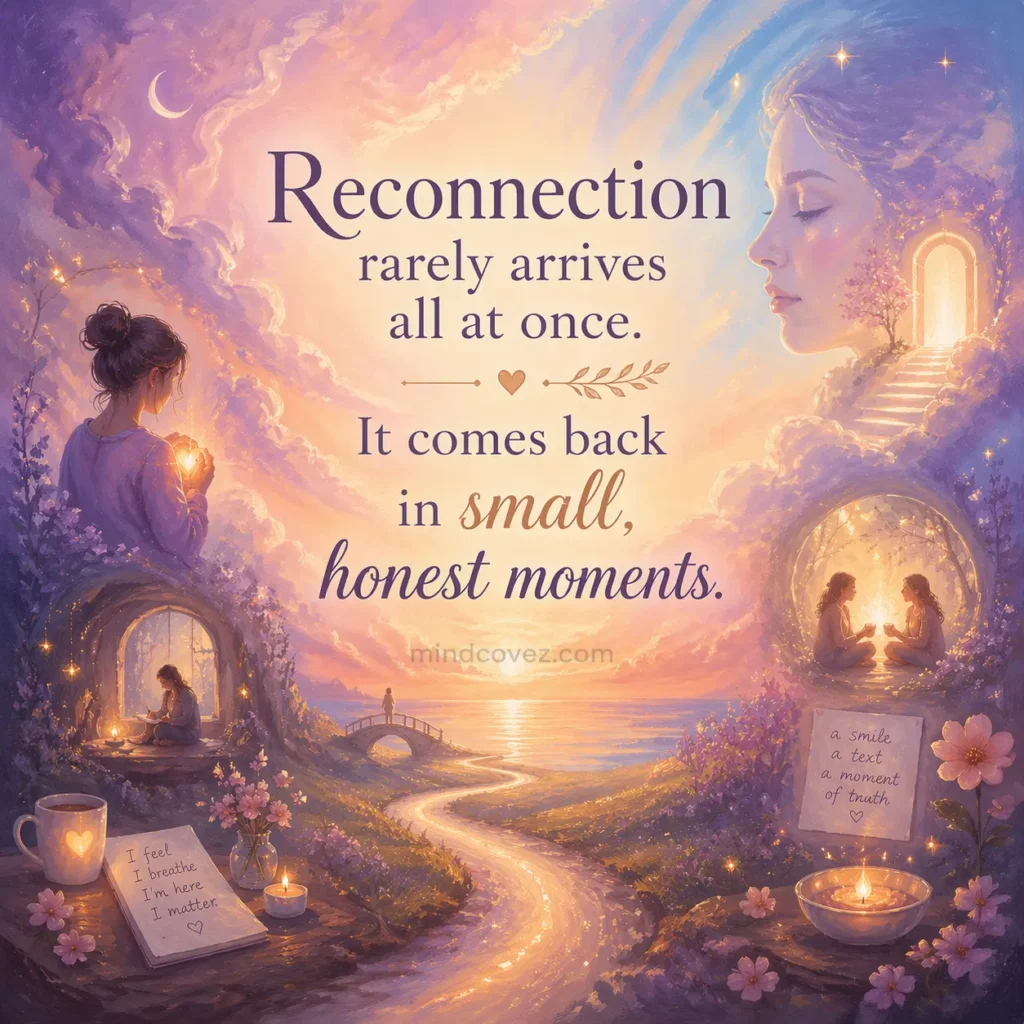
Reconnecting to Emotions
People usually want to rush this part. Fair enough. When you feel emotionally numb, you want something immediate. A reset. A release. Proof that you are still in there somewhere. But most recovery from numbness does not arrive as one big emotional moment. It comes back in smaller pieces.
The better question is usually not, “How do I make myself feel more right now?” It is, “What is making feeling unavailable, unsafe, or too effortful in the first place?” That changes the direction completely.
1. Start with the body, not the story
Go for a ten-minute walk without your phone. Stretch. Stand outside in morning light. Eat one meal without a screen. Take a shower and pay attention to the temperature. These are not glamorous interventions. Still useful. Emotions are embodied states, not abstract thoughts floating above the body.
I’ve watched people wait for motivation before doing any of this, and that usually keeps them stuck longer.
People often wait to feel motivated first. I would not. Motivation tends to arrive late.
2. Reduce emotional static
Create one pocket of quiet every day. No scrolling. No music. No multitasking. Just enough stillness to notice what has been blurred out. A lot of people find out here that they are not emotionally numb every minute. They are defended every minute. Different problem. Better news.
3. Add gentle novelty
Change something small on purpose. Take a different route. Sit somewhere new. Listen to music you used to love. Cook actual food. Walk in a park you usually ignore. Novelty can wake up reward pathways that have gone dim. Anhedonia often softens when life stops feeling mechanically identical.
A lot of this looks almost stupidly ordinary in real life. Someone starts taking tea on the front step instead of drinking it over email. Someone walks one block farther than usual. Someone plays a song they used to skip because it reminded them of a life they miss. Tiny changes. Still enough to wake something up.
4. Use emotional bridge cues
Watch a film scene that usually gets you. Revisit photos from a year that mattered. Listen to one song tied to one memory. Smell something familiar. Emotional bridge cues can reopen access without demanding a huge emotional performance. That matters for people who feel ashamed that they cannot cry on command.
5. Name feelings loosely
Do not force perfect emotional language. Start broad. Heavy. Flat. Tender. Shut down. Restless. Irritated. Numb but tired. Numb but lonely. Barrett made a strong case in 2017 for emotional granularity, and I think she was right. But broad words are enough at first. You are rebuilding contact, not taking an exam.
6. Tell one person the truth by five percent more
Not everything. Just a little more truth than usual. “I’ve felt emotionally detached lately.” “I’m here, but flat.” “I don’t think I’m broken, but I do think I’m disconnected.” Small honesty does more than private overthinking in a lot of cases.
This matters in relationships especially. Emotional detachment in relationships often gets worse in silence. One person withdraws. The other person guesses. Then both start reacting to assumptions instead of reality. When that pattern is tied to older wounds rather than just current stress, it becomes a more relevant next layer than general communication advice.
One caution here. I used to push harder for insight. Find the original wound. Interpret the shutdown. Get to the root straight away. Sometimes that helped. Sometimes it just made exhausted people feel like failed therapy projects. I do not think that way as much now. Sometimes the next right move is not deeper analysis. It is sleep, food, quiet, movement, and one unscripted conversation. For some people, the numbness gets worse the harder they try to manage every feeling perfectly, which is where it becomes more relevant than another self-improvement push.
When to Get Help
There is a point where emotional numbness stops being something to monitor gently and starts being something to take seriously. You do not need a dramatic collapse to count.
When should you get help for emotional numbness?
Get help when emotional numbness lasts for weeks, keeps getting worse, affects your relationship, work, parenting, or ability to care about things that normally matter, or shows up with panic, trauma symptoms, dissociation, hopelessness, or strong withdrawal from life.
What makes emotional numbness more concerning?
Emotional numbness is more concerning when it is persistent, impairing, tied to trauma symptoms, mixed with feeling unreal, or paired with thoughts of self-harm, severe hopelessness, or not wanting to be here.
Get urgent support right away if the numbness sits alongside thoughts of self-harm or not wanting to be alive. That is not the moment for self-optimization.
People wait longer with numbness than they do with panic, partly because flatness looks so strangely functional from the outside. That is also why it gets minimized for too long.
A good therapist or clinician can help sort out whether this is burnout, depression, unresolved stress, trauma-related shutdown, medication effects, grief, or something else. You do not have to decode it alone.
Quick FAQ
Yes, sometimes. Especially when it is tied to stress, overload, sleep deprivation, burnout, grief, or short-term emotional exhaustion. But if it lingers, spreads, or deepens, do not just wait it out.
Not always. Depression can include emotional numbness, but numbness can also show up with burnout, chronic stress, trauma, grief, dissociation, medication effects, or prolonged overload.
There is no neat timeline. Mild emotional detachment from stress can lift in days or weeks when the pressure changes. Persistent numbness that lasts several weeks or interferes with daily life deserves more support.
The fastest shifts are usually not dramatic. Sleep repair. Less overstimulation. More body-based routine. Slightly more emotional honesty. More real connection. Less pressure to perform, feeling on command.
Not always. Emotional detachment in relationships can reflect conflict, resentment, burnout, nervous system shutdown, or plain depletion. Sometimes it points to a relationship problem. Sometimes it points to a body-and-brain problem that got misread as a love problem.
Barrett, Lisa Feldman. 2017. How Emotions Are Made: The Secret Life of the Brain. Boston: Houghton Mifflin Harcourt.
Deci, Edward L., Anja H. Olafsen, and Richard M. Ryan. 2017. “Self-Determination Theory in Work Organizations: The State of a Science.” Annual Review of Organizational Psychology and Organizational Behavior 4: 19-43.
McEwen, Bruce S. 2006. “Protective and Damaging Effects of Stress Mediators: Central Role of the Brain.” Dialogues in Clinical Neuroscience 8(4): 367-381.
Porges, Stephen W. 2011. The Polyvagal Theory: Neurophysiological Foundations of Emotions, Attachment, Communication, and Self-Regulation. New York: W. W. Norton & Company.