
Some people do not miss your emotions. They notice them quickly. They hear the hesitation in your voice, remember what makes you feel guilty, and seem to understand the exact place where you are most vulnerable. At first, that can feel like closeness. Later, it can start to feel like something else: pressure, confusion, or control.
That is where dark empathy becomes worth understanding.
The difficult part is that dark empathy does not usually look like coldness. It often looks like warmth. It can sound caring, emotionally intelligent, even unusually perceptive. But the real question is not only whether someone understands your feelings. The real question is what they do with that understanding.
This piece looks at dark empathy as a psychology-informed relationship pattern, not as a diagnosis or internet label. The aim is to make the pattern easier to recognize: what it means, how it differs from healthy empathy, what signs tend to show up in real life, and how to think clearly if someone’s emotional insight leaves you feeling managed instead of understood.
The main idea is simple:
Dark empathy is not a lack of emotional insight. It is emotional insight without consistent care.
Once you see that, the question changes. You stop asking, “Are they really empathetic?” and start asking, “What do they consistently do with what they know about me?”
What It Is
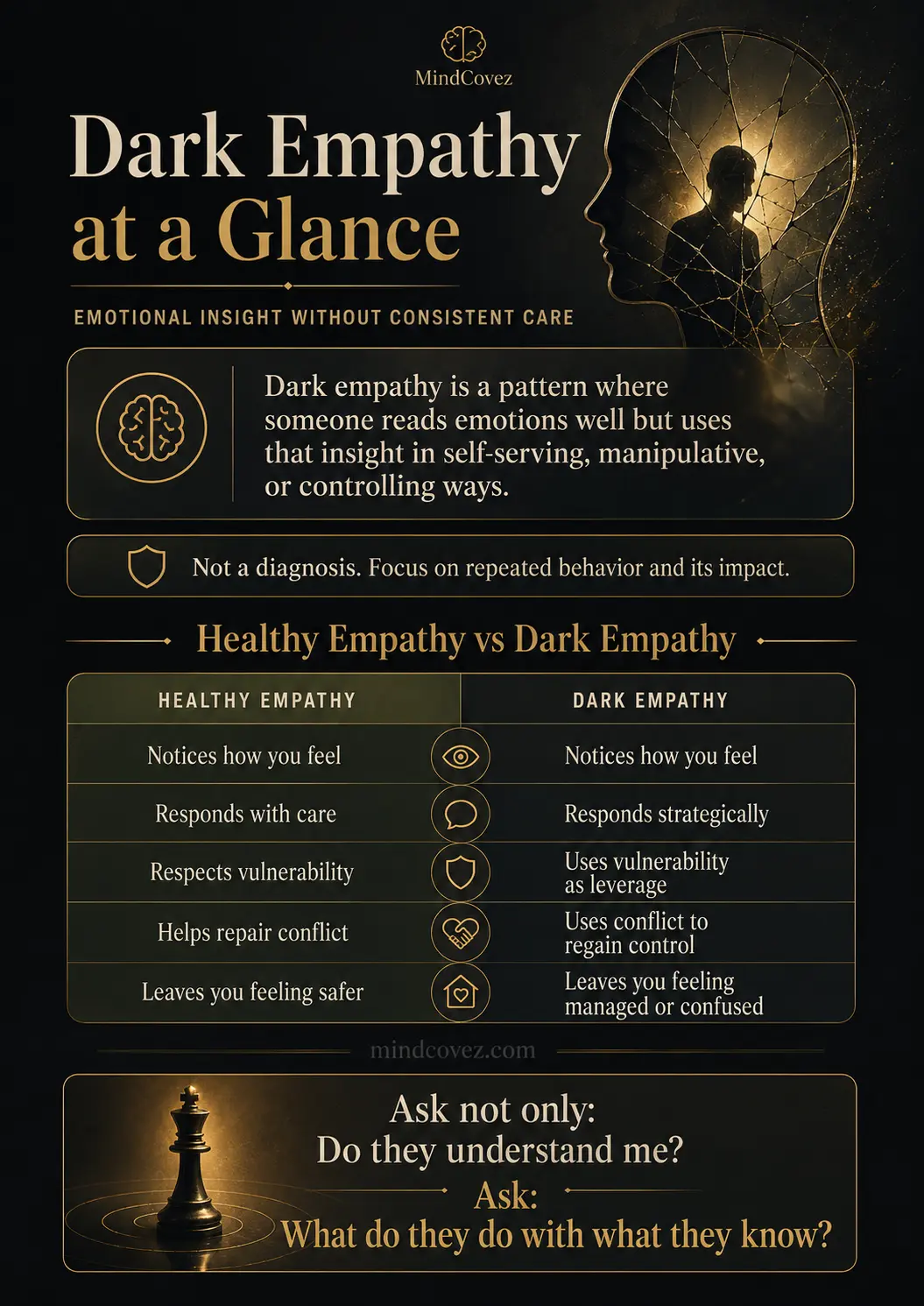
Dark empathy describes a pattern where someone has strong emotional perception but uses that insight in self-serving, manipulative, or controlling ways.
In simple terms:
A person with dark empathy can read emotions, but they may not use that understanding kindly.
That is what makes the pattern confusing. The person may notice when you are anxious. They may remember what hurts you. They may know what makes you feel safe, ashamed, loyal, or afraid of disappointing people. They may use the language of care very well.
And sometimes, to be fair, their emotional perception is real.
That is the uncomfortable part.
They may actually understand something about you. They may pick up on details other people miss. They may sense when your tone changes, when you pull back, when you are trying not to cry, or when you are pretending something is fine.
But over time, you may notice that their emotional insight does not make the relationship safer.
It gives them leverage.
The idea connects to research on empathy and dark personality traits. In 2002, psychologists Delroy Paulhus and Kevin Williams described the “Dark Triad” of personality traits: narcissism, Machiavellianism, and psychopathy. They framed these as related but distinct traits, not one identical thing. (ScienceDirect)
Later, Nadja Heym, Fraenze Kibowski, Claire Bloxsom, Alyson Blanchard, Alexandra Harper, Louise Wallace, Jennifer Firth, and Alexander Sumich published work on what they called the “Dark Empath” profile. Their research, published in Personality and Individual Differences in 2021, looked at people who showed elevated dark traits while also showing elevated empathy. The study included 991 participants, which is worth mentioning because this was not just a casual internet idea. (ScienceDirect)
Still, dark empathy is not a formal diagnosis.
That matters.
It is better understood as a descriptive personality pattern. You should not use it to diagnose someone. You can use it, though, to make sense of a repeated interpersonal pattern:
- Someone seems emotionally intelligent.
- They understand what people feel.
- They know how to sound caring.
- But the relationship leaves you feeling controlled, confused, or diminished.
A simple definition:
Dark empathy is the use of emotional understanding without reliable care, accountability, or respect for boundaries.
That definition keeps the focus where it belongs. On behavior.
Someone may have high cognitive empathy, meaning they can understand what another person is thinking or feeling. They may also have social intelligence, charm, emotional fluency, and a very good sense of timing.
But if that insight is used to pressure, guilt, seduce, punish, or control, it is not functioning as healthy empathy.
It is functioning as influence.
How It Differs From Empathy
Healthy empathy helps people understand others and respond with care. The American Psychological Association defines empathy as understanding a person from their frame of reference or vicariously experiencing that person’s feelings, perceptions, and thoughts. (APA Dictionary of Psychology)
Dark empathy keeps part of that ability, especially the ability to read people, but changes the purpose.
| Healthy empathy | Dark empathy |
| Notices how someone feels | Notices how someone feels |
| Responds with care | Responds strategically |
| Respects vulnerability | Uses vulnerability as leverage |
| Helps repair conflict | Uses conflict to regain control |
| Makes the other person feel safer | Makes the other person feel emotionally managed |
The key difference is not perception.
It is motive, pattern, and outcome.
A healthy empathic person may notice you are overwhelmed and say, “Do you want space, or do you want help?”
A person showing dark empathy may notice you are overwhelmed and use that moment to push a decision, extract reassurance, or make you feel guilty for needing space.
This is the reframe many people need, and it is not always easy to take in:
Someone can understand your emotions and still not be safe with them.
That can feel strange if you have always connected emotional intelligence with kindness. A lot of people do. They assume that if someone “gets it,” they must care.
But those are not the same thing.
- Emotional intelligence is an ability.
- Empathy can be a capacity.
- Care is a choice shown through behavior.
This is why dark empathy can be harder to spot than obvious coldness. It often comes wrapped in warmth. The person may say the right things. They may describe your feelings with impressive accuracy. They may even seem more emotionally aware than other people in your life.
But if their understanding regularly benefits them at your expense, the relationship deserves closer attention.
Dark empathy vs healthy empathy
Healthy empathy asks, “How can I understand you better?”
Dark empathy asks, “How can I use what I understand?”
That is the dividing line.
Not always perfectly clean. People are messy. Sometimes people are defensive, scared, selfish, immature, or just bad at repair.
But when the same pattern keeps repeating, when insight keeps turning into pressure, the distinction becomes harder to ignore.
Signs
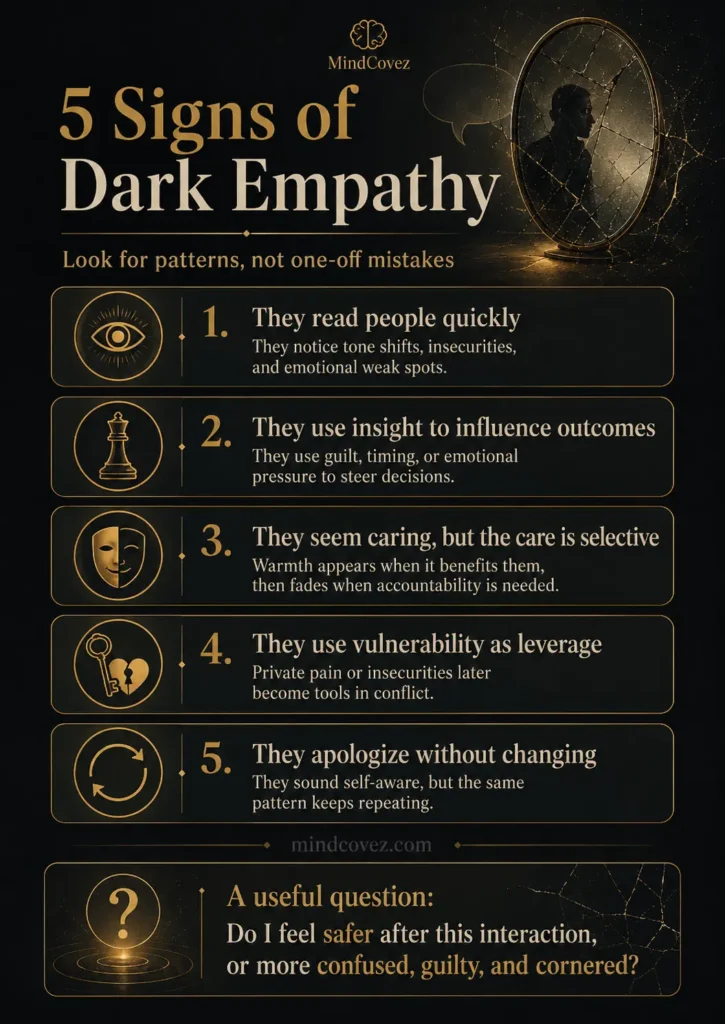
Dark empathy is usually a pattern, not a single bad interaction. Anyone can be selfish, defensive, or emotionally clumsy once in a while.
The concern grows when emotional insight repeatedly turns into:
- Pressure
- Guilt
- Control
- Self-protection
- Emotional confusion
- Boundary-pushing
The signs below are not meant to diagnose someone. They are meant to help you recognize patterns that may be affecting your judgment, confidence, or emotional safety.
They read people quickly
Some people are unusually good at noticing small shifts in tone, facial expression, posture, silence, and timing. They can sense when someone is insecure, eager to please, embarrassed, lonely, or afraid of conflict.
At first, this can feel flattering.
You may think, “They really get me.”
And maybe they do.
The problem is not always fake empathy. Sometimes the emotional perception is real. The issue is what happens next.
Over time, the same sensitivity may start to feel invasive. They remember your weak spots. They know which words soften you. They know when you are easiest to persuade. They may know exactly when to comfort you and exactly when to make you feel guilty.
That is when emotional attunement stops feeling like connection and starts feeling like control.
They use emotional insight to influence outcomes
A person with dark empathy may not pressure you directly. They may use emotional timing instead.
They bring up your fear of disappointing people right when they want a favor.
They remind you of a past mistake when you start setting a boundary.
They offer comfort, then attach an expectation to it.
They say they understand your pain, then use that pain to steer your decision.
The pressure is subtle. That is what makes it confusing.
You may not feel forced. You may simply feel emotionally cornered.
A common real-life pattern looks like this: you begin the conversation with a clear boundary, but by the end, you are apologizing, explaining, reassuring, and agreeing to something you did not want.
That shift is worth noticing.
They seem caring, but the relationship feels one-sided
Dark empathy often appears as care with a hook.
They may ask thoughtful questions, remember personal details, and say emotionally intelligent things. They may check in when you are upset. They may use language that sounds compassionate and emotionally mature.
But over time, you may notice the care mostly appears when it serves them.
They are attentive when they want closeness.
They are understanding when they want trust.
They are vulnerable when they want sympathy.
They are gentle when they want access.
But when you need accountability, the warmth disappears.
This is one of the clearest differences between healthy empathy and manipulative empathy. Healthy empathy remains present when it is inconvenient. Dark empathy often becomes selective.
I have seen this show up with a friend who can spend two hours helping someone process a breakup, then somehow uses that conversation later to make the person feel indebted.
Or with a partner who knows exactly how to soothe you after conflict, but never actually stops doing the thing that caused the conflict.
Small pattern. Big consequence.
They use vulnerability as leverage
This is one of the strongest warning signs.
In a safe relationship, personal information is handled with respect. In a manipulative relationship, it becomes material.
They may bring up something painful you told them in confidence. They may use your insecurities during an argument. They may turn your past trauma, fear, or needs into proof that you are “too sensitive,” “too needy,” “hard to love,” or “overreacting.”
The issue is not that they know your vulnerabilities.
The issue is that they weaponize them.
Someone knows you struggle with abandonment. During conflict, they say, “This is why people leave you.”
That is not empathy. That is emotional knowledge being used to wound.
Or they know you worry about being selfish. When you say no, they respond, “I guess I was wrong about you being a caring person.”
That is not honest communication. That is guilt used as leverage.
A quick situation I have seen more than once: someone in their early 30s tells a partner that they grew up feeling responsible for keeping the peace at home. Weeks later, during an argument about canceled plans, the partner says, “You always run away when things get hard. Maybe your family was right to depend on you because clearly you need pressure to care.”
It sounds almost analytical. Like an insight.
But it lands as punishment.
That is the difference.
Insight can illuminate. It can also cut.
They apologize without changing
People with dark empathy can sometimes sound very self-aware. They may say:
- “I know I hurt you.”
- “I understand why that made you feel unsafe.”
- “I can see how my behavior affected you.”
- “I get why you felt manipulated.”
Those words can be meaningful. But only if behavior changes.
A repeated pattern of insight without repair is a problem. Someone can understand your feelings and still keep using them against you.
This is where many people get stuck. They hear the insight and assume it means growth.
But insight is not the same as accountability.
A real apology usually leads to some form of changed behavior. A performance of apology often leads back to the same cycle.
And yes, change can take time. People do not become different overnight. But there should be some visible movement.
Less defensiveness.
More respect for limits.
Fewer repeats of the same harm.
If the words improve and the behavior stays the same, trust the behavior.
They frame control as care
This sign can be especially difficult to name because the words may sound protective.
They may say:
- “I’m only saying this because I care about you.”
- “I know you better than anyone.”
- “I’m trying to protect you.”
- “You’re too emotional right now to see this clearly.”
- “I understand your patterns, and this is one of them.”
Sometimes care does involve honest feedback. That is true. People who love us may see things we miss.
But healthy care does not require you to surrender your judgment.
Dark empathy can make control sound like concern. It can make intrusion sound like closeness. It can make guilt sound like love.
A useful question is:
Do I feel supported, or do I feel managed?
That question sounds simple, but it often cuts through a lot.
They rarely use insight to repair harm
This is one of the most important signs.
A person may understand exactly how they affected you. They may even explain your feelings back to you with impressive precision.
But if that insight does not lead to repair, it becomes another kind of performance.
Healthy empathy says, “I understand how that hurt you, and I will act differently.”
Dark empathy says, “I understand how that hurt you,” then uses the conversation to defend, redirect, charm, or regain control.
The words sound similar.
The outcome is different.
This is why I tend to pay less attention to how emotionally fluent someone sounds, and more attention to what happens after they have been told clearly, “This hurt me.”
That moment tells you a lot.
You leave interactions feeling confused
This is often the signal people ignore.
The conversation may sound caring on the surface. They may be calm. They may use thoughtful language. They may even seem more emotionally composed than you.
But afterward, you feel uneasy.
You may find yourself thinking:
- “Why do I feel guilty?”
- “Did I agree to something I didn’t want?”
- “Why am I questioning my own reaction?”
- “Why do they sound kind, but I feel smaller?”
- “Why do I feel like I have to prove I’m a good person?”
That aftereffect is important. Your body may notice the pattern before your mind has words for it.
What are the signs of dark empathy?
Signs of dark empathy include emotional perceptiveness, charm, selective care, guilt-based pressure, using vulnerability as leverage, apologizing without changing, framing control as concern, and leaving others feeling confused or emotionally managed.
Examples
Dark empathy can show up in dating, friendships, family relationships, workplaces, and online communities. It is not always loud. It often appears as emotional perception used as influence.
The examples below are not about diagnosing people. They are about recognizing how manipulative empathy can feel in real life.
Example 1: Dating
Someone you are dating quickly learns what makes you feel secure. They send thoughtful messages, remember your fears, and seem unusually tuned in.
They know when to reassure you. They know what makes you feel chosen. They may even speak with the kind of emotional clarity you have been wanting for years.
At first, it feels like safety.
Later, when you ask for space, they say:
“After everything you told me about being abandoned, I can’t believe you’re doing this to me.”
That sentence matters.
They are not simply expressing hurt. They are using your own vulnerability to make you feel responsible for their emotional state.
That is dark empathy in action: emotional insight turned into pressure.
The shift here is subtle but important. You do not have to decide whether the person is “good” or “bad.” You only have to notice that your pain is being used to override your boundary.
Example 2: Friendship
A friend is great at getting people to open up. They ask deep questions. They remember details. They make people feel seen.
But later, private information becomes social currency.
They hint at things you told them. They make jokes that expose sensitive information. They position themselves as the person who “really understands everyone,” while quietly controlling how others are seen.
The empathy builds access.
The access becomes leverage.
In a healthy friendship, being known usually creates more safety. In a dark empathy pattern, being known creates more risk.
This might show up with a friend who says, “I only brought it up because I care,” after sharing something you told them privately.
Or someone who turns your pain into a story that makes them look wise, loyal, or central.
You are left feeling exposed, but somehow they are the one receiving sympathy.
Example 3: Workplace
A colleague is excellent at reading the room. They know who wants approval, who avoids conflict, who feels insecure, and who wants to be liked.
Instead of using that awareness to collaborate better, they use it to manage perception.
They flatter one person.
They isolate another.
They frame themselves as reasonable while nudging others into conflict.
They rarely look openly aggressive. In fact, they may seem calm and emotionally intelligent.
But the result is the same: other people become easier to move around.
This kind of dark empathy can be difficult to challenge because it often hides behind professionalism. The person may not yell, threaten, or insult. They may simply understand everyone’s emotional incentives and use them strategically.
A practical test is to watch what happens when they lose influence.
Do they seek clarity and repair?
Or do they quietly punish, recruit, or undermine?
Example 4: Family
A family member knows exactly what makes you feel guilty. They know your loyalty, your fears, and your need to be seen as a good person.
When you set a boundary, they say:
“I guess I just don’t matter to you anymore.”
The words sound emotional, maybe even vulnerable. But the function is control.
They are using your care for them to make you abandon your limit.
This can be especially painful in family systems because the person may genuinely know your history. They may know the child version of you. They may know what you still feel responsible for. They may know which phrase will pull you back into an old role.
Dark empathy in families often sounds like love, but feels like obligation.
Example 5: Online or community spaces
Someone presents themselves as deeply sensitive, emotionally aware, and protective of others. They use the language of healing, safety, trauma, empathy, or accountability.
But when challenged, they turn that language into a weapon.
They accuse others of being harmful for disagreeing. They frame reasonable boundaries as cruelty. They gather sympathy while avoiding accountability. They use therapeutic language to stay in control of the group narrative.
This is one reason dark empathy can be so difficult to name. It can borrow the language of care while creating the opposite experience.
The issue is not the language itself. Words like safety, empathy, trauma, and boundaries can be important and valid.
The issue is whether those words are being used to create clarity or to control the room.
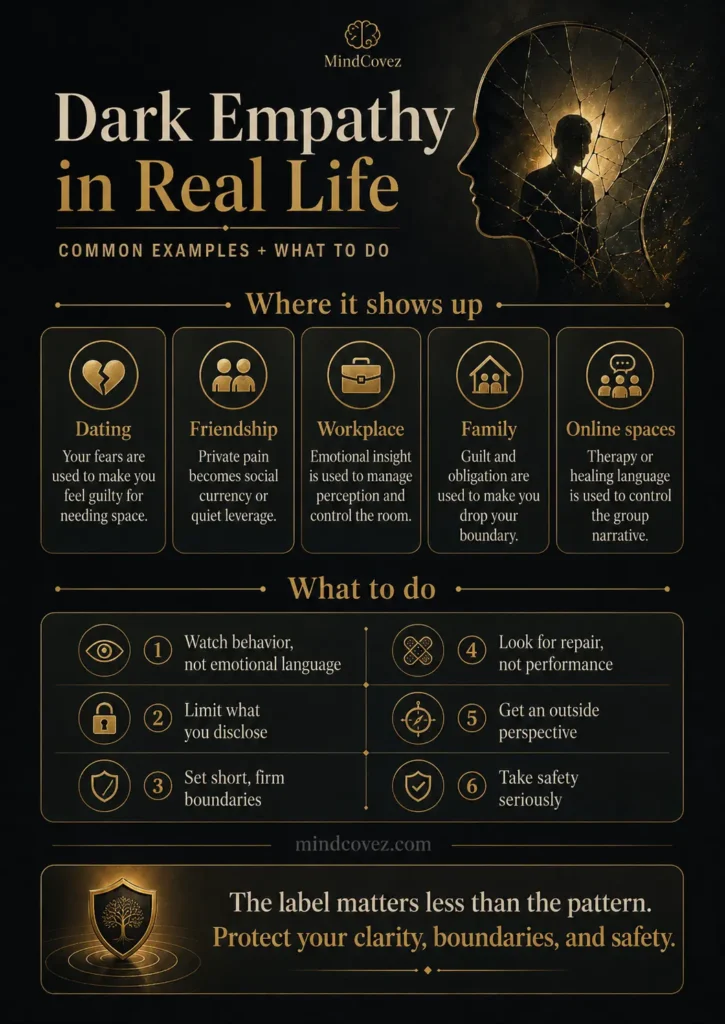
What to Do If You Encounter It
You do not need to prove that someone is a “dark empath” before protecting yourself.
The label matters less than the pattern.
Ask yourself:
What keeps happening around this person?
That question moves you out of overanalysis and back into reality. You do not have to read their mind. You do not have to diagnose their personality. You do not have to prove intent.
You can respond to the behavior.
Watch behavior, not emotional language
Some people know how to sound compassionate. That does not mean they are acting with care.
Pay attention to what happens after emotional conversations.
Ask:
- Do they respect your boundaries?
- Do they change harmful behavior?
- Do they take responsibility without turning it back on you?
- Do you feel clearer after speaking with them, or more confused?
Behavior is better evidence than wording.
This is especially important with people who are verbally skilled. They may explain, apologize, analyze, and reframe.
But if the same pattern keeps repeating, the explanation is not the repair.
Limit what you disclose
If someone repeatedly uses personal information against you, reduce their access.
You do not have to become cold or rude. You can simply become more selective.
Share less. Explain less. Pause before answering personal questions. Notice whether they respect your privacy or push for more.
A safe person can tolerate not knowing everything.
A person who uses dark empathy may treat your privacy as rejection. That reaction tells you something.
Set short, firm boundaries
Avoid long explanations with someone who uses details as leverage.
Instead of:
“I’m really sorry, but I’ve been overwhelmed lately, and I know you’ve been stressed too, and I don’t want you to think I don’t care…”
Try:
- “I’m not available for that.”
- “I’m not discussing this right now.”
- “Please don’t bring that up again.”
- “That does not work for me.”
- “I need time before I respond.”
Clear boundaries give less material to manipulate.
The goal is not to win the conversation. The goal is to stop giving the conversation unlimited access to your emotional life.
Look for repair, not performance
The real test is not whether someone can understand why you are hurt.
The test is whether they stop doing the thing that hurts you.
A person who cares may still make mistakes. But they will usually show some mix of humility, changed behavior, and respect for your limits.
A person using dark empathy may offer insight, emotion, or apology, then repeat the same pattern.
This is where the decision becomes clearer: if someone understands your pain and keeps using it, you may need stronger boundaries than you originally wanted.
That can feel harsh.
But it is often the point where confusion turns into clarity.
Get an outside perspective
Manipulative dynamics often become clearer when you describe them to someone grounded.
Talk to a trusted friend, therapist, mentor, or supervisor, depending on the context. You are not asking them to diagnose the person. You are asking for help seeing the pattern clearly.
This is especially important if you feel isolated, intimidated, or constantly unsure of yourself.
A good outside perspective will not simply tell you what to do. It will help you separate three things:
- What happened
- How it affected you
- What boundary is needed now
Take safety seriously
If the person is threatening you, stalking you, controlling your movements, monitoring your communication, or making you afraid to leave, treat the situation as serious.
Reach out to local emergency services, a domestic abuse resource, or a qualified professional in your area.
Dark empathy may be a useful phrase, but safety does not depend on finding the perfect label.
You are allowed to respond to harmful behavior directly.
How should you respond to dark empathy?
Respond to dark empathy by watching repeated behavior, limiting vulnerable disclosures, setting short boundaries, looking for real repair, getting outside perspective, and taking safety concerns seriously.
Final Thought
Dark empathy is not the absence of emotional insight.
It is emotional insight without consistent care.
That is why it can be so disorienting. The person may seem perceptive. They may know exactly what to say. They may understand your feelings better than most people do.
But empathy is not only about reading emotion.
It is also about what someone does with what they understand.
So the shift is not learning to label people faster. It is learning to trust patterns more than performances.
If someone’s emotional insight makes you feel safer, clearer, and more respected, it may be healthy empathy.
If someone’s emotional insight repeatedly makes you feel guilty, exposed, controlled, or unsure of yourself, it may be time to step back and ask a better question:
Is this person using what they know about me to care for me, or to control me?
Maybe that question does not answer everything at once.
It usually doesn’t.
But it does change where you look next.
Frequently Asked Questions
What is dark empathy in simple terms?
Dark empathy is when someone understands emotions well but does not always use that understanding with care. They may read people accurately, notice vulnerability, and say emotionally intelligent things, but the pattern can still feel manipulative or controlling.
The simple version is this:
Dark empathy is emotional insight without consistent care.
Is dark empathy a real diagnosis?
No. Dark empathy is not a formal mental health diagnosis.
It is better understood as a personality pattern or relationship pattern. The term is connected to research on empathy and dark personality traits, but it should not be used to diagnose someone.
It is more useful as a way to notice behavior.
The better question is not, “Can I label this person?”
The better question is, “What do they keep doing with what they know about me?”
How is dark empathy different from normal empathy?
Normal empathy usually helps someone respond with care, respect, and repair.
Dark empathy may still involve emotional understanding, but the understanding gets used differently. It may become pressure, guilt, control, or leverage.
A person with healthy empathy might notice you are overwhelmed and give you space.
A person showing dark empathy might notice you are overwhelmed and use that moment to push you into a decision.
Same emotional awareness. Very different outcome.
What are common signs of a dark empath?
Common signs of dark empathy include:
- Reading people quickly
- Knowing what makes someone feel guilty or insecure
- Using vulnerability during conflict
- Sounding caring while pushing control
- Apologizing without changing
- Making you feel confused after conversations
- Framing pressure as concern
- Using emotional language to avoid accountability
One sign alone does not prove anything. The pattern matters more.
Can someone be empathetic and manipulative at the same time?
Yes, they can.
That is what makes dark empathy confusing. Some people really can understand emotions and still use that understanding in self-serving ways.
Empathy is not automatically kindness. Emotional intelligence is not automatically safety.
Care shows up in behavior, especially when someone is asked to stop causing harm.
What should I do if I think someone has dark empathy?
Start by watching the pattern, not the label.
Ask yourself:
- Do I feel clearer or more confused after talking to them?
- Do they respect my boundaries?
- Do they use personal information against me?
- Do they change after apologizing?
- Do I feel safe being honest with them?
If the pattern keeps hurting you, share less, explain less, and set firmer boundaries.
If you feel afraid, controlled, monitored, or trapped, get outside support from someone safe or a qualified professional.
Can dark empathy show up in relationships?
Yes. Dark empathy can show up in dating, friendships, family relationships, workplaces, and online communities.
In relationships, it may look like someone knowing exactly what makes you feel loved, then later using that same knowledge to make you feel guilty, responsible, or afraid to leave.
That is why the early warmth can feel so confusing.
It was not necessarily fake.
But it may not have been safe either.
Is dark empathy the same as narcissism?
No. Dark empathy is not the same as narcissism.
Narcissism is one of the dark personality traits discussed in the Dark Triad research, along with Machiavellianism and psychopathy. Dark empathy refers more broadly to the mix of emotional understanding with darker, self-serving traits. Paulhus and Williams described the Dark Triad framework in 2002, while later Dark Empath research looked more specifically at empathy alongside those darker traits. (ScienceDirect)
A person can show manipulative empathy without having narcissistic personality disorder. That distinction matters. The American Psychiatric Association noted in 2024 that narcissistic personality disorder is more severe and persistent than casual narcissistic traits. (American Psychiatric Association)
The goal is not to diagnose them.
The goal is to understand what is happening and protect your own clarity.
When should I get help?
Get support if the relationship is affecting your confidence, sleep, mood, safety, or ability to make decisions.
You should take it seriously if someone is:
- Threatening you
- Monitoring your communication
- Controlling where you go
- Using fear to keep you close
- Making you feel unsafe leaving
- Punishing you for boundaries
In those situations, do not wait until you find the perfect label. Talk to someone safe, a therapist, a domestic abuse resource, or local emergency services if there is immediate danger.
Paulhus, D. L., and Williams, K. M. described the Dark Triad framework in 2002, identifying narcissism, Machiavellianism, and psychopathy as related but distinct dark personality traits. (ScienceDirect)
Heym, N., Kibowski, F., Bloxsom, C. A. J., Blanchard, A., Harper, A., Wallace, L., Firth, J., and Sumich, A. published research in Personality and Individual Differences in 2021 on the Dark Empath profile, describing people with elevated dark traits and elevated empathy. Their study included 991 participants. (ScienceDirect)
The American Psychological Association defines empathy as understanding another person from their frame of reference or vicariously experiencing that person’s feelings, perceptions, and thoughts. (APA Dictionary of Psychology)
The American Psychiatric Association described narcissistic personality disorder in 2024 as involving a pervasive pattern of grandiosity, need for admiration, and lack of empathy, while also noting that narcissistic traits alone are not the same as narcissistic personality disorder. (American Psychiatric Association)