I keep watching the same thing happen in different relationships. Someone uses therapy speak, the conversation ends fast, and the awkward part begins. The silence. The second-guessing. The feeling that nobody agreed on what just happened. If you read this, you will leave with a name for that moment, you will see the flip point where self-protection becomes withdrawal, and you will reach a decision point you can use the next time it happens.
I am writing this because I wanted to put my stance on the table and share my two cents from years of watching this play out in real rooms with real people. Not as a verdict on Gen Z, and not as a reaction to any one headline. I keep noticing most posts get stuck in extremes, either arguing that Gen Z selfish is the whole story, or insisting therapy language is automatically progress. That framing is loud. It does not help much when you are trying to keep a relationship intact. What I actually want to sort through is narrower: why mental health language can increase disconnection in everyday relationships, especially when Gen Z mental health strain is already high. I have sat with enough families, friends, and teams to know the intent is often sincere. The impact still lands hard.
The question underneath all of it is the one people keep circling without saying out loud:
When does self-protection become disconnection, and how do you catch it before a relationship quietly disappears?
The Moment That Sparked the Question
When USA Today ran a piece in January 2026 asking whether Gen Z is selfish and whether the misuse of therapy speak might be part of the story, I felt recognition more than outrage. I had already been tracking the same dynamic in notes, supervision conversations, and the quiet debriefs people do after a hard interaction.
A parent describing an adult child who said, “I need boundaries,” and then stopped calling. No explanation of what would make contact safe. No plan for repair. Just distance.
A manager telling me a feedback conversation ended the moment the employee said, “This feels unsafe,” and the room went still. No one knew what to ask next without sounding cruel.
A friendship that did not end with a fight. It ended with a phrase, then weeks, then months.
Around the same time, I kept returning to the Annie E. Casey Foundation article first published March 3, 2021 and updated May 12, 2024. It defines Gen Z as people born 1997 to 2012. It also reports that 84% of Gen Zers believe mental health is a crisis in the United States, and that they are over 80% more likely to report anxiety or depression than older generations.
Then I read UNICEF’s partnerships release dated June 3, 2025, describing a global survey of more than 5,600 Gen Z aged 14 to 25. The line I keep remembering is that 6 in 10 feel overwhelmed by current events.
The same UNICEF June 2025 release also laid out a few global percentages that keep showing up in my work, even when the setting changes:
- 4 in 10 still feel stigma around speaking out about mental health in schools and workplaces
- Only half know where to find resources to support their mental health
- 55% believe they have effective coping mechanisms
- 60% remain hopeful and want to contribute to shaping a better future
And later, I read a PsychPlus blog post dated March 4, 2025 describing Gen Z navigating a mental health crisis that is getting worse, tied to academic pressure, social media overload, uncertainty about work and the economy, and the background noise of global crises. The article included:
- 42% of Gen Z diagnosed with a mental health condition
- Over 70% stressed or anxious about work, money, and the future
- More than half saying social media negatively impacts their mental health
Those pieces, plus what I see in practice, keep forming the same picture. This is not just a language trend. It is language under strain, inside a Gen Z mental health backdrop that is already heavy.
What People Mean by Therapy Speak and Why It Matters
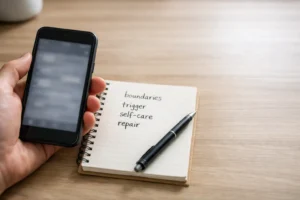
Quick in-flow reset, because people use these words differently. When people say therapy speak, they usually mean the mental health terms that used to mostly stay inside therapy rooms, now used in everyday conflict. Boundaries, triggers, trauma, gaslighting, self-care, unsafe, toxic. Sometimes those words fit. Sometimes they become shortcuts that skip the part where the other person can stay oriented.
And for anyone who does not live inside generational labels, Gen Z here means the cohort born 1997 to 2012, the definition used in the Annie E. Casey Foundation article published March 3, 2021 and updated May 12, 2024.
I do not think therapy speak is inherently harmful. It arrived on the back of real progress. Mental health became more discussable. People started naming experiences earlier. The American Psychological Association was already reporting rising stress and mental health strain in Gen Z around 2018 and 2019, and by 2022 the reporting on stress and mental health in younger cohorts was hard to ignore.
The Annie E. Casey Foundation article also points to major professional bodies, including the American Academy of Pediatrics and the American Academy of Child and Adolescent Psychiatry, declaring a national state of emergency in youth mental health.
It also notes something I lean on when I am trying not to moralize: ages roughly 14 through 24 are a dense developmental window, with major cognitive, biological, and psychosocial change, and about 75% of mental illnesses emerge between ages 10 and 24. That timing changes how conflict feels. It changes what risk feels like.
Wikipedia contributors were describing therapy speak as a cultural phenomenon back in the late 2010s. At the time, it sounded neutral. Now it feels like a warning label. Because once a term escapes the therapy room, it gains social power fast.
Here is the simplest way I can say the pattern without turning it into a lesson:
Therapy speak becomes risky when it functions as a verdict instead of a bridge.
That is the spine of what I keep seeing, whether the stressor is personal, local, or the broader global churn UNICEF described in June 2025.
Why Therapy Language Sometimes Feels Like Selfishness
Most people who say “Gen Z is selfish” are trying to name a feeling: “I am being shut out and I do not know why.” That confusion is real. The relational cost is real. The label can be unfair and still point to something worth examining.
The inward shift
A lot of conflict language now starts and ends inside the self.
- “I don’t owe anyone anything.”
- “I’m protecting my peace.”
- “I’m prioritizing myself.”
Those statements can be healthy in the right context. They can also land like a closed door when there is no follow-up.
This might show up with a sibling who stops attending family events and explains only, “It’s too much.” Or a coworker who refuses collaboration citing boundaries but cannot explain what collaboration would look like without harm.
UNICEF’s June 2025 findings complicate this, in a way people often skip. It noted that 4 in 10 still feel stigma around speaking out about mental health in schools and workplaces, and only half know where to find resources to support their mental health. When people feel stigma and uncertainty, they often reach for rigid scripts that sound safe. They may not have better tools.
Barry Schwartz wrote in 2004 about how choice and autonomy can erode social trust when responsibility drops out. I used to think that was philosophical. It feels practical now, in conversations where Gen Z selfish is the accusation but the lived experience is confusion.
Emotional compression
“I was triggered.”
“This is toxic.”
“That’s gaslighting.”
Sometimes these labels are accurate. Sometimes they are shorthand for a real nervous system reaction. But in relationships, the label alone can stop the conversation.
I have watched a person say “I’m triggered,” then go silent, and the other person sits there trying to decide which is worse: asking for detail, or saying nothing and becoming the villain in their own head.
This is where the selfish accusation often shows up, not because someone is asking for care, but because the other person is left with no map.
Self-care without context
The World Health Organization formally recognized burnout in 2019. That mattered. It gave language to something many people were living.
But self-care became a kind of universal exemption in some relationships.
For example, this could apply to someone repeatedly canceling plans with “self-care” as the only explanation. Or an adult child going no-contact under the banner of healing, without ever specifying what would make contact safer. The boundary might be necessary. The silence still has consequences.
The PsychPlus March 4, 2025 post described Gen Z as deeply stressed, with over 70% reporting stress or anxiety about work, money, and the future, and more than half describing social media as negative for their mental health. When that is the background, self-protective language becomes more frequent. It still can leave people alone.
The Reframe Most Conversations Miss
I do not think the best frame is selfish versus sensitive. That is a fight about character.
The more useful frame, the one that matches what I see, is this: high stress changes what words are used for. That is not a moral claim. It is functional.
The Annie E. Casey Foundation article notes that nearly two-thirds, 65%, of Gen Zers reported at least one mental health problem in the past two years, from a multi-year study released in 2023. It also references the CDC Youth Risk Behavior Survey showing 42% of high schoolers reported persistent sadness or hopelessness in 2021, with 57% for girls in 2021 compared to 35% for girls in 2001.
UNICEF’s June 3, 2025 survey puts a parallel strain story in global terms:
- 6 in 10 overwhelmed by current events
- 55% believing their coping mechanisms are effective
- 60% still hopeful and wanting to contribute
If someone’s baseline is already threat, a hard conversation can feel like a risk event. They may use therapy speak as armor. The problem is that armor works by keeping things out. Sometimes it keeps out the repair too.
So the flip is not “Gen Z selfish.”
The flip is “Gen Z is stressed, and stress changes how therapy language is deployed in relationships.”
That is not an excuse. It is a mechanism.
The One Idea That Keeps Holding Up
The strongest idea I have tested over time is the one that refuses to sound dramatic:
Language designed to stabilize individuals does not automatically sustain relationships.
Therapy frameworks often start with internal safety. Relationships require negotiation, timing, accountability, and repair. When those logics collide without translation, both people leave feeling unseen.
I have tried small, practical experiments with this. Not perfect. Just workable.
- “This is toxic” becomes “When you joke about my work in front of others, I shut down. I need you to stop.”
- “I’m triggered” becomes “This reminded me of something older. I need five minutes, then I can talk.”
- “I need boundaries” becomes “I can do Sundays, not last-minute weeknights. If plans change, text first.”
Sometimes that second sentence changes everything. Sometimes it fails because the relationship is already too brittle, or because one person uses psychological language to avoid responsibility and the other uses “repair” language to demand access.
UNICEF’s June 2025 survey noted that only half know where to find resources, and 55% believe they have effective coping mechanisms. That matters here. If coping is thin, language becomes the tool, even when language cannot carry the whole load.
Real Situations Where This Shows Up
I have watched workplace feedback sessions collapse after someone labeled the interaction toxic without naming what crossed the line.
I have seen friendships stall after one person asked for space and never said what returning would look like.
I have sat with parents who tried to respect boundaries they did not understand, hoping silence was the right choice, while quietly grieving the loss of contact.
None of these felt like cruelty. They felt like misalignment and fear of making it worse.
The Annie E. Casey Foundation article included a 2023 Gallup survey showing 47% of Gen Z (ages 12 to 26) often or always feel anxious, and 22% often or always feel depressed, with 74% anxious and 50% depressed among LGBTQ+ adults.
UNICEF’s global numbers are blunt, but I also find it helpful when a country-level cut is available, because it stops readers from assuming the global average is everyone’s reality. UNICEF Switzerland and Liechtenstein published a related summary on November 5, 2025. In Switzerland, it reported:
- 52% feel overwhelmed by news and events
- 42% perceive stigma in school, 44% perceive stigma in the workplace
- 43% knowledgeable about where to find resources
- 42% find their coping methods effective
- 70% believe schools should have a major role in supporting mental health efforts, 54% believe employers should
- 69% think they should have a role in helping peers deal with stress, anxiety, and overwhelm from news and events
Those numbers do not replace the U.S.-specific 84% figure. They show the same themes repeating in different places, with different intensities.
What Psychology Actually Supports and What It Does Not
Brené Brown said in 2010 that boundaries are clarity about what is okay and what is not. The way I remember it, boundaries were never meant to be vanishing acts.
Attachment research keeps pulling me back for the same reason. Bowlby’s early work in 1951, expanded by Ainsworth in 1978, kept pointing to security as a blend of autonomy and responsiveness. Too much avoidance, even when it feels protective, can reinforce threat rather than reduce it.
But I am careful with this. I have watched people weaponize responsiveness. They use it to demand access. They call it communication when it is actually control. So I do not romanticize repair.
Some people need distance to heal. Some people use distance to avoid accountability. The evidence does not hand out clean rules. It offers tradeoffs.
The Quiet Decision Underneath All of This
Most people are not deciding whether mental health matters. They are deciding whether to stay engaged when it feels uncomfortable.
Do I use therapy speak to pause and return, or do I use it to exit without saying I am exiting?
That decision is rarely explicit. It is still a decision.
Access makes it harder. The Annie E. Casey Foundation article notes Gen Z tends to be open to seeking help, with 39% reporting working with a mental health professional in person or online, yet it also describes major access gaps. It cites Mental Health America reporting that 60% of Gen Z youth ages 12 to 17 with major depression do not receive treatment, and it references the Kaiser Family Foundation survey from 2022 where 47% of young adults ages 18 to 29 did not get care when they thought they might need it, often due to cost.
When care is patchy, people often reverse-engineer therapy from social media clips and cultural language. Sometimes it helps. Sometimes it turns into rigid scripts that do not include repair.
UNICEF’s June 2025 release included something else that complicates the “Gen Z selfish” story. It said 60% remain hopeful and want to contribute to shaping a better future. That hope coexists with overwhelm. People can be overwhelmed and still care. They can withdraw and still want to matter.
Questions People Keep Asking
I do not see evidence of a simple moral shift. I see a generation under pressure, with higher reported anxiety and depression, using protective language more often. The impact can still feel like selfishness to others. The global data shows 6 in 10 overwhelmed and 4 in 10 feeling stigma, which sounds like context more than character.
Often, yes. Especially when boundaries are explained, negotiated, and revisited. Less so when the boundary becomes the end of the relationship without naming that choice.
Because therapy speak carries social authority without shared rules for use, and because the mental health load in this age group is consistently reported as high across sources like the Annie E. Casey Foundation (March 3, 2021, updated May 12, 2024), PsychPlus (March 4, 2025), and UNICEF (June 3, 2025), with country-level snapshots like UNICEF Switzerland (November 5, 2025) adding detail.
A Thought I Keep Sitting With
Mental health language is not the problem. Assuming it replaces relational effort might be.
Some days I think we are overcorrecting. Other days I think we are finally noticing costs that were always there. I keep returning to one practical hinge point. The moment where “I need a boundary” is followed by nothing, and the other person is left spinning.
I keep wondering what changes if there is one more sentence. Not a confession. Not a debate. Just orientation.
- What I can do
- What I cannot do
- What I am still willing to repair
- What I am not
And I keep noticing how hard that is to say when someone is already exhausted, already anxious, already overwhelmed by current events, already scrolling, already trying to get through the week without falling apart.
References
- American Psychological Association, 2019: Gen Z more likely to report mental health concerns
https://www.apa.org/monitor/2019/01/gen-z - Annie E. Casey Foundation, Posted March 3, 2021 (Updated May 12, 2024): Generation Z and Mental Health
https://www.aecf.org/blog/generation-z-and-mental-health - UNICEF, June 3, 2025: Mental health study shows Gen Z overwhelmed but undeterred by unrelenting global crises
https://www.unicef.org/partnerships/mental-health-study-shows-gen-z-overwhelmed-undeterred-unrelenting-global-crises - PsychPlus, March 4, 2025: The Gen Z mental health crisis: why it’s getting worse + what can be done
https://psychplus.com/blog/the-gen-z-mental-health-crisis-why-its-getting-worse-what-can-be-done/ - UNICEF Switzerland and Liechtenstein, November 5, 2025: The effects of ongoing global instability on the mental health of Gen Z in Switzerland
https://www.unicef.ch/en/current/news/2025-11-05/unicef-study-effects-ongoing-global-instability-mental-health-gen-z - Bowlby, J., 1951
- Ainsworth, M., 1978
- Schwartz, B., 2004
- World Health Organization, 2019
- Brown, B., 2010
- USA Today, January 2026
- CDC Youth Risk Behavior Survey, 2021
- Harvard University national survey, 2022
- Gallup, 2023
- Mental Health America, 2023
- Kaiser Family Foundation, 2022
- Wikipedia contributors, Therapy Speak, late 2010s