

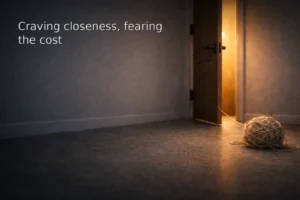
Because the flip keeps happening, right in the moment you thought things were finally okay. If you find yourself in a loop where closeness appears and then something within you tightens, this is worth reading. You should walk away with three things you can use immediately: a name for the pattern that matches what you experience, a clearer picture of the exact moment it turns from comfort to threat, and a decision point you can recognize before you withdraw, lash out, go numb, or start rewriting the relationship in your head. I am writing it this way because most posts about fearful avoidant attachment describe traits and categories. In my work, and in the research I keep circling back to, it behaves more like a fast safety response. A switch. Sometimes a sequence. Once you see the switch, you stop doing that painful debate with yourself about whether you really care, whether you are secretly avoidant, whether you are too needy, whether you are “bad at relationships.” You start tracking what actually happens.
The question underneath it, the one I keep coming back to, is simple and annoying.
When closeness feels both good and dangerous at the same time, do you continue to use distance as your primary safety measure, or do you build a different kind of safety that can include connection without compromising your own well-being?
That is the struggle. That is the decision. The transformation is smaller than people want. It is not becoming secure overnight. It is catching the step back moment early enough that you have a choice.
What Fearful-Avoidant Attachment Really Feels Like (In Real Life)
The problem is not that you do not want intimacy. Most people I have worked with who fit fearful avoidant attachment want it badly. They just do not want what intimacy used to mean.
A lot of this sounds like a contradiction because it is.
You may experience:
- Craving connection and fearing dependence at the same time
You want closeness, but once you feel attached, you also feel exposed.
I hear versions of, “I want you, but I do not want to need you.” - Mistrust and longing in the same breath
Kindness can feel suspicious. Consistency can feel unfamiliar.
Not because you are cynical. Because your system is scanning for shifts. - High sensitivity to rejection and high sensitivity to engulfment
People focus on the fear of abandonment. With fearful avoidant attachment, it is often both.
Fear of abandonment: “You will leave when I need you.”
Fear of engulfment: “If I get close, I will lose myself.” - Sudden shifts: intensity to distance
You can be warm, expressive, deeply bonded, and then something crosses a threshold and you go quiet, cold, numb, or “fine.”
Partners read it as punishment. Friends read it as flakiness. Coworkers read it as an attitude. You might read it as proof that you are incapable of staying.
I used to think these flips were mostly about thoughts. Now I am less sure. The more I read and the more I sit with people in real time, the more it looks like emotion regulation and threat systems leading, cognition following. There is a long line of attachment work tying insecurity to emotion regulation differences. Mikulincer (2019) is one of the overviews I still quote to myself. Not because it is comforting. Because it matches what I see.
Lived examples (romance, dating, friendship, and “calm feels unsafe”)
What I want here is not “examples” like a workbook. More like snapshots. The exact kind of moment people describe with embarrassment because it sounds irrational out loud.
In dating
In dating, it can be almost predictable. A great conversation. A good night. That feeling of being seen. Then the next day, irritation, overwhelm, doubt. “Maybe I am not ready.” “Maybe they are not right.” You create distance.
Sometimes it is not even a full day later. It is the next text. They send something simple, “Had a really nice time.” You read it, your stomach drops, and you suddenly want to correct them. Or you want to go quiet. Or you feel this weird urge to pick a fight about something small, like the wording, like the timing, like the emoji. Not because the emoji matters. Because closeness just got confirmed. Now it is real.
I have seen people start “cleaning up” their story at this point. They decide the person is boring. Or too into them. Or not into them enough. Or secretly unsafe. Sometimes that is true. But the speed of the conclusion is the clue. The speed is often the nervous system.
In long-term relationships
In relationships, reassurance lands in two steps. First, relief. Then a tightness that feels like dependence. “I hate that I needed that.” Sometimes a flash of, “Now they have power.”
This can show up in mundane places. Not dramatic places. A partner offers help with something you usually do alone. You say yes. They do it. You feel cared for. Then later, you feel irritated, and you cannot explain why. You start looking for what they did wrong. You find something. You make it about that. Under it is often a simpler feeling: I let you in, and now I feel exposed.
I have watched couples get stuck on the same argument for months, and when we slow it down, it is not really about chores or tone. It is about safety and control. Who is allowed to need? Who is allowed to say, “I am scared.” Some people would rather be angry than scared. It feels cleaner.
In friendships
In friendships, you open up, and later you feel exposed. You disappear. Not because you do not care. Because vulnerability registers as risk.
This is the pattern I hear a lot: a friend invites real closeness, you take the step, you share something personal, and then on the way home, you start regretting it. You repeat what you said. You imagine how it sounded. You imagine how they will use it. You wake up the next day and decide you overshared. So you avoid them, but politely. “Busy week.” “Sorry, just seeing this.”
Sometimes the friend reaches out more. That can feel sweet. It can also feel like pressure. And then the push-pull dynamic starts.
In family relationships and caregiving
In family relationships, it can be quieter. An adult child visits a parent and suddenly feels like a teenager again. They get affectionate, then snappish. Or they agree to help, then feel trapped, then stop answering messages. Or they show up for a sibling’s crisis and then ghost for a week because being needed feels like a hook.
What surprises people is how fast the “old role” returns. You walk into the house, and your body remembers. You are five again, or fifteen again. You are the fixer, the peacemaker, the one who does not need anything. Or you are the one who gets judged. It is not always about what the family is doing now. Sometimes it is. But sometimes it is the emotional memory.
I have seen this in caregiving situations,s too. Someone steps in for a grandparent or a parent. They feel devoted. Then they feel swallowed. Then they feel guilty for feeling swallowed. Then they disappear for a day and hate themselves for it. That guilt cycle is its own kind of trap.
In school, training, mentorship, and authority
In school or training settings, I have seen it show up as a student who wants mentorship and then cannot tolerate feedback. They ask for help, get help, then feel ashamed and avoid the instructor. Not laziness. A threat response dressed up as “I should do this alone.”
The tricky part is that it can look like confidence from the outside. The person is capable. They are smart. They do not “need” help. And that becomes the identity. Then, the moment they do need help, it is not just help. It is exposure. It is the risk of being seen as dependent, messy, and not in control.
In workplaces and teams
This shows up in teams in small ways. Someone says, “Can you take the lead on this?” The person says yes. They deliver. Everyone praises them. Then they get distant. They miss meetings. They start being sharp. Or they quietly disengage and start applying for other jobs.
It can also show up as a strong reaction to a warm manager. Some people feel safer with formal distance. Warmth feels like an obligation. Or like the start of control. I am not saying that is always wrong. Some workplaces are genuinely unsafe. But the pattern is recognizable when it repeats across different bosses, different companies, different contexts.
When calm feels unsafe
And in stable relationships, the calm itself can be the trigger. Things are consistent, and instead of relaxing you get restless or suspicious, like calm is the pause before pain. That part is hard to explain to people who grew up with steadiness. It does not sound logical. It is not logical. It is familiar.
I hear people say, “I feel like something bad is coming.” Nothing is coming. They know nothing is coming. Still the body is waiting.
This pattern creates a particular loneliness. You are not alone, but you do not feel safe being fully known.
The One Strong Idea That Explains the Pattern
Here is the idea I use as the spine when I am trying to make sense of a push pull relationship cycle.
Fearful avoidant attachment is not fear of love. It is fear of what closeness might cost you.
That cost is usually not romantic. It is practical and bodily.
- losing control
- being seen too deeply
- being rejected after opening up
- being trapped or consumed
- relying on someone who might change
This is why “just communicate” advice collapses. It assumes the problem is a skill gap. Often it is a safety problem. The fear is not only in thoughts. It is physiological. Your body treats closeness like threat.
I am not saying the body is always right. It is often wrong in the present. But it is consistent. It is trying to keep you safe the way it learned. Messina (2024) is one of those recent reviews that basically keep repeating this theme in different languages, across different studies. Secure attachment correlates with more flexible regulation, insecurity with less. It is not destiny. It is a pattern.
This is also why you can have real tenderness and real shutdown in the same relationship. It is not fake closeness. It is not manipulation. It is a nervous system that moves faster than your values.
I used to think of it as ambivalence. Over time, it looks more like a rapid protection sequence.
Why Fearful-Avoidant Attachment Develops (Without Pathologizing You)
Fearful avoidant attachment tends to form when closeness and threat are paired early. Not always through obvious trauma, though sometimes yes. Often, through unpredictability that a child cannot name.
Common roots include:
- inconsistent care or emotional unpredictability
Warm one day, distant the next. Loving sometimes, rejecting other times. - emotional or relational instability
Homes where emotions were volatile, unsafe, shaming, or ignored. - closeness paired with fear, shame, or confusion
Connection had consequences. Criticism, pressure, humiliation. Emotional role reversal. - the nervous system learning: closeness equals risk
When care does not feel reliable, the body adapts. It becomes alert.
I have to be careful here because it is easy to tell a neat origin story and pretend we know. We do not always know. People have patchy memory. Families have secrets. And research can show patterns without predicting individual lives.
Still, the broad map is not imaginary. John Bowlby, 1988, framed attachment as a system for seeking security through caregivers. Mary Main, 1990, pushed attachment work into more complex territory where fear can coexist with attachment needs. Lyons-Ruth, 1999, wrote about disrupted caregiving and later regulation patterns in ways that keep echoing in adult relationships. Sue Johnson, 2008, made attachment feel visible in the room through emotionally focused therapy, especially around repair.
More recent work on disorganized attachment in infancy keeps warning clinicians not to treat these patterns like fixed traits, and not to flatten them into “trauma equals disorganization.” Granqvist, 2017, is the review I remember for that, because it reads like someone trying to stop a field from oversimplifying its own language.
It is not about turning your life into theory. It is about realizing there is a map at all.
Common Fearful-Avoidant Relationship Patterns (Push–Pull Explained Clearly)
This cycle looks confusing from the outside and internally it can still feel confusing, but there is a logic. Approach for connection. Retreat for safety.
Push–pull closeness
You move toward someone, feel connection, then feel overwhelmed and retreat.
Example: you send the text. They respond warmly. Your chest tightens. Suddenly you want space.
This can also show up in family caregiving. A parent gets sick, you step in, you feel useful and connected, then you feel swallowed. You start avoiding calls. You tell yourself you are busy. Maybe you are, but the timing is specific.
Testing + withdrawing
You may test the bond indirectly, then withdraw when you feel too exposed.
Example: you say “It is fine” when it is not. If they do not notice, you feel unseen. If they do, you feel unsafe being known.
I see versions of this in workplaces too. Someone wants recognition, then cannot tolerate being seen. They do great work, get praise, then become unreachable, or suddenly critical of the team, or start planning an exit.
Difficulty trusting support
You want reassurance. When you get it, you doubt it.
Example: they say “I am here.” You feel relief, then you think, “They will change their mind.”
This one can be brutal in parenting. A child reaches for comfort, takes it in, then pushes away, sometimes literally. Not because the child is bad. Because comfort and threat got linked somewhere early. Same mechanism, different age.
Emotional intensity then distance
Intensity can create bonding quickly, but closeness can trigger threat once it becomes real.
Difficulty feeling safe long-term
Steadiness can feel unfamiliar. Calm can feel like waiting for loss.
One thing I have noticed is that people often blame the other person for the flip. Sometimes the other person is truly unreliable. Sometimes the other person is fine. The flip still happens. That is the part that feels humiliating. “Why did I do that when nothing was wrong.”
How Fearful-Avoidant Attachment Shows Up in Everyday Life
I used to talk about this as an “adult relationships” thing because that is where people notice it most, and because the stakes get louder. But the same push pull pattern shows up anywhere closeness, dependence, responsibility, or being seen is on the table. Family. Parenting. Siblings. Friend groups. School. Workplace teams. Even community roles where people start relying on you. The context changes, the nervous system pattern often does not.
In romantic relationships
Fearful avoidant attachment can look like:
- strong chemistry followed by withdrawal
- wanting commitment but feeling trapped by it
- avoiding conflict until it bursts
- craving reassurance but struggling to receive it
This is not about not loving. It is often loving intensely, then feeling afraid of what love exposes. Dependence. Need. The possibility of loss.
And it shows up in very ordinary places. Someone says, “I miss you.” You feel warmth, then a quick tightening. You want to reply, then you want to correct them, or delay, or change the subject. Later you tell yourself it is no big deal. But your body already filed it under closeness.
In friendships
You may keep friendships light because depth feels risky:
- disappearing after vulnerability
- pulling back after closeness
- avoiding being fully known
I see this show up when someone shares something real, then later says, “I should not have said that.” Then the person avoids the friend, not the topic. The whole bond feels risky.
Sometimes the friendship is perfectly safe and the withdrawal still happens. Sometimes the friendship has subtle power dynamics and the withdrawal is not irrational. That is the hard part, sorting which is which without turning everything into either self-blame or suspicion.
In work & teams
This pattern can show up at work too:
- strong independence, difficulty asking for help
- sensitivity to criticism
- discomfort with authority closeness, mentorship can feel like control
- conflict avoidance
It can look like competence with a private stress response underneath. People do great work and still feel braced. Workplace dynamics can trigger family dynamics in quiet ways.
One version I see a lot is someone who wants recognition, then cannot tolerate being seen. They deliver something excellent, get praise, then go distant. Miss meetings. Get sharp. Or quietly disengage and start planning an exit. It reads like attitude from the outside. Internally it is often exposure.
With parents, siblings, and family roles
This is where the pattern can hide in plain sight because people call it personality, or “that is just how our family is.”
With parents, it can look like being warm for a moment and then getting snappish or flat. You visit, you care, you feel connected, then you feel cornered into an old role. The responsible one. The invisible one. The one who never needs anything. Or you are the one who gets judged. Then you pull back, sometimes by picking a fight, sometimes by becoming “busy,” sometimes by leaving early and calling it practicality.
With siblings, it can look like closeness that spikes in crisis and disappears when things settle. You show up for an emergency. You become the fixer. Then when your sibling wants regular contact, you feel pressure and start avoiding. Or you feel jealous of their needs and ashamed of the jealousy. Then you go quiet.
With family group chats, it can be almost comedic. Someone sends a caring message, you feel fond, then you feel the urge to escape the whole thread. You tell yourself you will reply later. Later never comes. Then guilt, then more avoidance.
With children, parenting, and being needed
This is the one people do not like to talk about, but it matters. Not because it means you are a bad parent. Because being needed can be the trigger.
A parent can be deeply loving and still feel flooded by the intensity of a child’s attachment needs. The child reaches for comfort, takes it in, then pushes away, sometimes literally. Not because the child is bad. Because comfort and threat got linked somewhere early. Same mechanism, different age.
Or the parent is the one who flips. The child clings, the parent feels tenderness, then suddenly feels trapped and wants space. The parent might get brisk, overly practical, or distracted. Later, the parent feels guilt and becomes extra accommodating. That oscillation can be confusing for everyone.
In families where one child is anxious and another is avoidant, the fearful avoidant caregiver can end up pulled in both directions, wanting closeness and wanting escape. I do not have clean answers for how much is attachment pattern versus exhaustion versus lack of support. Usually it is all of it.
And yes, I know the old heading used to say “adult life.” But the pattern does not suddenly appear at 18. I have seen versions in teenagers who are desperate for belonging and terrified of being judged. In kids who cling and then push away. In people who care for aging parents and feel both devotion and resentment. The contexts change. The push pull stays.
Signs You May Have Fearful-Avoidant Attachment (Non-Diagnostic Checklist)
If you have ever asked, “Do I have fearful avoidant attachment,” this list is a mirror. Not a label.
You may relate if:
- closeness feels both comforting and overwhelming
- you want reassurance but struggle to receive it
- you withdraw after emotional intimacy
- trust feels fragile even in stable relationships
- fear of abandonment and fear of engulfment both show up
- you feel safest when you can leave first
- you over-read tone, timing, micro-signals
- you oscillate between “I need you” and “I cannot do this”
Fearful avoidant attachment is often marked by a push pull dynamic: wanting closeness while also fearing it.
Fearful-Avoidant vs Disorganized Attachment (Clear, Gentle Distinction)
People ask this often. Partly because the internet blurs terms. Partly because many people feel like a mix.
Where they overlap:
- fear mixed with closeness
- inconsistency in attachment behavior
- a history where connection did not reliably equal safety
A helpful difference in plain language:
- fearful avoidant attachment can be more relationally aware. You feel the contradiction and can often describe it.
- disorganized attachment can feel more chaotic or freeze-based. The system may swing into shutdown, dissociation, or abrupt contradiction that feels less integrated.
Fearful avoidant attachment and disorganized attachment can overlap, but they are not always the same pattern.
I do not love overconfident sorting here. Some people move between patterns depending on stress level. Some people look fearful avoidant in romance and more secure in friendships. Some people look fine until caregiving or workplace authority triggers old stuff. The point is less taxonomy, more recognition.
Can Fearful-Avoidant Attachment Heal or Change?
Yes, in the sense that learned patterns can shift. No, in the sense that it is not a simple decision.
The pathway is usually not “think differently.” It is learn safety differently.
The most consistent healing elements include:
- repeated safe connection (not perfect connection)
The bond becomes safer through many small experiences of being met. - relational repair
Conflict does not have to mean abandonment. Repair teaches the system that connection can survive strain. - body-based regulation
When fear is physiological, insight alone is not enough. Regulation creates space to choose differently.
Practical examples people actually use: slowing the breath, grounding through sensory cues, tracking body signals, pacing intimacy rather than all at once vulnerability.
I will add a few more here because people always ask what “regulation” means in the moment, and I do not love vague language. Some people keep a small script on their phone for the exact moment they want to disappear: “I am activated. I need 20 minutes. I will come back at 7:30.” Some people do a simple body check before replying to a message: jaw, chest, stomach, hands. If the body is braced, they do not hit send. Not because avoidance is good. Because they have learned that braced replies often become damage.
Some people do the opposite. They practice staying. They choose one tiny form of contact that does not flood them. A short voice note. A walk with a friend instead of a long intense dinner. A boundary that prevents resentment. It is all pacing, really.
Research on attachment and emotion regulation keeps supporting the idea that insecurity relates to less flexible regulation strategies and greater stress reactivity. Eilert, 2023, is one of the reviews I remember because it pulled together physiological measures, not just self-report. Park, 2022, is another meta-analytic paper I recall because it looked at attachment insecurity and positive emotions, which sounds like a small thing until you notice how many people cannot tolerate good feelings without scanning for the drop. - self-trust + boundaries
One of the biggest shifts is learning that closeness does not require self-erasure. Boundaries can be the structure that makes intimacy tolerable.
Fearful avoidant attachment can change through safe relationships, repair, and nervous system regulation.
I feel obligated to say I do not think this happens only in therapy. Some people shift through friendships. Some shift through a partner who stays steady and does not retaliate. Some shift by leaving a chaotic relationship and watching their nervous system quiet down. I have seen that too.
And I also have to say, I do not always know which ingredient mattered most. People want a single lever. Life is not like that.
Small Signs of Healing to Look For (Realistic Progress Markers)
Healing is often quiet before it is visible:
- pausing before withdrawing
- staying present during discomfort
- asking for clarity instead of assuming
- receiving care without immediately distrusting it
- tolerating steadiness without chasing intensity
- repairing after conflict rather than disappearing
- allowing closeness while staying yourself
The goal is not becoming fearless. It is becoming less ruled by fear.
I have also seen people call healing “boring.” They say it like a complaint. And then they look relieved.
One more thing I notice, and I do not know if it counts as healing or just maturity. People stop trying to win the internal argument. They stop asking “who is right.” They start asking “what happens if I do the same thing again.”
Reflection Questions That Help You Decide (Not Just Understand)
If you are stuck in the loop, these questions are usually the ones that move something:
- When do I withdraw most, after closeness or conflict
- What part of closeness feels most threatening, being seen, being needed, losing control
- What do I assume will happen if I let someone in
- Where in my life do I already feel safe, and what creates that safety
- What would it look like to choose closeness in a paced way rather than all or nothing
This is where the decision becomes real. Do I keep using distance as my main form of safety, or do I learn a safety that includes connection.
And the “decision point” is not always about staying close. Sometimes the decision is choosing distance on purpose, cleanly, without punishment. Sometimes it is admitting that the relationship you are in is actually unsafe, and your nervous system is not being irrational. That is a hard one. People do not like it when I say that. I get it. It complicates the story.
Questions People Often Ask
Is fearful-avoidant attachment the same as disorganized attachment?
Not always. They can overlap, but fearful avoidant often presents as push pull with more awareness, while disorganized can involve more freeze or shutdown and less integration.
Why do I push people away even when I care?
Because closeness can trigger threat responses that are older than the relationship. Creating distance can be an attempt to regain safety and control.
Can you move from fearful-avoidant to secure attachment?
Yes. Most people shift through repeated safe connection, repair after conflict, boundaries, and regulation, not by forcing vulnerability.
Do fearful-avoidant people fall in love?
Yes, often deeply. The challenge is not love. It is staying present when love makes you feel exposed.
Why does fearful-avoidant attachment show up more in some relationships?
Different partners trigger different fears. Inconsistent partners can trigger pursuit. Stable partners can trigger fear of dependence.
Fearful avoidant attachment often shows up differently depending on the relationship dynamic and emotional triggers.
The Shift That Creates Transformation
The reframe that holds up, across dating, long-term relationships, friendships, caregiving, and workplace dynamics, is this:
You are not afraid of connection. You are afraid of the version of connection that once hurt you.
When you start noticing the withdrawal moment in real time, when your body tightens, when your thoughts rush, when you suddenly want distance, you get back something the pattern takes away. Choice.
And I do not mean the choice to be brave. I mean the choice to slow down and ask, “What is the cost my body thinks is coming.” Sometimes you need space. Sometimes you need a repair conversation. Sometimes you need to stop dating people who replicate your childhood. Sometimes you need to admit that the intensity was the hook. I have watched people resist that sentence for months.
I have also watched people misapply the reframe and stay too long in relationships that were genuinely coercive or chaotic, because they assumed every alarm was “just attachment.” That is the tradeoff. If you make everything internal, you miss the external. If you make everything external, you never see the pattern. The work is sorting, case by case, week by week, with imperfect information, and sometimes you get it wrong and you have to backtrack
References
- Bowlby, J. (1988). A Secure Base: Parent-Child Attachment and Healthy Human Development. Basic Books.
- Main, M., & Solomon, J. (1990). Procedures for identifying infants as disorganized/disoriented during the Ainsworth Strange Situation. In M. T. Greenberg, D. Cicchetti, & E. M. Cummings (Eds.), Attachment in the Preschool Years: Theory, Research, and Intervention (pp. 121–160). University of Chicago Press. (SCIRP)
- Lyons-Ruth, K., & Jacobvitz, D. (1999). Attachment disorganization: Unresolved loss, relational violence, and lapses in behavioral and attentional strategies. In J. Cassidy & P. R. Shaver (Eds.), Handbook of Attachment: Theory, Research, and Clinical Applications (pp. 520–554). Guilford Press. (The Open University)
- Johnson, S. M. (2008). Hold Me Tight: Seven Conversations for a Lifetime of Love. Little, Brown and Company. (SCIRP)
- Mikulincer, M., & Shaver, P. R. (2019). Attachment orientations and emotion regulation. Current Opinion in Psychology, 25, 6–10. doi:10.1016/j.copsyc.2018.02.006 (ScienceDirect)
- Granqvist, P., Sroufe, L. A., Dozier, M., Hesse, E., Steele, M., van IJzendoorn, M. H., Solomon, J., Schuengel, C., Fearon, P., Bakermans-Kranenburg, M. J., Steele, H., Cassidy, J., Carlson, E., Madigan, S., Jacobvitz, D., Foster, S., Behrens, K., Rifkin-Graboi, A., Gribneau, N., et al. (2017). Disorganized attachment in infancy: A review of the phenomenon and its implications for clinicians and policy-makers. Attachment & Human Development, 19(6), 534–558. doi:10.1080/14616734.2017.1354040 (VU Research)
- Messina, I., Calvo, V., & Grecucci, A. (2023). Attachment orientations and emotion regulation: New insights from the study of interpersonal emotion regulation strategies. Research in Psychotherapy: Psychopathology, Process and Outcome, 26(3), 703. doi:10.4081/ripppo.2023.703 (PMC)
- Eilert, D. W., & Buchheim, A. (2023). Attachment-Related Differences in Emotion Regulation in Adults: A Systematic Review on Attachment Representations. Brain Sciences, 13(6), 884. doi:10.3390/brainsci13060884 (MDPI)
- Park, Y., Sanscartier, S., Impett, E. A., Algoe, S. B., Leonhardt, N. D., Schrage, K., Carmichael, C., Collins, N., Conte, F., De Rosa, O., Ficca, G., Fredrickson, B. L., Harris, P., Keltner, D., West, T. N., & MacDonald, G. (2023). Meta-analytic evidence that attachment insecurity is associated with less frequent experiences of discrete positive emotions. Journal of Personality, 91(5), 1223–1238. doi:10.1111/jopy.12796 (PMC)