

The question lingers for days, tucked behind school runs, lunchboxes, wet towels on the floor, and the dull weight of unspoken expectations.
Where am I in all this?
But instead of answers, she reaches for the only thing she believes she can still control: her food.
It feels like the start of something she calls discipline, but it becomes the first step into the emotional eating cycle that quietly shapes her days.
It begins quietly, almost innocently, with a vow whispered to herself one morning as she pulls her hair into a tired bun.
Enough is enough.
This time, I will fix it.
She opens the kitchen cabinets not as a mother preparing meals but as someone stepping onto a battlefield she has created inside her own mind.
Rice is a big No…
Potatoes are removed.
Biryani is absolutely forbidden.
Desserts disappear from her world entirely.
Anything soft, warm, familiar, comforting
Anything that tastes like home is …… exiled without hesitation.
It feels like control, but the control is brittle and fragile.
For a week, she becomes a strict, joyless version of herself. She eats only what she believes she is allowed to eat. It is not nourishment. It is punishment wearing the mask of discipline, a form of self-denial she convinces herself is strength.
By the third day, dizziness hits her in the middle of folding laundry.
By the fifth, irritation clings to her skin, making her voice sharp and her smile forced.
By the seventh, she is hollow, surviving solely on willpower, her hunger growing louder than her thoughts.
And then it happens.
The crash.
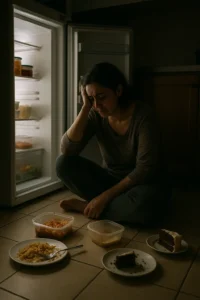
One evening, after everyone is asleep, she stands in the kitchen staring at leftover biryani. Golden. Fragrant. A plate she made with her own hands. A plate she denied herself all week.
Something inside her snaps.
The first bite is fast.
The second, desperate.
Within minutes she is eating like someone gasping for air.
A plate full of biryani.
Cake straight from the fridge.
A fizzy drink she normally saves for guests.
She is not tasting anymore. She is escaping.
When she finally stops, breathless and ashamed, the silence lands like a verdict.
What have I done?
Why can’t I control myself?
Why do I fail every single time?
She sits on the cold kitchen floor, the glow of her phone lighting her face as she scrolls.
Perfect mothers.
Smooth stomachs.
Colorful bowls of food arranged like artwork.
Women who seem born disciplined, born beautiful, born lighter.
Transformation reels.
Bright leggings.
Smiling faces doing burpees like it is effortless.
Burpees with Bagels flashes across her feed again, the women glowing even in sweat.
She mutters bitterly, heat rising in her chest.
Easy for them. They do not live my life.
She scrolls faster, as if speed will shield her from the sting of comparison.
But bitterness, like hunger, has a way of finding her.
Deep beneath the scrolling and shame, a familiar heaviness returns.
She does not feel weak because she binged.
She feels weak because she is trapped — between expectations, the internet’s noise, and the emotional overwhelm that defines so much of motherhood.
Restrict.
Starve.
Crash.
Binge.
Regret.
Restart.
Repeat.
The emotional eating cycle loops until the days blur together, and the guilt feels older than she is.
Later that night, lying in bed pretending to sleep, her body heavy and full, her heart aching, the small voice returns.
Soft.
Steady.
Unyielding.
Is this the only way you know how to take care of yourself?
She does not know the answer.
Not yet.
But once again, the question refuses to let her go.