
You probably do not need another soft, vague article telling you to “be more understanding.” You need to know whether empathy can actually be learned, what helps in real life, and what sounds good in theory but falls apart the minute somebody feels criticized. That is the problem this piece is solving.
Yes, empathy can be learned. Not in a magical personality-overhaul way. In a practical, trainable way. Davis, in 1983, argued that empathy is not one single thing. Decety and Jackson, in 2004, made a similar point. It is a cluster of abilities, things like perspective-taking, emotional attunement, empathic accuracy, and emotion regulation. Some people are strong in one area and clumsy in another. Which is actually good news, because skills can be practiced. Zaki, in 2019, made a similar case, and honestly, that matches what I have seen in real rooms with real people.
And one more thing, because this gets confused all the time. Emotional shutdown is not always the same thing as low empathy. Sometimes it is defense. Sometimes it is overloaded. Sometimes it is attachment panic wearing a flat face. Singer and Klimecki, in 2014, made a distinction here that I still think is useful. Empathy can tip into personal distress when there is no regulation around it. Some people are not lacking feeling. They are swamped by it, then they go numb.
That is really the question under all of this. Can empathy be learned? More like: what do you do when you care about people and still keep missing them? Or when someone keeps telling you that you are cold, dismissive, self-focused, impossible to reach, and part of you knows that is not the whole story.
What I keep coming back to is pretty simple. Empathy works less like a trait and more like a set of capacities that go offline under pressure. That changes the whole conversation. It takes people out of the dead-end question, “Am I an empathic person or not?” and moves them toward a more useful one: which part of empathy disappears first for me when I feel stressed, ashamed, rushed, or sure I am right?
That is also why this tends to help more than the usual advice. A lot of posts on empathy stay airy. They tell you to imagine other people’s feelings. Fine. But that is not the hard part. The hard part is doing that when you feel accused, flooded, defensive, numb, or quietly resentful. That is where things usually break.
Can empathy be learned?
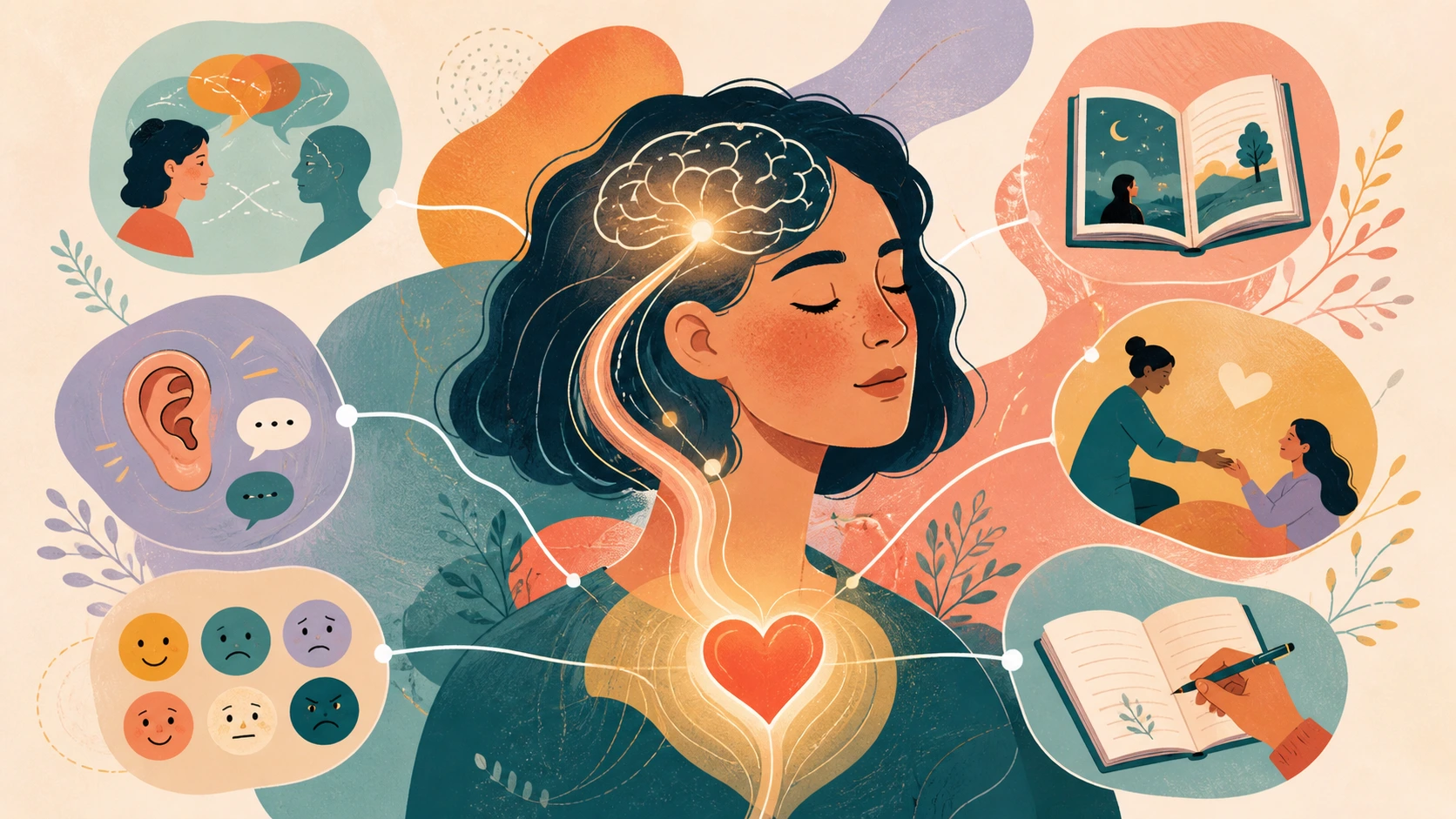
Yes. Most adults can strengthen empathy through repeated perspective-taking, active listening, affect labeling, reading fiction, volunteering, and reflection. The change is usually gradual. Still real. Still worth doing.
Perspective-Taking
Perspective-taking is the part of empathy that asks, What is this like from the other person’s side? No, do I agree with them? Aren’t they objectively right? Just what might make their reaction make sense from inside their own nervous system, history, and expectations?
This is usually where I start, partly because it is concrete. It gives empathy somewhere to stand.
It also sounds easier than it is. Most people can do perspective-taking when they are calm enough. They lose it when they feel criticized, embarrassed, dismissed, or backed into a corner. Then the Mind narrows. Fast. Mentalizing drops. Self-protection takes over. You can watch it happen in a room.
A practical exercise here is the three-view rewrite:
- Write the conflict from your point of view.
- Write the same conflict from the other person’s point of view.
- Write it again as a neutral observer who likes both of you.
This works because it interrupts certainty. And certainty is often the thing blocking empathy.
One quick example. A couple once spent ten full minutes arguing in their kitchen about a half-loaded dishwasher on a Wednesday night around 9:40, not because either of them cared that much about plates. He heard, “You are failing again.” She heard, “You will always carry this alone.” Same dishwasher. Same conversation. Different meanings entirely. Once they could see the private story each person had attached to that tiny moment, the heat came down a little. Not instantly. But enough.
That is usually the shift. Empathy gets stronger when you stop asking, “What is wrong with this person?” and start asking, “What am I not seeing yet?”
And no, perspective-taking does not mean giving up your own point of view. It just means yours is not the only one with depth.
Active Listening
Active listening gets recommended all the time. For good reason. But people usually hear that phrase and think it means repeating someone’s words back to them in a calm voice. That is not quite it.
Active listening means regulating yourself enough to stay curious while another person is talking.
That is harder than it sounds. Sometimes much harder.
I used to think reflective listening did more of the heavy lifting here. Then I watched too many people say all the right words in a flat, dead way.
“It sounds like you felt hurt.”
Okay. Maybe accurate. But they were still waiting to correct, rebut, or defend themselves. The script was fine. The contact was not. So I changed my mind a bit. Not because the research was wrong. More because the way people use the skill in real life is often thinner than the theory.
The listen, reflect, check exercise.
- Let the other person finish one full thought.
- Reflect the meaning, not just the words.
- Check whether you got it right.
A line that often works is:
“It sounds like you felt dismissed, not just upset. Is that right?”
That last part matters. Is that right? That is where empathic accuracy gets built. You are not performing understanding. You are checking it.
One small rule helps more than people expect: delay your advice by 30 seconds.
Thirty seconds does not sound like much. In a tense conversation, it is a lot. That pause tends to show you whether you are listening to understand or just waiting for your turn. It also lowers the odds that you will rush into fixing, minimizing, or explaining before the other person feels understood.
A lot of empathy failures are not cruelty. They are speed.
“Name the Feeling”
This one looks small. It is not.
A lot of empathy problems are actually emotion-language problems. People do not know what they are feeling, so everything gets flattened into “stress,” “anger,” or “fine.” Then they do the same thing to other people.
Lieberman and colleagues, in 2007, found that putting feelings into words can shift emotional reactivity. I still think about that study because affect labeling sounds almost too simple until you watch someone stop spiraling once the feeling gets named correctly.
Try this once or twice a day:
Right now I feel ______. Under that, I may also feel ______.
Not just angry. Maybe disappointed. Embarrassed. Helpless. Rejected. Jealous. Relieved, which people weirdly forget is a feeling.
Then do the same thing with someone else:
- What do I think they are feeling?
- What clues am I using?
- What might I be assuming too fast?
This is where cognitive empathy tends to sharpen. People often realize they were reacting to tone while missing the actual feeling underneath.
I have seen this change a conversation almost embarrassingly fast. Someone thinks their partner is overreacting. Then they slow down long enough to realize the feeling is not anger at all. It is humiliation. Or panic. Or grief that came out sideways because grief feels too exposed.
That becomes a different conversation.
And it answers one of the quieter questions people usually have here: what if I care, but I still keep misreading people? In a lot of cases, caring is not the problem. Emotional granularity is.
Reading Fiction
This one gets underestimated because it sounds softer than the others.
Reading fiction can help because it places you inside other minds. You spend time with motives, blind spots, contradictions, losses, and private meanings that are not your own. Mar, Oatley, and Peterson, in 2009, wrote about this. Kidd and Castano, in 2013, pushed the conversation further when they found short-term theory-of-mind gains after reading literary fiction.
I would not oversell it, though.
A few years ago, I was probably a little too enthusiastic about this one. Then I watched plenty of emotionally defensive people read smart novels and stay just as rigid in their actual relationships. So no, fiction alone does not make someone empathic. It seems to help most when the reading gets reflective, when you stop and ask what a character is protecting, what they keep misreading, what they want, what they cannot tolerate.
A better way to use it:
- Pick a novel with strong character interiority.
- Pause after a conflict scene.
- Ask: What does each person want here?
- Ask: What are they protecting?
- Ask: Where am I judging too fast?
It is basically perspective-taking practice in disguise.
And it matters because empathy depends on complexity. The faster you flatten people into heroes, villains, manipulators, victims, or “just difficult,” the less empathy you are likely to have access to when things get messy.
Volunteering
Empathy also gets built through contact.
Not abstract opinions. Not hot takes. Actual contact.
Volunteering helps because it reduces emotional distance. Other people become harder to keep theoretical once you have spent time around them in ordinary, human ways. That matters more than people think.
The caveat matters too. Volunteering does not help much if it becomes a moral performance. People can absolutely turn service into ego management. You have probably seen that. I have.
The better frame is humility. Show up. Pay attention. Let another person’s reality become harder to stereotype.
This can be small:
- tutoring
- visiting older adults
- helping at a food pantry
- supporting a community center
- joining a local mutual-aid effort
Batson, in 2011, wrote about empathy and prosocial motivation, and one thing that keeps holding up in real life is this: direct contact changes the story your mind tells. It gets harder to reduce people to categories when you have actually spent time with them as people.
Still, boundaries matter here. If your allostatic load is already high, overcommitting will not make you more empathic. It will make you thinner-skinned and more brittle. Good boundaries protect empathy. They do not cancel it.
Reflection Prompts
This is where the gains tend to stick.
Without reflection, people try empathy exercises for a week and then slide right back into certainty, speed, projection, and defensive attribution the minute stress comes back online. Which it does.
Reflection is what turns a decent exercise into an actual pattern shift.
Here are the prompts I would actually use:
- When did I feel most understood recently? What exactly did that person do?
- When did I fail to understand someone? What got in the way?
- Which emotions in other people are hardest for me to tolerate?
- Who do I judge quickly, and what story do I tell about them?
- What assumptions do I make about people whose choices differ from mine?
- In conflict, do I become more focused on being right than on understanding?
- What would empathy look like here without losing my boundaries?
If I had to reduce the whole thing to one line, it would probably be this: empathy gets stronger when you become less reactive, more precise with feelings, slower with assumptions, and more willing to test your interpretation instead of trusting it just because it feels true.
That is usually the transformation people are actually after. Not becoming endlessly selfless. Becoming easier to be close to.
FAQ
Yes. For most people, empathy is not fixed. Adults can strengthen perspective-taking, emotional labeling, listening, and empathic accuracy with practice.
The fastest useful start is usually a mix of perspective-taking and active listening. In plain language, slow down your assumptions and reflect on what you heard before you argue your point.
Usually, yes. Naming feelings can lower emotional reactivity and improve clarity, which makes it easier to understand yourself and other people.
Sometimes. It can strengthen perspective-taking and theory of mind, especially when you read reflectively. Helpful, yes. Magical, no.
Absolutely. Healthy empathy is not over-functioning, rescuing, or absorbing everyone else’s distress. Good empathy includes limits.
Final Thoughts on Why Empathy Can Be Learned
So, can empathy be learned?
Yes. Usually slowly. Usually awkwardly. Usually, with more repetition than people want.
But yes.
Not because people become saints. Because they become more curious. Less certain. More willing to name what is happening. More able to sit with another person’s internal reality without instantly correcting it, fixing it, or defending against it.
That is what tends to change first. Quietly, usually. Then other things start moving around it.
If repeated disconnection, emotional shutdown, or relationship strain keep showing up and are affecting daily life, it may be worth talking with a licensed therapist.
Batson, C. D. (2011). Altruism in Humans. New York: Oxford University Press.
Davis, M. H. (1983). Measuring individual differences in empathy: Evidence for a multidimensional approach. Journal of Personality and Social Psychology, 44(1), 113-126.
Decety, J., & Jackson, P. L. (2004). The functional architecture of human empathy. Behavioral and Cognitive Neuroscience Reviews, 3(2), 71-100.
Kidd, D. C., & Castano, E. (2013). Reading literary fiction improves theory of mind. Science, 342(6156), 377-380.
Lieberman, M. D., Eisenberger, N. I., Crockett, M. J., Tom, S. M., Pfeifer, J. H., & Way, B. M. (2007). Putting feelings into words: Affect labeling disrupts amygdala activity in response to affective stimuli. Psychological Science, 18(5), 421-428.
Mar, R. A., Oatley, K., & Peterson, J. B. (2009). Exploring the link between reading fiction and empathy: Ruling out individual differences and examining outcomes. Communications, 34(4), 407-428.
Singer, T., & Klimecki, O. M. (2014). Empathy and compassion. Current Biology, 24(18), R875-R878.
Zaki, J. (2019). The War for Kindness: Building Empathy in a Fractured World. New York: Crown.