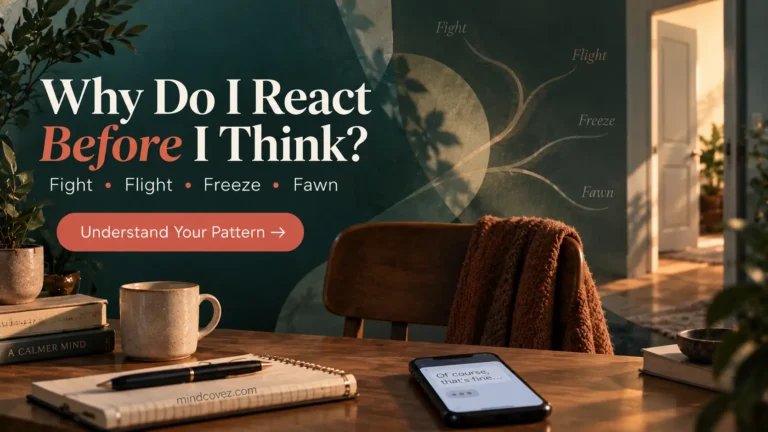

Have you ever replayed a moment in your head, an email you read too quickly, a tone you took the wrong way, a conversation where your chest tightened, and your mind went blank, and thought, “Why did I react like that?” If that question feels familiar, this is worth reading. Not because you need more willpower, but because there’s usually a very real brain-and-body thing happening underneath it. Once you can name that thing, you can often catch it earlier. Not always. But earlier than you did last time.
This post is written for one specific moment: when emotions spike so quickly that calm thinking feels unavailable. A lot of posts explain the amygdala clearly, as it lives in a diagram. This is for the moment it shows up in the middle of your day. Halfway through a conversation. In a crowded shop. In front of your inbox.
I’ve worked around that moment for years, and I still get caught off guard by how ordinary the triggers can be. That part still annoys me a little, honestly.
It helps to hold three things in mind during an amygdala hijack:
- The pattern has a name (amygdala hijack)
- There’s a “flip” you can learn to recognize (threat system online, calm thinking offline)
- There’s usually a decision point (react automatically, or pause long enough to regulate and choose your response)
The core question we’re answering is the decision that creates a real transformation:
When your brain says “danger,” will you react automatically, or pause long enough to regulate and choose your response?
Small calm is still calm. And it builds.
What you’ll learn (and what will change for you)
In this post, you’ll learn:
- What an amygdala hijack is (in plain language)
- Why does it happen so suddenly
- common symptoms in the body and mind
- real-life triggers and examples
- calming techniques that work in the moment
- daily habits that help your brain stay calmer over time
The one strong idea that makes everything else make sense
Here is the main takeaway: the thing I come back to when someone feels embarrassed by what they said, how they froze, or why they could not “just calm down”:
An amygdala hijack is not a character flaw. It’s a nervous-system survival response, and you can interrupt it.
I did not land there from a single paper. It was repetition. Patterns. The same story told in different outfits.
A harsh tone at work. A late reply from a partner. A child crying in a way that drills into your ribs. A crowded place where your chest tightens before you even pick a direction.
Daniel Goleman used the phrase “amygdala hijack” in Emotional Intelligence back in 1995, and yes, the phrase can feel pop-psych now. Still, the basic clinical reality holds.
When threat circuitry is hot, reasoning gets harder to access. People do not suddenly become “irrational” as a personality trait. Something flips.
I’ve noticed the reaction often arrives before meaning. Body first, story second. Then the story shows up, very convincing, as if it were always the point.
I’ve watched it in session. I’ve watched it in myself. On poor sleep, too much caffeine, too many decisions, too many micro-stresses stacked.
And this is where the reframe matters, because it changes what you do next.
You’re not being dramatic. Your brain is trying to protect you.
Understanding the amygdala (in the easiest terms)
The amygdala is a small but powerful part of your brain that works like an internal smoke detector.
Its job is simple: protect you fast.
It constantly scans for danger and responds quickly, often before your thinking brain has time to analyze what’s happening fully.
That means:
- It reacts before you think
- It reacts before you reason
- It reacts before logic gets a chance to speak
This isn’t a flaw. It’s how survival works.
But in everyday life, the amygdala can sometimes interpret stress, conflict, uncertainty, or past pain as danger, even when you are physically safe. That’s why emotions can feel sudden and bigger than the situation.
Your threat system is fast. Your thinking brain is slower and more flexible. Calm happens when they work together.
Joseph LeDoux’s work in the 1990s helped me stop moralizing that speed. His descriptions of fast threat responding made it easier to say, “Of course it happens quickly.”
Later discussions got messier about tidy pathways, “high road” and “low road,” and I’m fine with the mess.
In real life, speed is still speed. People still get flooded.
What an amygdala hijack really is (simple definition)
An amygdala hijack happens when your brain’s threat system activates so strongly that it temporarily takes over your reactions and makes calm thinking much less accessible. It is sometimes described as emotional flooding or an “emotional hijack.”
It’s the moment your emotional brain says:
“Danger.”
Even if your life isn’t actually in danger.
In the moment, you’re not trying to fix your whole life. You’re trying to get calm enough to choose your next sentence.
During a hijack, your body shifts into survival mode. You may feel like:
- You can’t think clearly
- Your logic disappears
- You’re reacting automatically
- You’re not fully in control
This is not a weakness.
This is the survival system doing its job too intensely.
You’re not being dramatic. Your brain is trying to protect you.
Why does it happen so suddenly (and why “small things” feel big)
Amygdala hijacks happen more easily when your nervous system is already under pressure. This is why a “small” event can trigger a “big” reaction.
Your baseline stress is already elevated.
Common triggers include:
- lack of sleep
- overworking/burnout
- high caffeine or low food intake
- feeling criticized or rejected
- uncertainty and overthinking
- trauma history or chronic stress
- arguments, conflict, or raised voices
- sensory overload (noise, crowds, busy days)
It’s not always the situation itself.
Sometimes it’s your nervous system saying:
“I’ve had too much.”
I have mixed feelings about how often people try to “think” their way out of this once it starts. It sounds reasonable. It often fails when the body is already signaling a threat.
The American Psychological Association’s stress reports have been consistent for years in the basic idea that stress shows up in both mind and body and accumulates. People underestimate the accumulation part.
They keep looking for the one big cause and miss the slow pile-up.
For example, this could apply to someone who is generally “fine” until the fourth meeting, the second coffee, and the skipped lunch.
Then the one slightly sharp comment lands like a punch.
What happens during an amygdala hijack (the survival response)
When your brain senses a threat, it prepares you to survive. This is a stress response driven by your nervous system.
That can look like:
- Fight (arguing, snapping, blaming, anger)
- Flight (escaping, avoiding, wanting to leave)
- Freeze (going silent, shutting down, blank mind)
- Fawn (people-pleasing, agreeing to avoid conflict)
All of these are nervous-system responses, not personality flaws.
In practice, this is where consequences build.
- A fight can damage trust fast.
- Flight can create avoidance loops that shrink your life.
- Freeze can look like indifference, when it’s actually overwhelm.
- Fawn can feel “nice” in the moment, and then turn into resentment later.
This might show up with couples where one person freezes and the other fights.
The fighter escalates because silence feels like abandonment.
The freezer goes quieter because escalation feels like danger.
Neither is choosing it consciously. The system is choosing for them.
Small everyday snippets that reveal the emotional brain in action
Amygdala hijacks don’t only happen in extreme situations. They often show up in ordinary moments, especially when you’re tired, overstimulated, or already carrying stress.
Examples:
- Someone uses a harsh tone, and you instantly feel attacked. You misplace something, and panic rises.
- A short message makes you fear the worst
- A sigh from a loved one feels like blame
- A sudden noise makes your whole body jump
- Walking into a crowd makes your chest tighten
These are normal emotional responses.
Sometimes the threat response activates before your brain fully understands what’s happening.
A big feeling doesn’t always mean a big problem. It often means your brain lit up too quickly.
One concrete observation I keep seeing: the “interpretation” often arrives after the surge.
People tell me, “I knew they were mad.”
Then, slowed down, it becomes:
“My chest tightened, so my brain looked for a reason.”
That difference matters.
The second version is less accusative. More workable.
Here’s a quick real-life example with details, because this is usually how it looks. A 42-year-old project manager I worked with told me she opened an email at 9:17 a.m. on a Monday. Subject line: “Quick chat.” No greeting. No context. She had slept for five hours, had two coffees, and hadn’t eaten yet. Her heart jumped. Hands started shaking. She immediately drafted a defensive reply, then reread the email five times, looking for proof she was in trouble. Ten minutes later, her manager wrote back: “Just need your input on the timeline.” That’s the whole thing. The “danger” was her body’s certainty, not the actual message.
How an amygdala hijack feels in the body (common symptoms)
Your emotional brain communicates through physical sensation. When your threat system activates, your body often tells the truth first.
Common signs include:
- fast heartbeat
- tight chest
- shaky hands
- a drop in your stomach
- heat or chills
- foggy thinking
- urge to escape or argue
- emotional overload
- regret afterward
These aren’t character flaws.
They are survival alarms firing.
If symptoms feel extreme, happen often, or include chest pain, fainting, or feeling medically unsafe, consider professional support to rule out physical causes and to get personalized care.
I include that even when it feels awkward in a blog post.
Because sometimes “anxiety” is not only anxiety. Sometimes it is arrhythmia, thyroid issues, medication side effects, anemia, or sleep apnea.
Not in every case. Still, often enough that I do not like pretending it never happens.
Checklist: signs you’re having an amygdala hijack
Sometimes it helps to name it clearly.
You may be in an amygdala hijack if you notice:
- racing heart
- tight muscles
- shaky hands
- sudden fear
- urge to flee or argue
- tunnel vision
- emotional overload
- going blank or “mind freeze.”
- regret afterward
When you notice the early signs, you reclaim your power to choose differently.
I know that phrase can sound lofty. I mean something practical.
If you can name it early, you can do one small thing before the next sentence leaves your mouth.
Amygdala hijack vs anxiety vs panic attack (quick clarity)
People often mix these up, and it makes sense because they can feel similar.
Here’s a simple way to understand the difference:
Amygdala hijack
A sudden emotional takeover that can lead to impulsive reactions, shutdown, overwhelm, and often regret afterward.
Anxiety
Ongoing worry and anticipation about what might happen.
Panic attack
A sudden intense wave of fear with strong physical symptoms (often peaking quickly). Many people also feel a powerful sense of danger in the body, even if they’re physically safe.
If you experience intense symptoms regularly, fear you’re having panic attacks, or feel unsafe, it can help to speak with a mental health professional for personalized support.
I’m cautious here because the boundaries blur. Real people do not come in neat boxes.
Still, it’s useful to ask: is the main feature “worry over time,” “a sharp fear peak,” or “a reactive takeover that changes behavior”?
That question tends to clarify the next step.
Self-help techniques for emotional regulation (tools that work)
The goal isn’t to “never react.”
The goal is to interrupt the hijack long enough for your body to settle, so calm thinking can return.
These emotional regulation tools help calm the nervous system using breathing, grounding techniques, gentle touch, and flexible thinking.
Below are simple tools you can use immediately.
1) The Pause Technique (3–5 seconds)
What to do: Pause for 3–5 seconds before responding.
Why it helps: It interrupts the automatic reaction and gives your thinking brain time to join.
Try this: Inhale once. Exhale slowly. Then speak.
I used to underestimate how hard three seconds can be when someone is staring at you.
Three seconds is often the difference between “I regret what I said” and “I can stand by what I said.”
2) Name the Emotion (Label It)
What to do: Say quietly to yourself:
- “This is anxiety.”
- “This is frustration.”
- “This is fear.”
Why it helps: Naming what you feel can reduce intensity and bring clarity.
Try this in the moment: “My chest is tight… this is stress.”
Matthew Lieberman and colleagues were writing about affect labeling in the mid-2000s, and I remember thinking, finally, something that matches what I see.
When people put words to a feeling, the feeling often becomes more tolerable.
Not gone. Less engulfing.
3) Long Exhale Breathing (Fast Calm)
What to do: Inhale normally. Exhale twice as long.
A simple rhythm:
- Inhale 2–3 seconds
- exhale 4–6 seconds
Why it helps: Long exhales engage the calming side of your nervous system.
I’m careful about overselling breathing as a magic switch. It isn’t.
But it’s one of the most accessible levers we have. The respiratory system is one of the few places where voluntary action can shift physiology quickly.
It lands best when people stop trying to breathe “perfectly” and just commit to the longer exhale.
4) 5–4–3–2–1 Grounding
What to do:
- 5 things you can see
- 4 things you can feel
- 3 things you can hear
- 2 things you can smell
- 1 thing you can taste
Why it helps: It breaks the fear loop and brings you back into the present.
This grounding technique is especially helpful when your mind is spinning.
People sometimes roll their eyes at this one, then later tell me it worked in the grocery store line, or in the car before walking into a meeting.
The point is not elegance. The point is shifting attention from the internal threat story to the external sensory reality.
5) Hand-on-Chest Technique
What to do: Place one hand gently on your chest (or upper arm).
Why it helps: Gentle touch signals safety and can help your body soften.
Try pairing it with one slow exhale.
This is the kind of technique I once dismissed as “too simple.”
Then I watched how often people stop clenching their jaw the second they add contact.
I have mixed feelings about the way self-soothing gets mocked. The body does not care. It responds.
6) Thought Reframing (One Gentle Question)
When the brain is hijacked, it often jumps to the worst-case meaning.
Ask: “What else could this mean?”
Examples:
- “They haven’t replied.” → “They may be busy.”
- “They sounded col.d” → “They may be stressed.”
This doesn’t deny reality. It adds flexibility.
If you have a trauma history, this step can feel like gaslighting yourself. I get that.
The difference is whether it opens possibilities or shuts you up.
I’m not asking you to ignore danger. I’m asking you to check whether your mind is adding certainty where there is none.
7) The 60-Second Reset
This is a simple mini-sequence to bring your brain back online:
- 10 seconds: breathe slowly
- 10 seconds: name what you feel
- 10 seconds: relax shoulders/jaw
- 10 seconds: notice 3 things you see
- 10 seconds: choose one supportive thought
- 10 seconds: choose your next step
Even one minute can change your entire response.
I like this because it’s not one trick. It’s a sequence.
If one piece fails, another piece can still land.
How to use these tools in real time (step-by-step)
When you’re in the middle of a hijack, you don’t need perfection.
You need one small reset.
Try this 5-step approach:
- Notice the early signs of activation.
- Choose one calming technique.
- Use it for 10–30 seconds.
- Ask: “Do I feel even 5% calmer?”
- Then choose your response, not your reaction.
Small calm is still calm. And it builds over time.
The “5% calmer” question matters more than it looks like.
People wait for calm to be complete. That delay is where the damage happens.
What to say during an amygdala hijack (simple scripts)
Sometimes the hardest part is communication, especially in relationships.
Here are a few phrases that reduce conflict while you regulate:
“I’m feeling overwhelmed. Give me one minute.”
“I want to respond calmly. Let me breathe first.”
“My nervous system is activated. I’m not trying to fight.”
“I care about this. I just need a second to settle.”
“Can we pause and come back to this in 10 minutes?”
These scripts protect the connection while supporting your nervous system.
I’ve seen couples argue about whether “pause” is avoidance. Sometimes it is. Sometimes it is the only reason the conversation stays respectful.
The difference is whether you return. Ten minutes later. An hour later. Tomorrow morning.
The return is the trust.
Situational examples and simple solutions
Here are common real-life situations and what to do quickly.
Work
Sudden email → panic
Solution: slow exhale + “This is stress.”
Criticism → defensiveness
Solution: hand on chest + pause.
Relationships
Raised voice → shutdown
Solution: slow exhale + “I need a moment.”
Late reply → fear
Solution: reframe: “They are likely busy.”
Parenting
Child crying loudly → overwhelmed
.Solution: relax jaw + long exhale.
Social
Entering a crowd → chest tightness
Solution: feel your feet firmly on the ground.
Finances
Unexpected bill → panic
Solution: write one small next step.
Health Anxiety
Strange sensation → fear
Solution: hold something warm or cool and breathe slowly.
Night Overthinking
Replaying conversations → overload
Solution: 60-second thought dump on paper.
I’ve watched people treat these as separate “issues” and miss the common thread.
Different trigger, same system.
Once you see the common thread, the shame drops, and the choice shows up sooner.
How the brain learns calm (this is neuroplasticity)
Your brain changes through repetition. That’s neuroplasticity.
With daily practice:
- Your thinking brain becomes stronger
- emotional reactions become softer
- The threat response becomes less easily triggered
- recovery becomes quicker
- calm becomes more available
Your brain learns calm the same way it learns anything: with gentle, repeated action.
You don’t need to force calm.
You train it.
Norman Doidge wrote about neuroplasticity in a way that stuck with the public in 2007.
I still mention him because it helped people believe change was possible.
At the same time, I’m wary of turning neuroplasticity into a promise. The brain can change. It can also get stuck.
Sometimes the “practice” required is not a morning routine.
Sometimes it’s trauma treatment, medication, finally sleeping, or leaving a chronically unsafe environment.
Tradeoffs.
Daily emotional health habits that support calm
These habits help lower your baseline stress so your brain alarms less often, and make emotional regulation easier.
Morning habits
- Gentle stretching (release overnight tension)
- Drink water (hydration supports regulation)
- Slow breathing in the shower (starts the day grounded)
- Plan one easy win (builds control and confidence)
Daytime habits
- Slow breath before replying (less reactive conversations)
- Mini walks (release stress hormones)
- Mindful first bites of food (signals safety to the body)
- Pause between tasks (prevents overload)
- Soft voice during stress (calms you and others)
Evening habits
- Warm shower (signals “danger is over”)
- Screen-free wind down (less stimulation)
- Emotion journaling (helps process feelings)
- Herbal tea (supports relaxation)
- Soft music / slow movements (guides the body to rest)
Relationship habits
- Take a moment before responding
- slower speech
- listen fully
- gentle tone
Self-kindness habits
- forgive mistakes
- acknowledge progress
- kind self-talk
- rest without guilt
These may seem small, but small habits change the nervous system.
I have a bias here. I like small habits because they’re testable.
You can try “slow breath before replying” for a week and see if your conversations change.
Some people want a full identity overhaul. Most people need fewer fires.
Frequently Asked Questions
Because the brain sometimes interprets stress as danger. When your nervous system is activated, your reactions can feel larger than the moment.
Yes, not by forcing calm, but by interrupting the reaction with pausing, breathing, grounding, and naming.
Because your body prepares for survival. The brain sends signals that create real sensations like tightness, shaking, heat, or nausea.
Yes. Calm is a trainable skill. With practice, your brain becomes less reactive and recovers faster.
It varies, but many amygdala hijacks last for minutes to an hour. Duration often depends on stress load, sleep, caffeine, and food levels, and whether you can downshift your nervous system with breathing, grounding, or a pause. With practice, recovery typically becomes quicker.
For many people, the fastest “reset” tools are long-exhale breathing, labeling the emotion (“This is fear”), and a grounding technique like 5–4–3–2–1. Even 20–60 seconds can reduce activation and help your thinking brain come back online.
Closing Reflection
Place your hand gently on your chest.
Take a slow breath.
Ask:
“What does my emotional brain need from me today?”
Your emotional brain is not your enemy.
It is your oldest protector.
With understanding and daily gentle habits, you can guide it into safety, clarity, and calm.
You are allowed to grow softer and stronger at the same time.
Sometimes I think the real shift is noticing how quickly the body tries to protect you, and deciding you can listen without obeying. Not every alarm is wrong. Not every alarm is right. The part I still find interesting is how often the first sign is not a thought at all. It’s the jaw tightening, the shoulders lifting, the breath getting shallow, and then the mind rushing in to justify whatever comes next, especially when the day has already been loud, and you have been carrying more than you admitted to yourself.
References
- American Psychological Association, Stress in America report series (2023)
- Norman Doidge (2007), The Brain That Changes Itself
- Daniel Goleman (1995), Emotional Intelligence
- Joseph LeDoux (1996), The Emotional Brain
- Lieberman et al. (2007), affect labeling and amygdala activity, Psychological Science.