
I return to this topic because it shows up in ordinary places and then, somehow, years have passed. If you are stuck on a wrong path, stuck in a relationship loop, stuck in control habits, or stuck in the need to be right, reading this should give you three practical outcomes:
- You will recognize the pattern that keeps you holding on.
- You will notice the small flip that changes the felt experience of letting go.
- You will reach a decision point that does not require perfect certainty.
A lot of posts about letting go of control either glamorize leaving or scold you for staying. Neither helps when you are still inside the situation, still trying to talk yourself into one more stop. What I’m trying to do here is name the repeating mechanics: what control is doing for you, what it costs, and where release becomes possible without waiting for perfect closure.
I’ve also learned something inconvenient: “letting go” gets treated like a personality trait—like you either have it or you don’t. In my notes, and in what I’ve watched over time, it looks more like pressure points: places where fear shows up and places where the mind insists it can solve a feeling by tightening its grip. Ariane Resnick wrote in 2024 that the need for control is rooted in fear, especially fear of what might happen outside our control. I hate how much I recognize that.
Sometimes the Wrong Train Takes You Home: The Courage to Let Go
We live in a world that often celebrates holding on to control, beliefs, expectations, timelines, relationships, and even who we think we’re supposed to be. Persistence gets framed as proof of character. Certainty gets framed as confidence.
But what if true emotional strength lies in learning how to let go?
Lately, I’ve been sitting with a question:
What could I choose to release—not because I’m giving up, but because I’m choosing love for myself and those around me?
And one clear answer emerged:
The need to always be right.
Not because my opinions don’t matter. Not because I should silence myself. But because I’ve realized how heavy it feels to carry the constant pressure of proving, defending, explaining, and “winning.” Sometimes the need to be right isn’t about truth at all. It’s about safety—being seen and not feeling misunderstood.
That’s where letting go becomes healing.
I’ve also noticed this pattern doesn’t only show up in conversations. It shows up in life choices, too. The same grip that insists on certainty can keep you riding paths you’ve already outgrown.
Sometimes I think the “need to be right” is the socially acceptable version of the bigger thing. The nervous system wants certainty. The mind tries to lock down an outcome so it can finally relax. I didn’t take that seriously early on. Then I started noticing how often people could argue their way into staying. The argument sounded logical. Their sleep did not.
You Can Spend Years on the Wrong Path Simply Because You’re Afraid to Pause
There’s another kind of holding on that often looks like strength on the outside but feels like quiet suffering on the inside: staying on the wrong path because stopping feels terrifying.
“Sometimes the wrong train takes you to the right station.”
(Japanese Proverb)
Life nudges first—subtle signs long before you’re ready to admit what you already sense. But when you ignore those whispers, they eventually become louder. Sometimes they become jolts.
We all have our “wrong train” stories:
- The relationship that once felt like home but now drains you
- The job you prayed for that slowly erodes your joy
- The life path that once seemed right but now feels misaligned
And sometimes what keeps you there isn’t love or alignment. It’s attachment—to familiarity, to identity, to comfort, to what you’ve already invested.
That’s the part I’ve seen again and again in rooms that are too quiet. In sessions where people keep saying, “I should be fine,” while their bodies say something else: headaches, jaw pain, that flat voice, a numbness that creeps in slowly.
One of the least glamorous findings that keeps holding up, at least in the clinical research I return to, is how uncertainty can function like a threat amplifier. Carleton said in 2016 that intolerance of uncertainty shows up as a core vulnerability across anxiety-related problems. That maps onto what I see when someone tries to step off the wrong path. People can feel worse before they feel better—not because leaving is wrong, but because the unknown spikes the system.
I also have to be careful here. It’s not “your nervous system made you stay, so you have no agency.” That’s not what I mean. I mean, the body sometimes votes before the mind finishes the sentence.
Resnick wrote in 2024 about routes that feed the need for control, and they’re familiar in an almost boring way: anxiety, past trauma, insecure attachment. People with anxiety can struggle with uncertainty, worry about future events, ruminate over situations they cannot control, and mentally rehearse to feel prepared. People with PTSD can show hypervigilance after trauma. People with an insecure attachment style can seek reassurance, avoid abandonment, avoid vulnerability, and sometimes micromanage a partner to reduce fear.
I’ve seen all three. I’ve also seen the uncomfortable mixes—someone who looks “controlling” but is really just terrified.

The Psychology of Letting Go
From a mental health perspective, letting go isn’t about forgetting or surrendering. It’s a conscious, empowered choice to release emotional attachments that no longer support your psychological well-being, self-growth, or peace of mind.
Letting go is a conscious, empowered decision to loosen emotional attachment to what no longer supports your well-being, peace of mind, or growth.
I used to think letting go was mostly a values decision. Then I started paying more attention to physiology and repetition. The decision matters, yes—but it’s often the last domino. Earlier dominos are rumination, threat scanning, and a nervous system that has learned to stay braced.
I still remember reading Aldao, Nolen-Hoeksema, and Schweizer in 2010 and feeling that uncomfortable click: rumination and suppression showing up across symptoms; reappraisal and problem solving looking different. Not magic—patterns.
There’s also a tradeoff I don’t see talked about enough. Sometimes people “let go” cognitively before they can let go biologically. They know. They decide. Then their body keeps reacting as if nothing changed. That lag can make you doubt yourself. You might think, “If I were really sure, I wouldn’t feel this anxious.” I’m not convinced that’s true.
Resnick wrote in 2024 that trying to control everything creates unnecessary stress and anxiety, and that it’s important to realize we can never control everything. When we try anyway, we get negative emotions when things don’t go exactly how we try to force them. Letting go of control isn’t always easy, particularly under uncertainty. But letting go can bring a greater sense of peace and free up time and energy for what you can actually influence.
Thompson said in 1981 that perceived control shapes how stress lands. Resnick echoed that in 2024, plainly,y I keep returning to: it’s the perception of control that has a major effect on how people respond to aversive situations.
And there was an “at a glance” line in the 2024 Verywell Mind piece that I keep thinking about because it was almost too simple: letting go of control is one of the most tangible ways to feel better, and the real question is why we do the opposite and how we even begin.
1. Cognitive Perspective
Many of us get caught in what psychologists call rumination loops—replaying past conversations, fixating on “what ifs,” and overanalyzing choices.
This is the mind trying to regain control through analysis. But the truth is simple: overthinking rarely creates clarity. It creates exhaustion.
Letting go in this context means using tools like cognitive reframing and mindful detachment—learning to observe thoughts without being ruled by them. These practices are essential for breaking free from overthinking and reclaiming emotional space.
This might show up with you rewriting a text message for two hours. Or replaying a meeting for three days because you hate the feeling of being misread. You might tell yourself, “I just want to understand it.” But a lot of the time, you’re trying to create a version of the past that doesn’t hurt.
And the evidence is not as tidy as people want. It’s often correlational. Still, rumination keeps showing up as tightly linked with depression and anxiety. Stade and Ruscio said in 2023 that worry and rumination both relate to internalizing symptoms. Not proof of causality—more like a recurring footprint.
A gentle reminder:
“Not every thought deserves an argument.”
Some thoughts deserve observation, compassion, and release.
Often, rumination is less about solving the past and more about justifying what feels familiar—even when it’s no longer healthy.
There’s another cognitive piece that keeps sneaking in: cognitive dissonance. Festinger said in 1957 that when behavior and beliefs collide, people push for internal consistency. The modern versions are more nuanced, but the basic pattern still shows up.
If you’ve invested years in a path, admitting it’s misaligned threatens self-concept: “I make good choices.” “I’m loyal.” “I don’t quit.” So the mind generates a story that protects identity—not necessarily well-being. Harmon-Jones and Mills wrote in 2019 about how dissonance processes keep shaping behavior. I find myself watching people negotiate with reality in real time.
Resnick wrote in 2024 that people with anxiety may mentally rehearse and plan to ensure they are in control and that unexpected events don’t derail their plans. That is such a clean description of what I see in notes. The rehearsal feels productive. It rarely is. It creates the illusion of preparedness while the nervous system stays tense.
No long explanations. No defensive essay. No pleading.

The Lie of Familiarity
This is where so many of us get stuck, because the familiar is seductive. It gives scripts to follow—even when those scripts are painful.
We convince ourselves to stay:
- “It’s just a rough patch.”
- “Nothing’s perfect.”
- “Maybe I’m expecting too much.”
But deep down, you know.
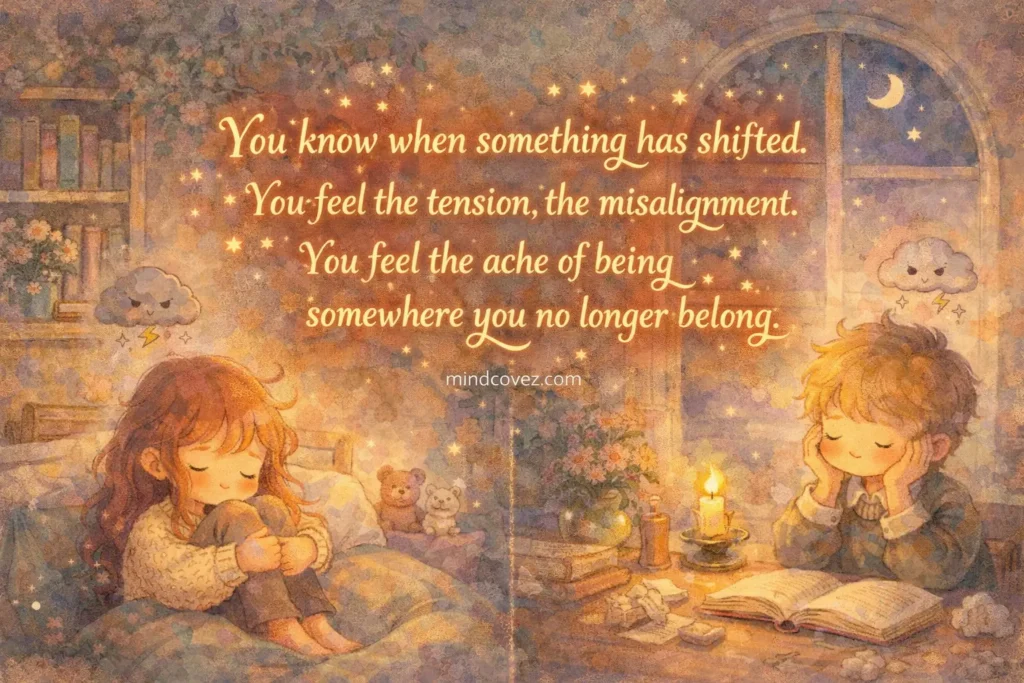
You know when something has shifted.
You feel the tension, the misalignment.
You feel the ache of being somewhere you no longer belong.
Sometimes it’s not about fixing or enduring. It’s about knowing when to step off the wrong train, even if you don’t yet know where the next one leads.
This might show up when you keep defending a relationship by listing good memories like receipts. Or when you keep moving the goalpost at work: “Once this project ends, it will calm down.” Then the project ends. A new one starts. The sleep stays broken.
And the familiarity piece has a behavioral cousin that makes it even stickier: intermittent reinforcement. Ferster and Skinner wrote in 1957 about reinforcement schedules, and it still describes why people stay on trains that mostly hurt. If warmth or relief or approval shows up unpredictably, the system learns to keep trying. The rare good days become evidence: “See, it can be good.”
I don’t love how clinical that sounds, but it matches what I see. Someone gets one kind text after a week of silence, and suddenly the whole week feels negotiable.
Resnick framed it in 2024 in simpler terms that I actually like: the desire for control is tied to feeling safe, and familiarity can masquerade as safety—even when it’s not.
2. Emotional Regulation and Self-Awareness
Letting go also supports emotional regulation: the ability to recognize, process, and manage emotions. It’s one of the building blocks of emotional resilience and inner calm.
When we release:
- Old resentment
- The urge to control everything
- Emotional clutter
…we create space for compassion, self-healing, and clarity. Letting go allows you to better understand what’s really driving discomfort, and that’s where deeper self-awareness begins.
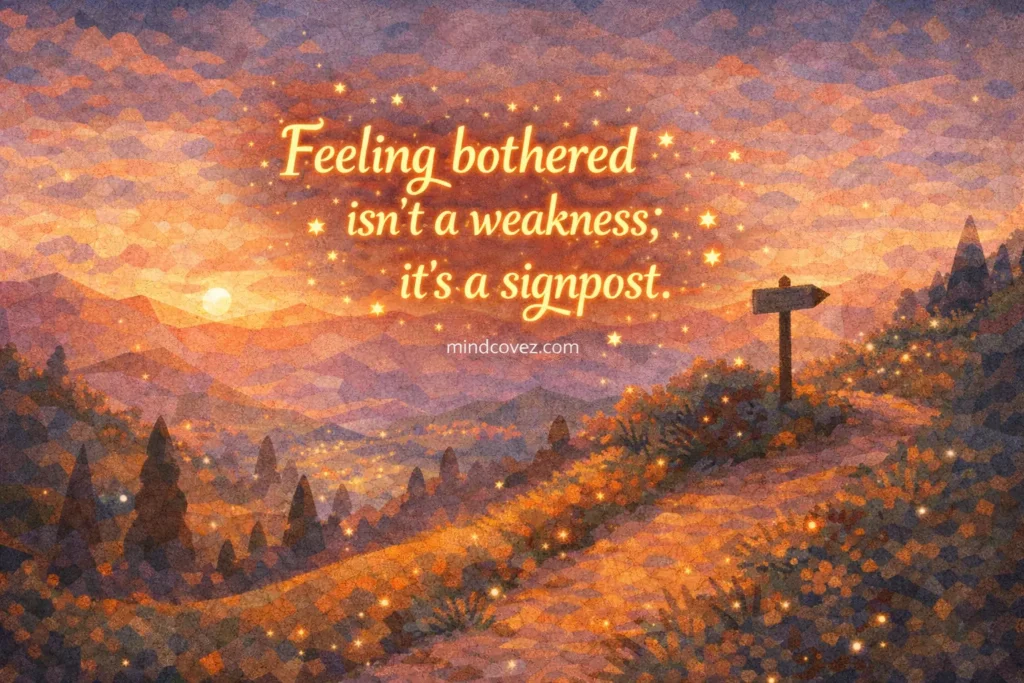
“Feeling bothered isn’t a weakness; it’s a signpost. Releasing emotional baggage helps us tune in rather than shut down.”
I don’t always love mindfulness language because it can get vague fast. But I can’t pretend the evidence base hasn’t grown. Hofmann and colleagues said in 2010 that mindfulness-based therapy has measurable effects on anxiety and depression in meta-analytic work. It’s still part of why I take mindfulness-based approaches seriously in certain cases—not as a lifestyle, but as a tool.
For some people, it softens the loop. For others, it initially makes things feel worse because they finally notice how loud their inner world is. That tradeoff matters.
Resnick wrote in 2024 that mindfulness is about being present, being in the moment, appreciating what’s good as it happens, and that it can help emotion regulation, particularly if you struggle with feeling the need for control. She also noted it can reduce stress, which increases with the need for control.
Instead of asking, “How do I get rid of this emotion?” we begin asking:
“What is this emotion trying to show me?”
Once you can name what you feel, the next question becomes unavoidable: if this is costing peace, what keeps the grip in place?
I’ll add a practical observation that feels psychological, not inspirational. When people start letting go, the first change is often not confidence. It’s less internal negotiation. They stop rehearsing the same explanation. Their shoulders drop a little in the middle of a sentence. The thought still shows up, but it doesn’t hook as hard.
3. Attachment and Identity
According to attachment theory, we don’t just bond with people. We form attachments to outcomes, routines, and identities that shape how we see ourselves.
Sometimes the reasons you stay are the surface logic: fear of the unknown, sunk cost, waiting for a sign. But attachment and identity are the deeper roots that make leaving feel like losing yourself.
We also form attachments to:
- outcomes
- routines
- roles (the helper, the achiever, the “strong one”)
- identities (the responsible one, the misunderstood one, the one who never fails)
But when those attachments start limiting rather than supporting growth, letting go becomes a path to emotional freedom. It’s not about becoming detached from life. It’s about choosing presence and peace over programming and patterns.
“Am I holding on because it’s truly meaningful—or just because it feels familiar?”
I’ve had to correct myself here more than once. I used to assume someone’s reluctance to leave was “low self-worth,” when it was actually an attachment alarm. The 2022 meta-analysis by Zhang and colleagues found that adult attachment is reliably associated with mental health outcomes. It’s not “you are broken.” It’s “your system learned a strategy.” Strategies are stubborn.
Resnick wrote in 2024 that insecure attachment can turn control into reassurance seeking, and that people with an anxious attachment style may micromanage a partner to assure themselves the relationship is not at risk. I’ve seen that play out in small behaviors: checking read receipts, tracking tone, asking the same question in different disguises. The person doing it often hates it, too. They just don’t know what else to do with the fear.
Sometimes identity is the whole train. Someone stays because leaving would collapse their story: “I’m not the kind of person who walks away.” And I get it. I’ve watched people rebuild a self-concept after letting go, and it’s not always graceful. It can be disorienting—quietly humiliating, even.
Before I get into the “wrong train” logic again, I want to name the moment when letting go of control became concrete for me. Not as a theory—as a boundary. As the moment I realized I was carrying emotions that weren’t mine. That’s a specific form of control, too: trying to manage someone else’s inner weather so the room feels safe.
Letting Go of What Isn’t Yours: A Healing Journey Toward Boundaries, Clarity, and Self-Liberation
This is where letting go stopped being a concept and turned into boundaries.
The argument started the way it always did.
“Why didn’t you call me back?”
The voice on the other end of the line was sharp, edged with accusation.
“I’ve been waiting all day. You know how that makes me feel.”
My stomach dropped. Instantly, my mind started sprinting:
You should have replied sooner. You’ve upset them. Fix it. Make it better.
“I’m so sorry,” I said quickly. “Work’s been crazy, but it’s my fault. Tell me what’s going on. How can I make this right?”
As the conversation went on, the blame grew heavier. Their frustration spilled out as criticism: I was careless, distant, selfish. I listened, apologized, explained, and soothed. By the time the call ended, they felt calmer.
I felt drained.
On the surface, it looked like I was being supportive. Underneath, I was quietly disappearing.
I didn’t know it at the time, but I was living from an old survival pattern—one that taught me that my job was to absorb other people’s emotions and make everything okay, even when their feelings had very little to do with me.
I believed love meant fixing.
I believed care meant carrying.
I believed responsibility meant holding emotions that were never mine.
The Moment Everything Shifted
Months later, something changed. Not in them, but in me.
Another call. Another wave of frustration.
“I can’t believe you didn’t answer earlier,” they said. “You never think about how your actions affect other people.”
My body reacted first—heart racing, shoulders tensing, that familiar urge rising: fix it, fix it, fix it. I could feel the apology forming on my tongue.
But this time, something else appeared with it. A quiet, steady voice inside me:
“This isn’t yours to fix. This isn’t your responsibility to carry.”
I took a breath.
“I hear that you’re upset,” I said slowly, “and I’m willing to talk about it. But I’m not going to take on all the blame for your feelings. I had a full day. I’m allowed to have boundaries too.”
Silence.
On the other end, they were not sure what to do with this version of me—the one who was calm, present, and not collapsing under the weight of their disappointment.
“Are you saying this is my fault?” they snapped.
“I’m saying your feelings are valid,” I replied, “and they’re also yours. I care, but I can’t carry them for you.”
I didn’t argue.
I didn’t rescue.
I didn’t absorb the emotion into my body.
The conversation ended sooner than usual. I sat there, phone in hand, waiting for the familiar wave of guilt to crash over me.
Instead, I felt something else.
Clarity.
Relief.
Space.
And for the first time, I understood:
Healing isn’t about becoming harder.
Healing is about becoming clearer.
It was a quiet moment—almost unremarkable from the outside. But inside, something fundamental had shifted.
Where This Pattern Comes From
Many of us who become “fixers,” “peacekeepers,” or “emotional anchors” never consciously choose the role.
We learn it.
Maybe you grew up in a home where tempers were quick, and conflict was dangerous, so you became the one who smoothed everything over.
Maybe you were praised for being “so mature,” “so understanding,” “so helpful,” while your own needs quietly slipped to the bottom of the list.
Maybe, somewhere along the way, you absorbed messages like:
- “Don’t upset anyone.”
- “Keep the peace at all costs.”
- “If they’re angry, you did something wrong.”
So you learned to:
- soothe tension before it exploded
- solve problems you didn’t create
- absorb emotions that were never yours
Over time, these patterns fuse with your sense of self:
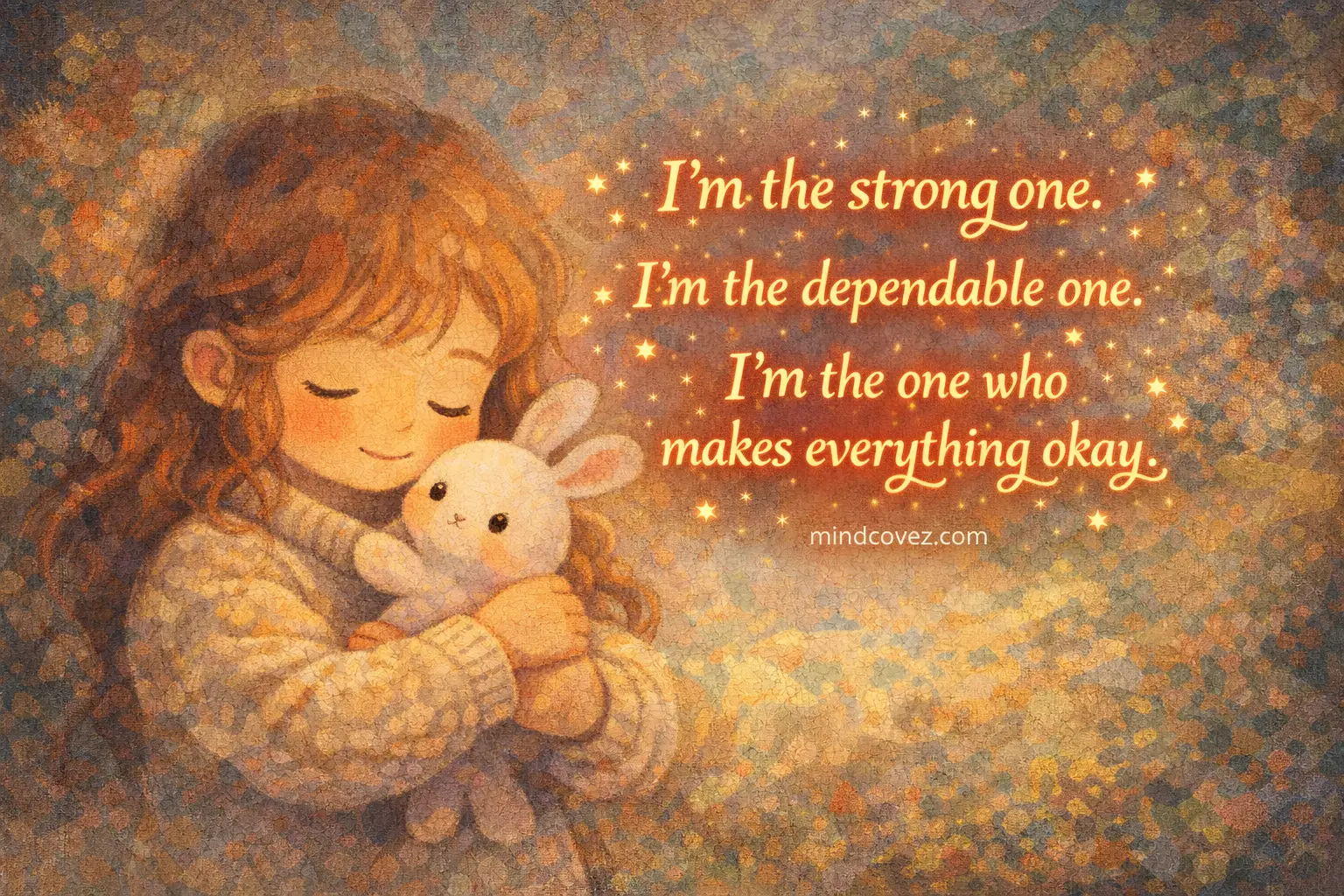
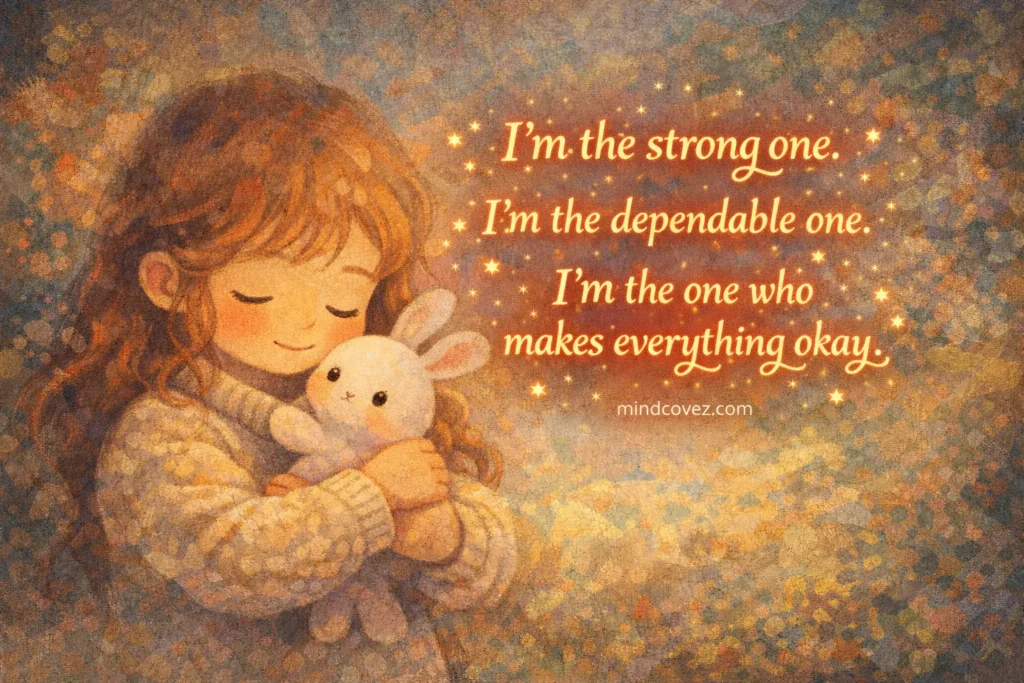
“I’m the strong one.”
“I’m the dependable one.”
“I’m the one who makes everything okay.”
But here is the painful truth:
When you are always rescuing others, you slowly abandon yourself.
Healing Teaches a Different Lesson
Healing does not mean you stop caring. It means you start caring for yourself, too.
It teaches you that boundaries are not punishments. They are healthy edges of responsibility. It shows you that choosing not to engage in dysfunction is not coldness. It is discernment.
It clarifies the difference between:
- empathy and enmeshment
- compassion and codependency
- supporting someone and carrying their chaos
Picture this:
You’re sitting at a family gathering. A relative starts complaining loudly, growing more irritated by the minute.
“This family never supports me,” they declare. “None of you understand what I go through.”
You feel every eye shift awkwardly. Old you would jump in:
“Hey, let’s not fight. Tell us what’s wrong. I’ll help you figure it out.”
But healed you does something different:
“I’m sorry you’re going through a lot,” you say, “and I hope you find the support you need. I’m not able to take this on right now.”
You’re calm, kind, and clear.
Love can exist without self-sacrifice.
You can say:
- “I care about you, and I can’t take this on for you.”
- “I’m here to listen, but I won’t be spoken to disrespectfully.”
- “Your emotions are valid, but they are yours to process.”
Instead of guilt, what you begin to feel is peace.
The Old Impulse Still Flickers
Healing does not erase old instincts overnight.
There are still days when someone raises their voice or withdraws into silence, and my body reacts like it used to. My chest tightens. Thoughts rush in:
You’ve done something wrong. Fix this. Keep them happy.
Recently, someone close to me sent a tense message:
“I guess I just can’t count on you as I thought.”
Old me would have replied instantly:
“I’m so sorry! What did I do? Tell me how to fix this.”
Instead, I paused.
I read the words again and noticed how they tried to hook into my sense of guilt and obligation. I took a breath and replied:
“I’m sorry you feel that way. That wasn’t my intention. I’m doing my best, and I can’t be available in the way you might want right now.”
Did it feel comfortable? Not at first.
But each time I respond this way, something inside me strengthens.
I prove to myself that:
- I am no longer defined by what I fix
- I am no longer controlled by someone else’s reaction
- I am no longer responsible for emotions that aren’t mine
- I am defined now by what I refuse to carry
That shift—subtle but powerful—is liberation.
Why We Stay on the Wrong Train
If you’ve ever wondered why you can “know” something isn’t right and remain there, you’re not alone.
We stay because:
- We fear the unknown more than continued pain
- We’ve invested so much time, effort, and emotion
- We confuse quitting with failure
- We wait for external signs louder than our own knowing
But what if the discomfort is the sign?
What if your stuckness is the universe whispering, “This is not your path anymore.”
Sometimes people wait for permission that never comes. A dramatic rupture. A clear diagnosis. A boss saying something unforgivable—something that makes the choice obvious, so they don’t have to own it.
And sometimes the body tries to do it for you: chronic headaches, digestive issues, that wired-tired feeling. The American Psychological Association’s stress reporting in 2022 is still in my head because the same cluster comes up again and again: fatigue, headaches, sleep disruption, and a feeling of being stretched beyond capacity.
There’s also a social psychology angle that is easy to miss when you are inside it. People around you may reward endurance more than alignment: “At least you have a job.” “Relationships take work.” “Don’t be dramatic.” Cialdini said in 2009 that social proof shapes what people do, and it still feels painfully recognizable. Social proof is not always wise.
Resnick wrote in 2024 that feeling the need to be in control is natural, but trying to control everything is not healthy—and it can backfire in the long run. It increases stress and anxiety.
Reframing the “Wrong Train”
Sometimes what you think is the wrong train was actually a necessary one:
- It taught you what you don’t want.
- It gave you tools for the next chapter.
- It showed you how far you’ve come.
Even the detour had a purpose. So don’t shame yourself for staying too long. Honor yourself for stepping off now—or even for considering it.
Signs You’re on the Wrong Path
Sometimes life misalignment shows up as:
- chronic exhaustion or burnout
- dreading something you once loved
- feeling emotionally numb or resentful
- constant self-doubt or anxiety
- a quiet, persistent voice saying, “This isn’t it.”
These aren’t things to “push through.”
They’re clues.
They’re gentle alerts from your inner wisdom.
For example, this could apply to someone who used to love their work, and now sits in the parking lot bargaining with themselves: “Just go in. Just get through today.” Or someone who used to feel warm with a partner, and now feels like they’re acting in a scene they already know the ending of.
Sometimes the sign is smaller. You stop laughing in a way that feels like you. You avoid making plans. You start fantasizing about getting sick just to have a reason to rest. I’ve heard that one more times than I wish I had.
The Side Effects of Not Letting Go
Refusing to let go—whether it’s pain, toxic relationships, control, or expectations—can create lasting emotional, psychological, and even physical consequences.
Chronic Stress and Anxiety
Holding onto unresolved emotions or control creates constant inner pressure. This can show up as anxiety, insomnia, overthinking, or emotional burnout.
Emotional Stagnation
When we refuse to release the past, we block emotional growth. This can leave you feeling numb, stuck, or unable to move forward.
Low Self-Worth
If you define yourself by what you can’t release—like betrayal or failure—you may start internalizing those experiences as part of identity.
Resentment and Relationship Strain
Unspoken anger and hurt can slowly erode relationships. What begins as silence often grows into emotional distance or passive aggression.
Decision Paralysis
When you cling to past “what ifs” or outdated ideals, it clouds your ability to make clear choices. You become stuck between who you were and who you could be.
Physical Manifestations
Suppressed emotions can show up physically: headaches, digestive issues, fatigue, or unexplained body tension. The mind-body connection is real.
The cost of emotional attachment isn’t just mental. It affects your entire well-being—from how you think and relate, to how you carry yourself in the body.
McEwen said in 1998 that allostatic load is the wear and tear of chronic stress adaptation. Wear and tear. The price of adaptation. Not everyone with chronic stress gets sick, and not every symptom is stress, but prolonged activation showing up in real bodies is hard to unsee once you’ve seen it.
These outcomes aren’t here to shame you. They clarify the choice. When holding on becomes harmful, letting go becomes self-respect.
Resnick wrote in 2024 that trying to control everything can reduce satisfaction. She noted that perceived control is associated with life satisfaction, and she tied it to self-determination theory—the idea that autonomy matters for personal growth and well-being. She also noted that people motivated by control can feel less satisfied when they can’t control everything. She named perfectionism as one reason nothing ever measures up.
That part hits hard for me. Perfectionism can sound like integrity. Sometimes it’s just panic wearing a blazer.
Resnick also wrote in 2024 that control can fuel more criticism. When you care too much about outcomes outside your control, criticism increases—and then that criticism can spiral into a cycle of getting progressively unhappier. She also pointed out that criticism of others can be damaging for people who deal with depression and anxiety, and it can boomerang into more self-criticism.
Sometimes it isn’t just stress. It’s the ache of acting against your values for too long. The “I should be grateful” line can hide a real values conflict. Litz and colleagues wrote in 2009 about moral injury in war veterans. I’m cautious about applying it outside that context, but the basic idea of internal violation shows up elsewhere too, carefully applied. The pattern is there.
When Is It Time to Let Go? (Indicators)
Letting go is rarely easy. But certain mental and emotional patterns can signal it’s time to release what no longer aligns with peace or purpose.
Chronic Emotional Drain
If holding on is exhausting you—emotionally, mentally, or spiritually—it might be time to loosen the grip. Emotional fatigue is a loud red flag. Listen to it.
Misalignment with Your Values
When something you once accepted—a job, a belief, a dynamic—no longer reflects who you’re becoming, it’s a sign you’re outgrowing it.
Mental Repetition or Rumination
If your mind keeps revisiting the same scenario or person, it’s likely taking up emotional bandwidth that could be better used for growth and peace.
Holding On Out of Fear, Not Love
Whether it’s fear of being alone, fear of change, or fear of the unknown—when fear becomes the reason to stay, it’s worth reevaluating.
Stagnation > Growth
When something that once gave you meaning now feels heavy or limiting, the only way forward may be through release.
Dependence on External Validation
If your self-worth depends on being understood, praised, or “fixed” by others, it might be time to come back to your own emotional center.
Letting go is how we reclaim emotional independence and inner alignment.
You don’t need everything to fall apart before you choose differently. You don’t need others to validate pain to make a move. You just need to trust your own knowing—the soft, insistent feeling that this isn’t where you’re meant to be anymore.
Leaving doesn’t mean you’ve failed.
It means you’ve learned.
It means you’re realigning.
And I’ll add this, because it’s where I’ve seen people get stuck: sometimes you need a smaller move before the big one. A boundary before an ending. A pause before a resignation. One honest conversation that changes the rules.
Also, leaving can feel like withdrawal. Not metaphorically—literally. People miss what hurt them. They get nostalgic. They only remember the good moments for a while. Kross and colleagues said in 2011 that social rejection shares representations with physical pain. I’ve never completely forgotten that. Loss registers—even when it’s the right loss.
How to Let Go of Control
Resnick wrote in 2024—and it was reviewed by psychologist Rachel Goldman in 2024—that the need for control is natural, but it can make life more complicated. She also noted that anything that helps you feel more okay with not being in control can be useful. It can be large or small, practiced often or only in moments of need.
I’m going to keep this grounded in how it shows up in real life. Less “be zen,” more “where is your energy going.”
Discern What You Can and Can’t Control
Resnick said in 2024 there’s no way to give up control until you know where it’s being used. Take stock. Think through what’s in your control and what isn’t. Then commit to treating the situations you don’t control differently. That can include disconnecting yourself from outcomes and treating other people differently when they don’t behave exactly how you want. She also noted it may help to think through different possible outcomes, do your best to feel settled with each one, remind yourself you’re safe, and you’ll be okay however things work out.
This might show up like this:
- You can control whether you send a clear message, but you cannot control whether it’s received the way you intend.
- You can control whether you show up to a difficult conversation, but you cannot control whether someone gives you the closure you want.
Practice Mindfulness
Resnick wrote in 2024 that mindfulness is about being present, being in the moment, appreciating what’s good as it happens, and that it can support emotion regulation and reduce stress—especially if control is your default coping strategy.
My caveat is the same as earlier. For some people, present-moment awareness is the first time they realize how much fear they’ve been carrying. The peace is real, but sometimes it’s a second step, not the first.
Journal
Resnick wrote in 2024 that journaling can relieve stress, and for people who feel the need to be in control, it can help work through potential outcomes and provide an outlet without enabling those feelings to amplify and grow.
I’ve seen journaling work like a container. Not for everyone. Some people spiral on paper. But when it works, it slows the mind down enough that the underlying fear becomes obvious. And once fear is obvious, people stop confusing it with “truth.”
Get Support From Loved Ones
Resnick wrote in 2024 that there’s no need to go through this alone. She suggested reaching out to a loved one who also tries to control everything, asking them to join you, checking in regularly, and leaning on someone who has already given up control and experienced the peace that comes with it.
I’ve watched someone step off a wrong train because a friend kept repeating one sentence calmly for months: “You don’t have to earn peace.” That wasn’t therapy. It was a stable cue of safety.
A Practical Path Toward This Kind of Healing
Growth is not theoretical. It is practiced in small, human-sized steps.
Here are practical ways to begin releasing what is not yours, expressed through everyday relational moments. It’s also how letting go of control becomes real.
1. Pause Before You React
A friend texts, “Wow, thanks for ignoring me all weekend.”
You feel your heart jump. Your fingers hover over the keyboard, ready to type a long explanation.
Instead, you pause.
You put the phone down for a moment and ask yourself:
- “Is this mine to solve?”
- “Am I reacting from compassion—or from guilt?”
- “Am I stepping into an old role?”
Only after that pause do you respond, briefly, honestly, and without self-betrayal.
Awareness is the turning point.
A different moment looks like this. Your partner crosses their arms and says,
“Must be nice. You’re always busy with your own stuff. I guess I just come last now.”
Old you would cancel your plans to prove your love.
You take a breath.
“I can see you’re feeling neglected,” you say, “and I’m willing to talk about that. But I also have commitments and a life outside this relationship. We need to talk about this without blaming.”
You’re not ignoring their feelings. You’re refusing to carry their narrative about you.
2. Name What You’re Feeling in Your Body
During a meeting, a colleague snaps:
“Well, if someone had done their part on time, we wouldn’t be in this mess.”
Everyone looks at you.
Your shoulders tense; your face heats up. You want to sink into the floor or over-apologize just to calm the tension.
You identify the feeling:
“My chest is tight. My stomach is knotting. This is the old fear of being blamed.”
You remind yourself:
“This sensation comes from old conditioning, not from present truth.”
You take a slow breath and respond:
“I’d like to talk about what actually happened and share my part honestly. I’m not going to carry responsibility that isn’t mine.”
You are no longer reacting from panic, but from presence.
Later, on a different day, your parent sighs over the phone:
“You never visit anymore. Ever since you moved, you’ve forgotten about us. But it’s fine. I’m used to being alone.”
Guilt surges.
You ground yourself, then say:
“I love you, and you are important to me. My life is full and demanding right now, and I can’t visit as often as you’d like. That doesn’t mean I’ve forgotten you.”
You acknowledge the feeling, without absorbing the blame.
3. Let Other People Own Their Emotions
A partner or friend says, “You made me feel stupid in front of everyone.”
Old you collapses into apology.
New you says:
“I hear that you felt embarrassed, and I’m sorry you had that experience. That wasn’t my intention. I’m willing to talk about what I said, but your feelings are ultimately yours to work through.”
You support, without absorbing.
Your boss later says,
“Because you were late on that report, I looked unprepared. You made me look bad.”
You answer calmly:
“I understand that was stressful. The delay had shared causes we already discussed, and I’ve taken responsibility for my part. I can’t take responsibility for the entire situation.”
You refuse the role of emotional scapegoat.
At home, your teenager shouts,
“You ruin my life! You never let me do anything!”
You stay steady:
“I know you’re angry. It’s okay to feel that way. My job is to keep you safe. I’m not changing this boundary.”
You let them feel, while you remain grounded.
4. Allow Discomfort to Exist
A family member sulks because you set a boundary.
“You’re different now. You’ve changed.”
This time you reply:
“Yes, I am changing. I’m trying to take better care of myself. I know it may feel strange, but this boundary is important to me.”
You allow discomfort to exist, without rescuing anyone from it.
A friend says,
“So you can make time for your new friends, but not for me? Got it.”
You respond:
“I care about you and our friendship. My schedule has been full, and I’m doing the best I can. I’m happy to plan something when I genuinely have the space, but I won’t over-extend myself out of guilt.”
Later, at a family dinner, an in-law announces loudly:
“Well, in our family, we always make time for each other. Some people are just too busy.”
You stay calm:
“I understand you value frequent family time. I have other responsibilities and ways of balancing my life. I’m here now, and I’m glad to be, but I won’t always be able to attend everything.”
You let the silence stay.
5. Re-Anchor Yourself in Worth
After a hard conversation, doubt creeps in:
Maybe I was too harsh. Maybe I should have taken more blame.
You re-center yourself:
“My value is not defined by what I fix.”
“I am allowed to protect my peace.”
“I can care deeply without carrying everything.”
Later, a sibling says:
“You’ve changed since you moved or got that job. You think you’re better than us.”
Instead of collapsing, you remind yourself:
“I am allowed to grow. I can love my family and still choose what’s right for me.”
You don’t shrink back into old roles.
More Relationship Examples
A partner says, “If you really loved me, you’d answer every time I call. I shouldn’t have to feel anxious waiting for you.”
You reply, “I do love you, and I’m committed to this relationship. I also can’t be constantly available. We might need to talk about how we handle communication, but I can’t take responsibility for all of your anxiety.”
A parent says, “After everything I’ve done for you, this is how you repay me? You won’t even do this one thing I’m asking?”
You say, “I appreciate what you’ve done for me, and I love you. I’m also an adult now, and I have to make decisions that are right for my life. Saying no to this doesn’t mean I don’t care.”
A colleague says, “If you cared about the team, you’d take this on.”
You respond, “I care about the team, and I also don’t have the capacity to add more right now. I won’t say yes to something I can’t sustain.”
A community member says, “We really need you on this committee. You’re so good at organizing. If you don’t do it, this might fall apart.”
You answer, “I’m honored you trust me with that, but I don’t have the capacity to take this on. I hope you find someone who’s a good fit.”
Same heart.
New boundaries…
A healthier self.
You Are Allowed to Be Free
Healing is not always loud. Sometimes it is a quiet moment when you choose clarity over guilt, self-respect over rescue, presence over self-abandonment.
You don’t have to bleed for every wound around you.
You don’t have to shrink to keep the peace.
You don’t have to carry what was never yours.
You can offer love without abandoning yourself.
You can stay kind without losing your boundaries.
You can remain open, and still remain whole.
And when you do, you discover something profound:
This isn’t just healing.
This is liberation—steady, grounded, deeply human liberation.
Self-Reflection Prompt
“Am I holding on because it’s helping me grow, or because I’m afraid of who I’d be without it?”
Letting go doesn’t mean giving up. It’s choosing to return to your center—to what feels real, to peace.
Questions People Ask
This might show up when you keep second-guessing yourself after the fact. For me, the clue is repetition. If the same situation reliably leaves you tense, shut down, resentful, or exhausted, it’s usually not just sensitivity. It’s data. Not perfect data, but consistent enough to treat seriously.
I don’t have a clean answer. I’ve seen people leave and feel grief for months, even when leaving was right. I’ve also seen people stay “to be sure” and lose another year. The best tradeoff I’ve found is to make reversible moves first when you can: a boundary, a pause, a conversation that changes the rules. Then watch what happens to your nervous system.
Sometimes it is. Sometimes you are repeating an old pattern. But “it’s me” can also be a way to stay in control. If it’s your fault, you can fix it—and you don’t have to face the possibility that the environment is not workable. I’ve seen both. I still get it wrong sometimes.
For example, this could apply to someone who keeps explaining their intentions until they’re hoarse. Letting go of being right is not agreeing with harm. It’s choosing the outcome you actually want—peace, clarity, a boundary—over the outcome your ego wants in that moment: a win.
Letting Go Isn’t Losing
We’re conditioned to fight for certainty, to chase outcomes, to prove ourselves. But sometimes the boldest act of courage is choosing stillness over struggle.
“Letting go means: I choose peace, even without perfect closure.”
Sometimes letting go looks like:
- pausing instead of reacting
- choosing peace over proving
- releasing the need for perfect closure
- allowing your nervous system to soften
- deciding the argument is not worth your energy
Clancy and colleagues said in 2016 that perseverative cognition relates to health behaviors. The effect sizes weren’t huge, but the direction was consistent. When the mind keeps chewing, people tend to reach for quick relief: more scrolling, more sugar, more drinking, more avoidance. Not because they’re weak—because their system is tired.
And the need to always be right fits here more than people think. It’s often a form of perseveration that looks socially competent. You can justify it. You can call it “standards.” You can call it “principles.” Meanwhile, you’re rehearsing the same argument in your head at 2 a.m.
Resnick wrote in 2024 about what can be gained by letting go of control, and she mentioned that giving up the need for control is often referred to as surrendering. She pointed to Michael Singer’s book in 2015, The Surrender Experiment, where he described his life improving when he stopped trying to control everything. Then she listed benefits I’ve also seen, sometimes reluctantly: increased peace and relaxation, better preparedness for the unexpected, and enhanced connections with self and others.
That “better prepared” part is interesting, because it sounds backwards until you’ve watched it happen. When you’re less set on one outcome, you handle whatever outcome arrives with more capacity. You become more able to go with the flow—not because you don’t care, but because your sense of being okay stops hinging on one specific outcome you may never control.
And the connection piece matters. Resnick wrote in 2024 that trying to control everything can make you more critical of yourself and other people. Giving up that control can deepen connection because you aren’t tying love and acceptance to specific outcomes. By letting people be how they are and allowing yourself to be less attached to how every situation turns out, you can love more freely—both others and yourself.
I’m not always comfortable with how “surrender” language lands, because it can sound like you’re supposed to accept harm. That’s not what I mean. I mean choosing where to spend your limited energy. I mean not turning your life into a courtroom.
What Could You Let Go Of?
For some, it’s the desire to be liked. For others, it’s a toxic habit, an outdated identity, or a version of themselves they’ve outgrown.
Consider asking yourself:
- What am I holding on to that’s costing me peace?
- Is this still serving my personal evolution, or just keeping me safe?
- What would inner harmony feel like if I let myself stop holding so tightly?
Sometimes the most powerful growth isn’t in adding something new, but in finally releasing what’s been weighing you down.
Final Thought
Letting go doesn’t mean you don’t care. It means you care enough to choose truth, alignment, and inner peace over resistance and fear.
For me, letting go started in the smallest place: releasing the need to be right. And I’ve learned that when we practice release in small moments, we build the courage to release bigger misalignments too.
“What are you ready to release—not as a loss, but as a return to the most grounded version of yourself?”
What train are you on?
Which area of your life feels off-track right now: career, relationship, purpose?
And if the answer is still “I don’t know,” I don’t think that means you’re failing. It might mean you’re finally being honest about how hard it is to give up control and step off a train without seeing the whole map. The part that still interests me is what happens next when you stop rehearsing, and you notice what you do with the space you get back.
References
Aldao, A., Nolen-Hoeksema, S., & Schweizer, S. (2010). Emotion-regulation strategies across psychopathology: A meta-analytic review. Clinical Psychology Review, 30(2), 217–237. https://doi.org/10.1016/j.cpr.2009.11.004
American Psychological Association. (2022, October). Stress in America 2022: Concerned for the future, beset by inflation. https://www.apa.org/news/press/releases/stress/2022/concerned-future-inflation American Psychological Association
Carleton, R. N. (2016). Into the unknown: A review and synthesis of contemporary models involving uncertainty. Journal of Anxiety Disorders, 39, 30–43. https://doi.org/10.1016/j.janxdis.2016.02.007
Clancy, F., Prestwich, A., Caperon, L., Tsipa, A., & O’Connor, D. B. (2016). Perseverative cognition and health behaviors: A systematic review and meta-analysis. Frontiers in Human Neuroscience, 10, Article 534. https://doi.org/10.3389/fnhum.2016.00534
Cialdini, R. B. (2009). Influence: Science and practice (5th ed.). Pearson.
Deci, E. L., & Ryan, R. M. (2000). Self-determination theory and the facilitation of intrinsic motivation, social development, and well-being. American Psychologist, 55(1), 68–78. https://doi.org/10.1037/0003-066X.55.1.68
Ferster, C. B., & Skinner, B. F. (1957). Schedules of reinforcement. Appleton-Century-Crofts.
Festinger, L. (1957). A theory of cognitive dissonance. Stanford University Press.
Goldman, R. (2024). Review of “Why letting go of control can help you enjoy life.” Verywell Mind. https://www.verywellmind.com/letting-go-of-control-can-help-you-enjoy-life-5208817 Verywell Mind
Harmon-Jones, E., & Mills, J. (Eds.). (2019). Cognitive dissonance: Reexamining a pivotal theory in psychology (2nd ed.). American Psychological Association.
Hofmann, S. G., Sawyer, A. T., Witt, A. A., & Oh, D. (2010). The effect of mindfulness-based therapy on anxiety and depression: A meta-analytic review. Journal of Consulting and Clinical Psychology, 78(2), 169–183. https://doi.org/10.1037/a0018555
Kross, E., Berman, M. G., Mischel, W., Smith, E. E., & Wager, T. D. (2011). Social rejection shares somatosensory representations with physical pain. Proceedings of the National Academy of Sciences, 108(15), 6270–6275. https://doi.org/10.1073/pnas.1102693108
Litz, B. T., Stein, N., Delaney, E., Lebowitz, L., Nash, W. P., Silva, C., & Maguen, S. (2009). Moral injury and moral repair in war veterans: A preliminary model and intervention strategy. Clinical Psychology Review, 29(8), 695–706. https://doi.org/10.1016/j.cpr.2009.07.003
McEwen, B. S. (1998). Stress, adaptation, and disease: Allostasis and allostatic load. Annals of the New York Academy of Sciences, 840(1), 33–44. https://doi.org/10.1111/j.1749-6632.1998.tb09546.x
Resnick, A. (2024, March 13). Why letting go of control can help you enjoy life. Verywell Mind. https://www.verywellmind.com/letting-go-of-control-can-help-you-enjoy-life-5208817 Verywell Mind
Singer, M. A. (2015). The surrender experiment: My journey into life’s perfection. Harmony.
Stade, E. C., & Ruscio, A. M. (2023). A meta-analysis of the relationship between worry and rumination. Clinical Psychological Science, 11(3), 552–573. https://doi.org/10.1177/21677026221131309 SAGE Journals+1
Thompson, S. C. (1981). Will it hurt less if I can control it? A complex answer to a simple question. Psychological Bulletin, 90(1), 89–101. https://doi.org/10.1037/0033-2909.90.1.89
Zhang, X., Li, J., Xie, F., Chen, X., Xu, W., & Hudson, N. W. (2022). The relationship between adult attachment and mental health: A meta-analysis. Journal of Personality and Social Psychology: Personality Processes and Individual Differences, 123(5), 1089–1137. https://doi.org/10.1037/pspp0000437 Nathan W. Hudson