

Because it is not the screen time itself that makes most families panic. It is what comes after. Headache at dinner. Gritty eyes in the bath. A bedtime that drifts later, and the next morning that starts with a fight. If you read this, you will leave with the pattern I see most often when screens tip kids into eye strain and sleep trouble, the flip that changes the experience without changing your whole life, and a decision point you can use the same day you notice things sliding.
I’m aiming this at one specific problem: the “everything gets worse after screens” pattern. Not just eyes. Not just sleep. The whole evening tone. A lot of posts treat this like either a parenting boundary issue or a medical issue. In the families I’ve worked with, it is usually a mix of body strain plus a nervous system that stays revved. The fix is rarely dramatic. It is usually environmental. Small, physical, repeatable.
The question I keep coming back to is simple:
When my child melts down after screens, am I looking at a behavior problem or a body problem?
That is the decision point. Not philosophical. Practical. Because what you do next depends on what you think you’re seeing.
Sometimes it is both. Sometimes it is mostly body, and you miss it because kids do not describe discomfort the way adults do. They do not say, “My eyes are dry.” They say, “I hate homework.” Or “My head hurts.” Or they get clingy and combative, and you spend the evening negotiating with someone who is already overloaded.
What digital eye strain looks like in kids (in the wild)
Kaur and colleagues published a review in 2022 that laid out the classic cluster: dryness, blurred vision, headaches, neck and shoulder discomfort. It is useful because it gives you a list. It is also misleading because kids rarely present like a neat list.
Parents rarely hear, “My eyes feel dry.” They hear:
- “My eyes hurt” right when the screen ends, especially after longer stretches
- Rubbing eyes during homework or right after gaming
- Headaches that show up late afternoon and disappear on screen-free days, then return
- A kid who gets snappy and clingy after screens, then feels better outside
- Slumping posture, chin forward, shoulders up, like the whole body is bracing
This might show up with a seven-year-old who can tolerate a school assignment on a tablet, then turns sharp at dinner. Nobody calls it eye strain. It gets called attitude. Bedtime takes longer. Then the morning is chaos. Once you see that loop a few times, you start to wonder whether the screen is “causing behavior,” or whether it is quietly stacking physical strain on top of the child’s already-small capacity.
I have to admit my bias. I see families when something is not working. I do not see the kids who use screens and feel fine and go to bed easily. Still, this pattern comes up often enough that I now ask about eyes and posture before I ask about discipline.
Why screens hit the eyes and sleep together
Two things tend to happen at once.
One is visual. Long near focus. Reduced blinking. Bright light. Small text. Awkward posture. The eyes work harder. The body tightens. A tired kid gets less tolerant of everything. That matches the symptom cluster Kaur’s 2022 review described, even if the family never uses the words “eye strain.”
The other is the nervous system. Even if the content is “good,” screens keep attention locked in. Fast pacing, reward loops, social tension, the feeling of one more. When you end it, the child is still revved. The American Academy of Child and Adolescent Psychiatry fact sheet, updated June 202,5 has that blunt bedtime line: remove screens 30 to 60 minutes before sleep. I remember reading it and thinking, yes, this is written like someone who has watched bedtime unravel for a living.
I’m not saying every kid is equally sensitive. They are not. And the blue-light discussion gets overclaimed online. I’ve read enough conflicting arguments to stay cautious. Still, even when light is not the main issue, stimulation often is. The mind stays switched on, then the body has to do the work of winding down.
The simple home setup that reduces digital eye strain
I like setups that do not rely on willpower. A kid should not have to remember “good posture” every five minutes. The environment can do some of the work.
Screen distance and height (small change, big payoff)
AAPOS, in guidance updated 24 February 2025 on screen time and online learning, kept it practical: screens atarm’sm length and at eye level.
What that looks like at home:
- Arm length means the child can reach the screen with straight-ish arms, not bent tight. If the face is close, the eyes work harder.
- Eye level means the top of the screen is roughly at eye height, so the child is not looking sharply down for long periods. A stack of books under a laptop is boring and effective.
For example, this could apply to a child doing homework on a tablet flat on the floor. Neck angled down. Eyes close. Shoulders up. They finish and complain of a headache, and everyone assumes avoidance. Raise the screen. Add distance. You often get fewer complaints within days.
Not always. But often enough that it changes what I try first.
Lighting that does not fight the screen
AAPOS also emphasizes good lighting in that same 2025 guidance. Not spotlight bright. Just balanced.
What I tell parents to look for:
- If the screen is the brightest thing in the room, the eyes work harder.
- If the room is too dark, the contrast can feel harsh.
- A warm lamp behind or beside the child often helps more than overhead glare.
This might show up with a teen scrolling in a dark bedroom. The phone becomes a flashlight for the face. The teen says they are fine. Then sleep gets worse. The family argues about responsibility when the environment is doing a lot of the damage.
Blinking and dryness (the part kids never notice)
AAPOS mentions blinking because kids forget. They stare. Their eyes dry out. Irritability goes up.
Simple ways this becomes real:
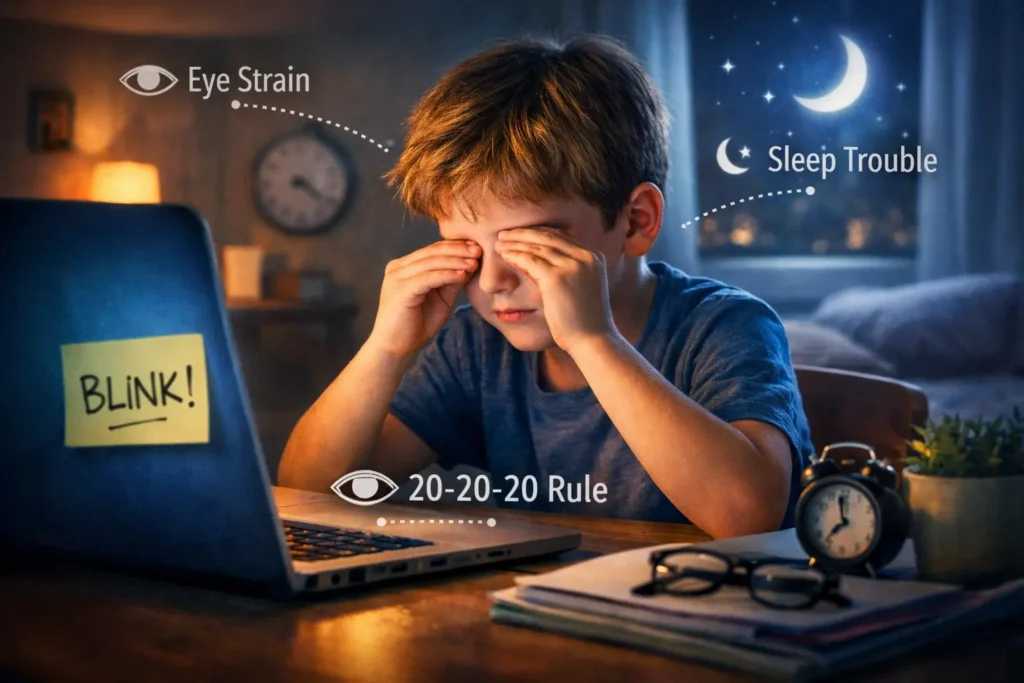
- Put a small sticky note near the screen that says “blink.”
- Build blinking into breaks.
- Notice if the child rubs their eyes after screens. That is often dryness, not defiance.
I’m not pretending blinking fixes everything. It just removes one avoidable stressor. Some families are surprised by how much “mood” improves when a physical irritant is reduced.
The 20 20 20 rule (and why it works better than it sounds)
The 20 20 20 rule is the one parents remember because it is simple: every 20 minutes, look at something 20 feet away for 20 seconds. AAPOS included it in their February 2025 guidance in exactly that practical tone. Look out the window. Look down the hall.
What matters is not the math. It is the interruption of near focus.
Ways families make it workable:
- Put a timer on the adult’s phone, not the child’s device, so it feels less like punishment.
- Pair the break with a tiny physical reset: stand up, roll shoulders, sip water.
- Use a predictable target: look at the tree, look at the clock, look at the far wall.
This might show up with a nine-year-old doing online homework. Every 20 minutes, they look out the window for 20 seconds, then continue. It feels silly on the first day. Then the headaches fade, and nobody wants to admit the silly thing helped.
Extra tips from AAPOS (with plain meanings)
AAPOS lists a few additional tips. They look small. They add up.
- Keep screens at arm’s length and at eye level.
Meaning: less strain from face-close viewing and neck-bent posture. - Use good lighting
Meaning: avoid a bright screen in a dark room, and avoid glare that makes squinting worse. - Encourage blinking to prevent dryness.
Meaning: less gritty, itchy discomfort that turns into rubbing, headaches, and irritability.
When it is not just eye strain
I have to say this carefully because it is easy to become alarmist online. Most kids with screen discomfort improve with a better setup and better breaks. Still, some patterns make me pause:
- headaches that are frequent, severe, or wake a child at night
- consistent squinting, one eye closing, or sitting extremely close to the screen
- complaints of double vision or persistent blur
- a child avoiding reading because it “hurts.”
That is the moment to consider a pediatrician or pediatric eye specialist. Not because screens are evil. Because the screen is revealing a stress point.
Screen Time and Sleep (Kids to Teens)
If you only change one thing for sleep, I would not start with the apps. I would start with the ending.
The AACAP fact sheet,t updated June 2025, recommends removing screens 30 to 60 minutes before sleep. That range is useful because it admits reality. Some families can do 60. Some can barely do 30. The point is to protect the bedtime off-ramp.
What I watch happen when families do not protect that off-ramp:
- Bedtime drifts later, then mornings become battles
- Kids get a second wind right when they should be winding down
- Parents start negotiating in bed, which trains everyone to expect negotiation
- Teens start hiding screens, not because they are bad, but because the system has become adversarial
I do not think the answer is control. I think the answer is design.
A bedtime setup that actually holds
This is the version I keep seeing work more than lecturing does:
- Charging stays outside bedrooms
A simple station in the hallway or living room. Phones have a home. - A consistent cutoff time
Not perfect, but predictable. The argument is not reinvented nightly. - A predictable replacement
Shower, snack, reading, music, stretching, conversation. Something real, not another screen.
This might show up with a teen who insists they need the phone for friends. Sometimes they do. The question becomes whether the social part can happen earlier, and whether the sleep boundary can stay stable without turning into a power contest.
Kids who “sleep fine” until they don’t
You see this most clearly in school-age kids and teens. They look okay on less sleep, until the cumulative effect shows up: mood swings, attention problems, morning fights, more screen cravings the next day.
I can’t prove screens are the only driver. Life is messy. But when bedtime screen use drops and mornings improve, I pay attention. Even if the mechanism is not only light. Even if it is arousal, anxiety, habit, or the endlessness of scrolling.
Where eye strain and sleep meet (a pattern worth noticing)
If a child’s eyes feel strained, they get more reactive. If a child is overtired, their eyes tolerate screens worse. Then the irritability gets blamed on behavior again.
This might show up like:
- a child who can handle screens earlier in the day but melts down late afternoon
- a teen who says “my head hurts” and then scrolls anyway because it numbs them
- a kid who complains of blur, then can’t settle at bedtime, then wants the screen again the next day
I do not love how circular it is. I just saw it.
Effects of Screen Time on Child Brain Development
At MindCovez, we know parenting in a digital world can feel overwhelming. We also know you are doing your best with the tools you have. The first years are a once-in-a-lifetime stage of brain growth,h and even small choices can make a big difference. This guide explains the science of the effects of screen time on children’s brain development, shares clinical insights, and offers practical ideas so you can shape screen use into something that supports rather than subtracts from your child’s growth.
When the body is strained or sleep is thin, kids reach for whatever feels easiest, and screens can become that shortcut. That is where “eye strain” stops being only an eye story and starts looking like displacement, because the more screens we solve in the moment, the more they quietly replace.
This is where I usually zoom out. Not away from eyes and sleep, but upstream from them. Because the same screen habits that leave a child rubbing their eyes or wired at bedtime also tend to be the habits that replace the inputs the early brain seems to need most. Faces. Voice tone. Shared attention. The boring back-and-forth that builds language and emotional control in the background.
The Early Brain Built for Faces, Not Screens
The first five years are a period of rapid neural wiring. Every smile, change in voice tone, and shared glance helps build pathways for executive function, emotional control, language,e and empathy. When screens take the place of live human engagement,t they remove the very input young brains need to flourish.
Research in the United States shows preschoolers with higher screen exposure have lower integrity in brain tracts tied to language and literacy (JAMA Pediatrics Hutton 2019). A multinational review confirms that interactive human presence can buffer these effects (Frontiers in Psychology 2024). The effects of screen time on a child’s brain development are not only about the minutes spent watching but also about what those minutes replace.
Tip
Build face moments into daily routines. Even while folding laundry or cooking, take 30 seconds to make eye contact and share a smile.
Speech Delay and Social Development in Kids
Children learn best by watching and responding to people. Words, facial expressions, and the back and forth of conversation form the foundation of communication and empathy.
Canadian cohort data links more daily screen time in toddlers to delays in communication problem solving and motor skills (JAMA Pediatrics, Madigan 2019). A Japanese study found similar patterns where screen exposure at age one predicted language and social delays at ages two and four (JAMA Pediatrics Takahashi 2023). Danish research adds that over an hour of mobile device use a day increases the likelihood of language difficulties (BMC Public Health 2024).
Trick
Narrate what you are doing throughout the day. “I am pouring milk into your blue cup,” or “We are walking past the big tree,” creates natural language-rich moments.
Emotional Learning and Screen Use
It is common to use screens to calm a child’s distress, but this shortcut can limit their ability to cope with emotions. Without the chance to name feelings and recover in real time, children risk developing low frustration tolerance and weaker self-soothing skills.
Peer interaction offers a vital balance. United States data shows that more screen time in toddlers often means less peer play, which relates to developmental delays (Infant and Child Development 2022). Simple phrases like “You are upset because it is over” help build emotional literacy and resilience. The effects of screen time on a child’s brain development extend into emotional health, making emotional coaching an essential counterbalance.
Tip
When your child is upset, pause before offering a screen. Label the feeling and offer comfort through touch or a small choice like “Do you want to read a book or go outside?”
Why Screen Dependency Forms Early
Parents often notice resistance when a device is removed, even after short use. This is because screens can become linked to comfort and emotional safety,y replacing boredom and creativity with instant dopamine. Once sadness is paired with a scene,n breaking the habit requires conscious effort.
The solution is not all or nothing. Gradual adjustments and loving boundaries keep technology in its place as a tool, not a constant presence.
Trick
Create transition rituals after screen time, like a snack together or a short dance break. This makes the shift feel fun instead of abrupt.
Official Screen Time Recommendations for Toddlers
Global health experts agree that screens should be introduced slowly and intentionally.
- 0 to 18 months Avoid except for occasional family video calls
- 18 to 24 months. If introduced, ensure high-quality content and co-viewing
- 2 to 5 years, Limit to about one hour daily with active adult involvement
The WHO emphasizes active play,y quality sleep, and direct care alongside these limits (WHO 2019). The American Academy of Pediatrics advises creating a family media plan to guide intentional screen use (AAP 2024). These guidelines help reduce the negative effects of screen time on a child brain development while supporting healthy growth.
Tip
Keep a simple daily chart where your child adds a sticker each time they choose a non-screen activity.
Practical Steps for Healthy Screen Habits
- Replace instead of remove Offer puzzles, drawing or outdoor adventures when you say no to screens
- Co view and co play Sit together during screen time pause often and connect the content to real life
- Create screen free zones Protect mealtimes bedrooms and car rides for conversation
- Model balance: Show your own healthy device habits.
- Have slow mornings. Delay turning on any screens for the first hour of the day
- Use countdowns. Give a 5-minute warning before screen time ends
- Screen swaps. Keep a boredom basket of books, building block,s and art supplies ready
- Outdoor challenge: Set a goal of 30 minutes outside daily before any screen time
Tech tickets: Give your child two tickets each day to spend on short viewing sessions. - Cook togethe.r Involve your child in stirring, pouring, and tasting
- Mini dance parties. Use music instead of video for quick fun breaks
- Family story night: Take turns making up silly stories instead of watching a show
Encouragement for Parents
Parenting in a digital world is challenging, and perfection is not the goal. Even ten minutes of focused screen-free interaction can benefit a child’s brain more than an hour of passive viewing.
Small steps such as turning off devices during dinner or replacing one screen session with a game of I Spy make a real difference. The gift of presence outshines any app. Your awareness today shapes tomorrow’s resilience and helps protect against the unwanted effects of screen time on children’s brain development.
Remember, your child does not need a perfect parent; they need a present one. Every small choice you make is an investment in their language skills, empathy, and emotional strength.
Gentle Strategies for a Screen Detox
- Start with tiny reductions. Reduce daily use by 5 to 10 minutes at a time instead of cutting it in half overnight.
- Add before you subtract. Introduce a fun alternative before taking the screen away.
- Shift the timing.g Move the screen use to later in the day so your child has already had real-world play and social time
- Plan yes activities. Have a ready list of activities your child loves that do not involve screens.
- Involve your child in the plan. Let them decorate a weekly chart showing screen-free times.
- Replace passive with interactive. Swap videos for building, cooking or pretend play
- Celebrate wins, praise moments when your child chooses a non screen option
- Stay calm during pushback. Expect resistance and acknowledge feelings without giving in immediately
- Lead by example. Keep your own phone or TV off during family time
- Make it specia.l Replace the last screen session of the day with a warm bedtime routine
- A screen detox is not a punishment. It is a gift of time, attention, and connection that allows your child to grow with balance and joy
Questions people ask
It is the cluster of discomfort that can show up after sustained screen use, like dryness, blurred vision, headaches, and neck or shoulder discomfort, described in Kaur’s 2022 review and echoed in day-to-day practice.
Look at something 20 feet away for 20 seconds every 20 minutes, as described by AAPOS guidance updated February 2025.
Keep the screen at arm length and at eye level, use comfortable lighting, and build in regular breaks, including the 20 20 20 rule. AAPOS updated February 2025 framed these as practical repeatable habits.
It can push bedtime later and make winding down harder. AACAP updated June 2025 recommends removing screens 30 to 60 minutes before sleep, which many families notice improves mornings over time.
The effects of screen time on child brain development are not only about the minutes spent watching but also about what those minutes replace, with research like Hutton 2019 and broader reviews like Frontiers in Psychology 2024 pointing toward language and literacy pathways being sensitive to displacement of live interaction.
A note I keep coming back to
Some days it really is as basic as moving the iPad off the couch and onto a table, adding a lamp, and forcing the eyes to look up and out of the room every so often. Other days you do all of that and the child still melts down, still stalls at bedtime, still insists they feel “fine.” That is the part that keeps me cautious. The evidence is real, but families are not lab conditions. And sometimes the first sign you are on the right track is not a dramatic change. It is a quieter evening that nobody even labels as different, until you realize the complaint about headaches did not show up, and the negotiation at bedtime started five minutes later, and you start wondering what else has been hiding inside “screen time,” and what you might notice next
References
- American Academy of Child and Adolescent Psychiatry, updated June 2025. Screen Time and Children (Facts for Families, No. 54).
- American Association for Pediatric Ophthalmology and Strabismus, updated 24 February 2025. Screen Time and Online Learning.
- Kaur, K., et al., 2022. Digital eye strain, comprehensive review (peer-reviewed review article).
- Hutton, J. S., 2019. Preschool screen exposure and brain tract integrity tied to language and literacy (JAMA Pediatrics).
- Frontiers in Psychology, 2024. Multinational review on interactive human presence buffering screen-related effects.
- Madigan, S., 2019. Toddler screen time links to communication, problem solving, motor skill delays (JAMA Pediatrics).
- Takahashi, 2023. Screen exposure at age one predicting language and social delays at ages two and four (JAMA Pediatrics).
- BMC Public Health, 2024. Danish research on over an hour of mobile device use a day increasing likelihood of language difficulties.
- Infant and Child Development, 2022. More screen time in toddlers linked to less peer play relating to developmental delays.
- World Health Organization, 2 April 2019. Guidelines on physical activity, sedentary behaviour and sleep for children under 5 years of age.
- World Health Organization, 24 April 2019. To grow up healthy, children need to sit less and play more (news release).
- American Academy of Pediatrics, 2024. Family media plan guidance for intentional screen use.