
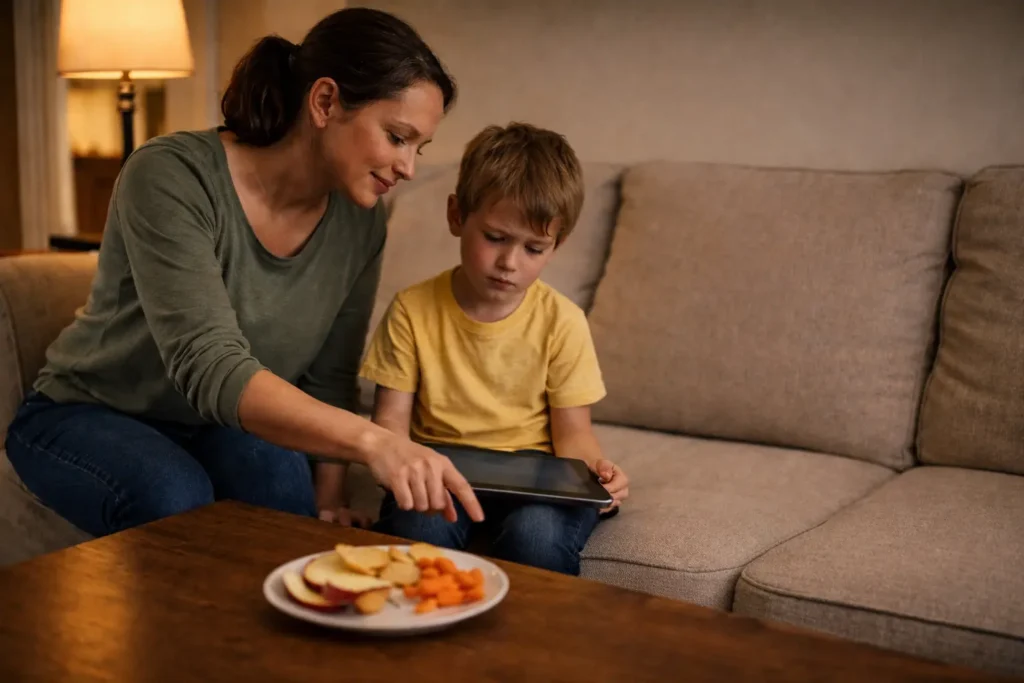
So it is 6:12 p.m., and I am already counting the minutes to dinner in my head, and the tablet is doing what it does. Bright, sticky, louder than it looks. If you read this, you will leave with the pattern behind most screen-time meltdowns, the small flip that changes what “time’s up” means in your home, and a decision point you can use right when things start to tilt toward screaming. That is the point. Not a perfect child, not a perfect parent, just a cleaner ending when you end screen time.
What keeps bothering me is how often the advice aims at the wrong target. People reach for stricter rules, firmer voices, better timers. Sometimes those help, sure. But the hardest part usually isn’t the limit itself. It’s the switch. The moment a child has to move from a high-reward, high-stimulation experience into something slower, in a brain state that is already narrowed. In practice, the meltdown is usually a transition problem plus a regulation problem, happening at the worst time of day, with a device designed to keep attention hooked. I can’t make it perfect. I can make it predictable.
The question I keep coming back to, in sessions and in my own notes, is simple:
When I end screen time, am I trying to stop a behavior, or am I trying to teach a skill?
That sounds lofty. In real life,e it looks like this: do you grab the tablet and tolerate the screaming, or do you do the slower thing that reduces screaming later?
Why does this keep happening (even with “good” limits)
A lot of parents come in feeling embarrassed because they “can’t control it.” Then we zoom in, and the picture changes.
The ending is hard because screens are high-reward, high-stimulation, and often open-ended. You’re asking a child to switch from something that is gripping to something that is not, in a brain state that is already narrowed. And children are not built for clean switches. Especially when they’re hungry, tired, overexcited, or already upset.
I also think we underestimate how much adults rely on screens for peace. Not because we’re lazy. Because we’re overloaded.
AACAP’s fact sheet Screen Time and Children (updated June 2025) has a line I’ve seen parents physically relax reading: avoid using screens as pacifiers, babysitters, or to stop tantrums, and protect bedtime by removing screens 30 to 60 minutes before sleep. It’s not shaming. It’s naming a trap. A quick calm now that can make future calm harder.
And then the research started catching up to what clinicians were already seeing. Radesky and colleagues, in a JAMA Pediatrics cohort paper in 2023, looked at parents using mobile devices to calm kids aged 3 to 5. They found links with emotional reactivity and executive functioning, and the relationship looked bidirectional over time. Not “screens cause tantrums” in a simple way. More like: stressed kids get screens to calm, and then the skill-building opportunities shrink. The next upset has fewer tools available.
Konok and colleagues in 2024 (Frontiers in Child and Adolescent Psychiatry) pushed on the same point from another angle: using digital devices to manage tantrums can hinder self-regulatory skills and show up later as poorer anger management and effortful control. Again, not a neat moral. A tradeoff.
So when parents ask me, “Is it bad that I hand over a phone in public?” I don’t answer with guilt. I answer with: how often, and what is it replacing? One emergency tool is different from a main strategy.
The flip that changes the ending
Here’s the shift that tends to matter:
Ending screen time works better when you treat the ending as a transition you build, not a switch you force.
I know that can sound like more work for parents. Sometimes it is. Sometimes it saves work within a week.
Main takeaway: ending screen time without meltdowns gets easier when you plan the transition, not just the limit.
The structure I keep seeingiss boring. Three parts. It repeats across ages.
1) Decide the stopping point before you press play
This one is annoyingly effective.
One episode. One short story. One level. One video call, then done. Not “a bit.” Not “until dinner.” A child hears “until dinner” as infinite time, especially younger ones.
I’ve watched families who set the endpoint first have fewer meltdowns, even when the total minutes stayed the same. The child isn’t losing something endless. They’re finishing something defined.
This might show up with a preschooler who can tolerate “two episodes” but melts down with “turn it off now.” The difference is not the child’s personality. The difference is predictability.
2) Build a bridge out of the screen
A bridge is any small thing that connects screen time to what comes next, so the brain does not experience the end as a drop.
Examples I’ve seen work:
- a snack ready on the table before the screen ends, so the next thing is immediate and physical, not abstract
- Shoes by the door if you’re going outside next, so the child can move straight into action instead of waiting
- for a favorite toy placed beside the couch, so their hands have something to do when the screen is gone
- a parent sitting down for the last minute, not the first minute, so the ending feels likea connection, not removal
It’s subtle, but it changes the emotional meaning. Ending is not abandonment. Ending is movement.
For example, this could apply to a child who turns the screen off more easily when an adult is already close by, but falls apart when the adult is across the room doing chores. The show ends and the connection feels gone too. Sitting down for the last minute shifts that.
3) Make a closing ritual that stays the same
This is where people roll their eyes, and then it works.
A simple ritual can be:
- “pause, wave goodbye, screen sleeps,” so there is a clear finish and a consistent script
- “two deep breaths, then stand up,” so the body gets a cue that the moment is changing
- “screen goes to its home” (charging spot, basket, shelf), so the device has a place and the ending isn’t a tug-of-war
Rituals reduce negotiation because the child is not deciding the ending every time. The family is.
I don’t claim this solves everything. Some kids still protest. But protest isn’t the same as a full meltdown. And the goal is often to move from meltdown to protest, and then from protest to acceptance. In that order.
Babies 0 to 18 Months: Keep Real Life First
You might wonder why I’m including babies in a post about meltdowns. Because the “ending” problem often starts early, with screens used as a quiet button.
The American Academy of Pediatrics in Media and Young Minds (2016) was clear that for infants, the recommendation is essentially no screen media except video chatting. The reason isn’t fear. It’s that infants learn best through responsive interaction.
If you’re doing live family video calls, the ending can still create fussing. The same structure applies, just softer.
What I’ve seen help:
- end the call with a predictable goodbye song, the same tune every time, so the baby hears the ending coming
- move straight into a familiar routine (feeding, bath, cuddle), so the baby’s body gets the next cue immediately
- keep the phone out of reach, so the baby is not trying to grab a glowing object and then losing it
Positive screen ideas
- Family video calls where loved ones sing or read, because it is interactive and the baby is responding to real people
- Let relatives respond to your baby in real time, so the screen stays social instead of passive
What to do instead
- Narrate your day while holding your baby, so they hear language paired with real moments
- Play peekaboo and sing lullabies, simple games that build attention and connection
- Offer safe toys with different textures, so the hands and mouth have real sensory input
Toddlers 18 to 24 Months: Learn Together
Toddlers are the ones most likely to look “possessed” when the screen ends. Not because they’re addicted. Because they have weak brakes and strong feelings. That’s the developmental deal.
Watching with your toddler turns content into learning. Choose high-quality, slow-paced shows and connect what they see to their real-life experiences. Brito and Barr in 2011, looking at toddlers learning from video versus books, is one of the reasons I keep pushing co-viewing. Transfer is fragile at this age. The adult bridge matters.
Now the ending.
What tends to work with toddlers:
- short countdowns they can grasp, like “three, two, one, done,” or “one more and then stop,” not a long lecture
- one clear “next” ready immediately, like snack in hand, bubbles already open, shoes already on the floor
- less talking during escalation, because some toddlers melt down faster when they get lots of language and choices
This might show up with a toddler who screams when the tablet disappears. If the next thing is already in your hand, snack cup, bubbles, shoes, the scream often shortens. Not always. Often enough.
Positive picks
- Shows like Sesame Street or Daniel Tiger, because the pacing is slower and the themes are easier to connect to real life
- Pause to name objects and link to their toys, like “That’s a truck, you have a truck,” so it becomes shared attention
What to do instead
- Pretend play with dolls or kitchen sets, because toddlers practice feelings and roles through play
- Stack blocks and solve simple puzzles, because the hands stay busy and the win is immediate
- Read together with picture books, because it is screen-free closeness with predictable rhythms
A note I keep repeating to myself: if you use screens to stop tantrums, you usually get more tantrums about screens. AACAP (2025) says that plainly. The Radesky work (2023) suggests why it might happen over time.
Preschoolers 2 to 5 Years: Balance and Meaning
Children at this age grow empathy, focus, and problem-solving skills. Limit screen time to about one hour a day and choose content you can watch together.
I add one sentence here because parents get confused about what is being counted. WHO’s 2019 guidance for under-5s framed the one-hour limit around sedentary recreational screen time, the kind that displaces movement, sleep, and interaction. A live family video call is a different category in most families. A short shared drawing activity is different too. The point is not to become a strict accountant. The point is to protect the rest of the day.
Preschoolers can handle a bit more negotiation than toddlers, but they also negotiate harder.
What I’ve seen help:
- give two acceptable choices for what comes next, so the child gets agency without reopening the “screen ends” debate
- do not bargain about whether the screen ends, only about what happens after, because the rule stays stable while the transition stays flexible
- keep the “next” physical (crayons, blocks, outside, snack), not another screen, because a second screen often keeps the same brain state going
Positive uses
- Watch a short story then act it out, because the screen becomes a prompt for play
- Use a drawing app then recreate with crayons, so the idea moves off the device into real life
- Talk about character choices and feelings, because it builds language for emotions instead of only reacting to them
This might show up like: “Screen is done. Do you want to act it out with your toys or draw the character?” The child can still protest. But the protest has somewhere to go.
Protecting Eye Health During Screen Time
Even quality content can cause eye strain. Follow the 20 20 20 rule and look at something 20 feet away for 20 seconds every 20 minutes.
AAPOS put the 20 20 20 rule into their February 2025 guidance on screen time and online learning in a very practical way. Look down the hall. Look out the window. Let the eyes relax.
This matters for screen time meltdowns too, indirectly. A child with a headache or dry eyes is more reactive. A child who has been locked into near focus for a long stretch often struggles more with transitions.
Extra tips from AAPOS
- Keep screens at arm length and at eye level, so the eyes are not straining at a close angle
- Use good lighting, so the screen is not the brightest thing in the room
- Encourage blinking to prevent dryness, because kids will stare and forget to blink
I keep an eye on the broader digital eye strain literature as well. Kaur and colleagues published a comprehensive review in 2022 describing symptoms like dryness, blurred vision, headaches, and neck and shoulder discomfort. Parents often assume irritability is purely behavioral. Sometimes it’s physical.
Using Technology to Support Growth
When chosen well, technology can encourage exploration and skill building and connection. Documentaries and science videos spark curiosity. Creative design apps build problem solving. Video calls with friends and family keep relationships strong.
This is where I do not want to sound anti-screen. I’m not. I’m cautious about one specific use: screens as the default emotional regulator.
Coyne and colleagues in 2021 looked at temperament, parental media emotion regulation, and problematic media use in young children. One takeaway I remember is that when media becomes the go-to tool for hard emotions, it can be linked with more problematic patterns, especially in kids who are already temperamentally intense. That is not blame. It is a risk pattern.
So the question becomes: can screens be part of growth without becoming the only soothing option. That’s what the ending ritual supports. It says, we can stop. We can shift. We can tolerate the feeling.
Examples of Purposeful Screen Time
Learn
- Language learning apps, especially when a parent sits nearby and repeats a few words in real life later
- Science experiments for kids, where the screen shows the steps and the child tries something hands-on afterward
Play
- Interactive games that inspire imagination, where the child builds, designs, or solves, not only watches
Connect
- Virtual playdates, where the social part matters more than the device itself
- Family calls and shared projects, like reading a short story together or showing a drawing on camera
If a virtual playdate ends in tears every time, it’s often because there is no ending structure. Ending screen time without meltdowns sometimes looks like: “two minutes left, say goodbye, wave, then we run outside.” Simple. Physical. Predictable.
Apps That Create Positive Screen Time
- Khan Academy Kids, usually easier to step away from because it feels like finishing a small activity
- ABCmouse, which can work well when the end point is one lesson, not “keep going”
- Toca Boca, often less sticky because it is open-ended play instead of autoplay
- Draw and Tell, which creates a natural stopping point when the drawing is saved
- Google Earth, which can end cleanly after “one place” or “one tour”
- National Geographic Kids, which can be framed as “one article” or “one animal” and then done
The app list doesn’t solve the ending problem. It can help reduce how sticky the experience feels. Open-ended creative apps tend to end easier than autoplay content, at least for many kids.
Life Skills That Screens Can Support
- Responsibility through following limits, like stopping after one episode even when they want more
- Respect with kindness and empathy online, especially as kids get older and their screens include social spaces
- Communication through clear speaking and sharing, like taking turns in a video call or explaining what they made in an app
Bandura’s Social Learning Theory (1977) keeps coming back here for me. Children learn what adults do. If we say “time’s up” and then keep scrolling ourselves, the rule feels fake. If we model stopping, the child still protests, but the rule feels real.
Parent Checklist for Positive Screen Time
- Set age appropriate limits, meaning limits the child can actually practice without constant crisis
- Pick slow paced educational content, because fast cuts and autoplay can make ending screen time harder
- Watch together and talk about it, even briefly, so the screen becomes shared, not isolating
- Take regular eye breaks, because comfort affects mood and transitions
- Balance with outdoor play and reading, so screens do not crowd out movement, sleep, or connection
One additional “rule” that sits underneath this list, and I wish more families heard it earlier: decide the stopping point before the screen starts. If the endpoint is invented in the moment, it becomes negotiable in the moment.
School-age kids (6–12): Build habits, not battles
By six, screens are not just entertainment. They’re homework, games, social connection. The question shifts from “How much?” to “What kind, and what does it crowd out?”
AACAP (June 2025) says to watch what screens replace, keep screens off during family meals and outings, and protect sleep. That advice looks basic until you watch a child’s mood improve when screens stop pushing bedtime later.
What often helps at this age is categorizing screen time, like food categories:
- homework screens, where the rule is “finish the assignment” rather than “stop at an exact minute”
- creative screens, like making something, where “save it and stop” can work as an ending
- social screens, like calls or chats, where you can practice a clean goodbye
- the scrolling kind that leaves them dysregulated, where you may need firmer guardrails and shorter sessions
The ending gets easier when rules match the category. “Homework can finish, games stop at one match, YouTube ends after one video” is clearer than “screens are bad.”
What positive screen time can look like (6–12)
- Learn: language learning apps, science experiments for kids, documentaries and science videos spark curiosity
- Play: interactive games that inspire imagination
- Connect: virtual playdates, family calls and shared projects
A very ordinary scenario: a school-age child melts down when you end gaming. If you let them finish the match, then stop, you sometimes get less rage. Not always. But often. The child gets closure. The brain doesn’t experience it as a sudden loss.
Teens: Shift from control to coaching
With teens, the ending problem doesn’t disappear. It moves. It becomes sleep. It becomes conflict. It becomes secrecy.
AACAP’s guidance about removing screens 30 to 60 minutes before bedtime (June 2025) is blunt because sleep is blunt. If sleep slips, everything else tends to get harder. Mood. attention. school mornings. family tolerance.
The most workable version I’ve seen is not yelling “hand it over.” It’s designing an environment:
- a charging station outside bedrooms, so the phone has a place that is not the bed
- a consistent cutoff time, so the argument is not reinvented every night
- a predictable alternative, shower, snack, reading, music, conversation, whatever actually fits the teen
Positive screen time for teens can include
- Learn: documentaries and science videos spark curiosity
- Create: creative design apps build problem solving
- Connect: video calls with friends and family keep relationships strong
I don’t pretend this is easy. Teens can out-argue most adults. And some teens have legitimate social reasons to be online at night. The question becomes, what is the cost to sleep, and what agreement is realistic.
Questions people ask
Define the endpoint before you start, give a short warning, bridge to a clear next activity, and keep the ending ritual consistent.
Because the screen is highly rewarding, the transition is abrupt, and the child’s regulation skills are still developing, especially when tired or hungry.
AACAP (2025) advises against using screens to stop tantrums, and studies like Radesky (2023) and Konok (2024) raise concerns about screens replacing emotion-regulation practice over time.
Look at something 20 feet away for 20 seconds every 20 minutes, as described in AAPOS guidance updated February 2025.
Final Thoughts on Positive Screen Time
Technology can be a bridge to learning and connection when guided well. Your presence and involvement turn a screen into a tool for growth and shared memories.
The parent who tells me, “I just need dinner cooked,” is not asking for ideals. They’re asking for a way to get through the day without turning the screen into the only working tool. Sometimes the first change is tiny. Same screen time, same show, but the snack is ready, the endpoint is decided, the parent sits down for the last minute, not the first, and when the child starts to escalate, the parent doesn’t negotiate the rule, they just move the child toward the next thing, and the child still cries, but it’s shorter, and the next day it’s shorter again, and then one day the child is mad but doesn’t implode, and you can almost see the brain learning that endings are survivable
References
- American Academy of Pediatrics, Council on Communications and Media, 2016. Media and Young Minds (policy statement).
- American Academy of Child and Adolescent Psychiatry, updated June 2025. Screen Time and Children (Facts for Families, No. 54).
- World Health Organization, 24 April 2019. To grow up healthy, children need to sit less and play more (news release).
- World Health Organization, 2 April 2019. Guidelines on physical activity, sedentary behaviour and sleep for children under 5 years of age.
- American Association for Pediatric Ophthalmology and Strabismus, updated 24 February 2025. Screen Time and Online Learning.
- Radesky, J. S., et al., 2023. Mobile device use for calming and emotional reactivity and executive functioning in children aged 3 to 5 years (JAMA Pediatrics).
- Konok, V., et al., 2024. Cure for tantrums? Longitudinal associations between parental digital emotion regulation and children’s self-regulatory skills (Frontiers in Child and Adolescent Psychiatry).
- Coyne, S. M., et al., 2021. Temperament, media emotion regulation, and problematic media use in young children (Computers in Human Behavior).
- Kaur, K., et al., 2022. Digital eye strain, comprehensive review (peer-reviewed review article).