

Because it always starts the same way. A parent says, “It was just ten minutes, so I could cook,” and then we are talking about bedtime fights, dry eyes, and a child who can’t shift gears when the screen goes off. If you read this, you’ll leave with three things that tend to help more than another batch of rules: you’ll be able to name the pattern that makes screen time spiral, you’ll see the small flip that changes what screen time does to the day, and you’ll reach a decision point you can reuse the next time your child asks for a device. That’s the practical heart of positive screen time for kids, at least as I’ve come to understand it.
I’m writing this as someone who has sat with families around this issue for years and has also had to keep updating my own thinking as the evidence shifts. Most posts either say “ban it” or “just limit it,” and both can feel detached from real life. What I’m trying to solve here is narrower and more usable: how to guide screen time so it adds value, protects eye health, and does not quietly crowd out sleep, play, and connection. I think this approach holds up better than most because it leans on one idea I keep seeing work across ages, even when the details change.
- Limit screen time for babies to make family video calls
- Watch together with toddlers and connect to real life
- Keep preschoolers to one hour a day of quality content
- Follow the 20 20 20 rule for healthy eyes
And the question underneath it all, the one that matters most when you’re tired, and your child is pleading:
When my child reaches for a screen, am I using it to escape the moment or to build something within it?
That question is the spine here. Not perfection. Not a moral stance. A choice that leads, over time, to a different home atmosphere.
Why Positive Screen Time Matters
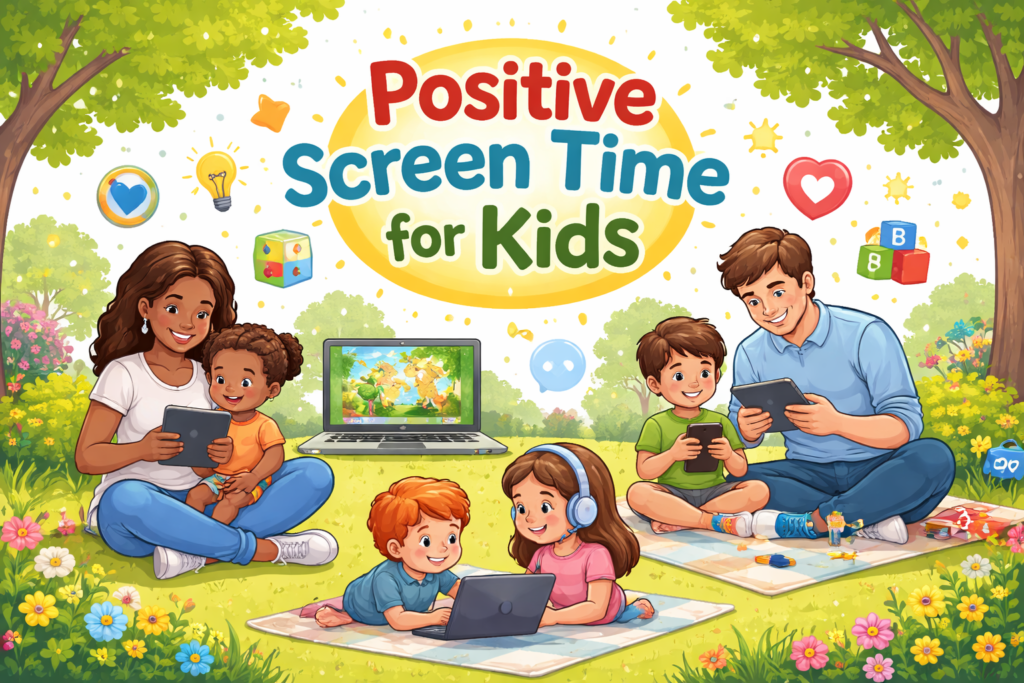
Modern life includes technology, so learning to use it well is key. Positive screen time for kids means children use devices to learn, create, and connect, while still having time for rest and play. I used to talk about “screen time” like it was one thing. Then I watched how it isn’t. One hour of a calm story you watch together can leave a child regulated and chatty. Twenty minutes of fast, bright, auto-playing clips can leave that same child edgy, whiny, and impossible to transition.
The American Academy of Pediatrics said something in its 2016 statement Media and Young Minds that I still hear in my head when parents ask for a single number. It wasn’t “minutes don’t matter.” It was closer to: the quality of content, and whether you’re with the child, changes what the screen does. I’m paraphrasing, but that general direction has matched what I see.
The World Health Organization’s 2019 guidelines for children under 5 were more direct about daily structure: sleep, movement, and sedentary time. Their public summary in April 2019 included the line many people quote because it’s so plain: for age 2, sedentary screen time should be no more than 1 hour, less is better, and when children are sedentary, reading and storytelling with a caregiver is encouraged. That framing matters to me because it puts screens in competition with other needs, not in isolation.
So I don’t throw out limits. I also don’t trust limits alone. The lever I keep coming back to is this: make screen time social, slow, and purposeful whenever you can. It doesn’t solve everything, but it changes the feel of the whole topic.
Babies 0 to 18 Months: Keep Real Life First
Face-to-face interaction builds a baby’s brain fastest. Short, warm video calls with family are the only screen time recommended. A smile or voice from a parent is more powerful than any app or video.
I say that, and I can still picture a mother who told me, almost apologizing, “He calms down to the dancing fruit.” She wasn’t wrong. Babies do calm to predictable sensory input. The question is what you are trading away when you rely on it.
Harvard’s Center on the Developing Child has talked for years about back-and-forth interaction as the engine of early development, the “serve and return” idea. In their 2016 materials, the emphasis was simple: babies build brains through responsive exchange, not passive exposure. It’s one of those things that sounds obvious until you are exhausted and the screen is the only quiet button you can find.
Positive screen ideas
- Family video calls where loved ones sing or read
- Let relatives respond to your baby in real time
What to do instead
- Narrate your day while holding your baby
- Play peekaboo and sing lullabies
- Offer safe toys with different textures
A small thing I’ve learned: video calls work best when the adult on the other side slows down. Waits. Responds to a babble. Smiles at the right time. It’s still a screen, but it behaves more like a relationship.
Toddlers 18 to 24 Months: Learn Together
Watching with your toddler turns content into learning. Choose high-quality, slow-paced shows, and connect what they see to their real-life experiences.
This is where I probably have the strongest bias. I trust co-viewing more than I trust “educational” branding. Toddler learning from video is possible, but it’s not identical to learning from real life. Brito and Barr in 2011 compared toddlers learning from videos versus books, and the gap wasn’t just about intelligence or attention. It was about the transfer. What a toddler can repeat on the screen isn’t always what they can use in the room.
Positive picks
- Shows like Sesame Street or Daniel Tiger
- Pause to name objects and link to their toys
What to do instead
- Pretend play with dolls or kitchen sets
- Stack blocks and solve simple puzzles
- Read together with picture books
This might show up with a simple scene. Your toddler watches a character named Emotions. Alone, it can slide by like noise. With you beside them, it turns into something usable: “He looks mad. Like when you wanted the blue cup.” Then, later, when the toddler is mid-tantrum over a cup, you have a shared reference point. Not a lecture. A bridge.
And sometimes you find the content is the problem. Fast cuts. Loud music. Overstimulating visuals. Some toddlers tolerate it, some don’t. I’ve changed my mind about “this show is fine” after hearing a parent track it for two weeks and realize the worst meltdowns followed the same type of content, not the same number of minutes.
Preschoolers 2 to 5 Years: Balance and Meaning
Children at this age grow empathy, focus, and problem-solving skills. Limit screen time to about one hour a day and choose content you can watch together.
One small clarification, because parents ask it constantly: when I say “about one hour” here, I mean recreational sedentary screen time for preschoolers, not a live family video call, and not a short educational use that you’re actively doing together. The WHO’s 2019 framing was about sedentary screen time displacing movement, sleep, and interaction, and that’s the spirit I’m using. It’s not meant to turn parents into timekeepers.
Positive uses
- Watch a short story, then act it out
- Use a drawing app, then recreate with crayons
- Talk about character choices and feelings
I notice parents often assume “quality” means “nice morals.” Sometimes. But for preschoolers, quality also means slow enough to process and simple enough that they can imitate it in real life. The best sign, in my opinion, is what happens after. Does the child act out the story with toys? Draw a character? Bring you a question? Or do they demand the next video before the first one is even finished?
That’s not a purity test. It’s information.
Protecting Eye Health During Screen Time
Even quality content can cause eye strain. Follow the 20 20 20 rule and look at something 20 feet away for 20 seconds every 20 minutes.
A brief explanation, because the numbers blur together when you’re busy: “20 20 20” is simply a timed reset for the eyes. Every 20 minutes of near work (a screen), you shift focus to something at a distance (about 20 feet) for 20 seconds. The American Association for Pediatric Ophthalmology and Strabismus included this in its February 2025 guidance on screen time and online learning, along with practical setup tips.
Extra tips from AAPOS
- Keep screens at arm’s length and at eye level
- Use good lighting
- Encourage blinking to prevent dryness
A separate line of evidence that keeps popping up in my reading is the “digital eye strain” discussion in clinical studies. Neena and colleagues in 2023, for example, described how increased screen time plus poor lighting and sustained near work can drive symptoms. That doesn’t mean every child will have trouble. It does mean the setup matters more than parents realize.
In real life, the easiest version is to attach the eye break to something natural. A scene change. The end of a level. A timer. Otherwise, “take a break” becomes one more demand the child resists.
Using Technology to Support Growth
When chosen well, technology can encourage exploration,d skill building, and connection. Documentaries and science videos spark curiosity. Creative design apps build problem-solving. Video calls with friends and family keep relationships strong.
Sometimes parents expect me to be anti-screen. I’m not. I’m wary of screens as the default emotional regulator, yes. Screens are “the only way my child calms down,” or “the only way dinner happens,” because those patterns tend to grow. But screens as a tool for learning, creativity, and connection can be genuinely supportive.
The tradeoff is usually not screen versus no screen. It’s screen versus what it replaces.
Examples of Purposeful Screen Time
Learn
- Language learning apps
- Science experiments for kids
Play
- Interactive games that inspire imagination
Connect
- Virtual playdates
- Family calls and shared projects
For example, this could apply to a virtual playdate that has a shape. Ten minutes of show-and-tell. A shared drawing prompt. A scavenger hunt. The screen becomes a container for social interaction, not a substitute for it.
Apps That Create Positive Screen Time
- Khan Academy Kids
- ABCmouse
- Toca Boca
- Draw and Tell
- Google Earth
- National Geographic Kids
I always hesitate to list apps because some parents will treat the list like a vaccine. Download it, and you’re safe. That’s not how it works. Still, these names come up often because they generally aim at learning, creativity, or exploration rather than endless scrolling.
Life Skills That Screens Can Support
- Responsibility through following limits
- Respect with kindness and empathy online
- Communication through clear speaking and sharing
Bandura’s Social Learning Theory (1977) is old, but it keeps showing up in modern parenting problems because modeling is relentless. Children learn what we do with screens, not just what we tell them. I’ve watched parents set “no phones at dinner” rules while answering messages mid-meal, and the child becomes the “problem,” when really the family norm is the problem.
Parent Checklist for Positive Screen Time
- Set age-appropriate limits
- Pick slow-paced educational content
- Watch together and talk about it
- Take regular eye breaks
- Balance with outdoor play and reading
A small rule that makes this checklist usable in real homes: define the stopping point before you press play. One episode, one short story, one level. Parents usually know the list. The hard part is the transition. A clear endpoint reduces negotiations and helps the child switch to the next activity. That’s part of positive screen time for kids, too, the boring part that actually works.
School-age kids (6–12): Build habits, not battles
By six, screens are not just entertainment. They’re homework, games, and social connections. The question shifts from “How much?” to “What kind, and what does it crowd out?”
The American Academy of Child and Adolescent Psychiatry updated its Screen Time and Children fact sheet in June 2025. The tone of that guidance is basically what I end up saying in sessions anyway: watch for what screens replace, keep screens out of family moments, and protect sleep. It’s not dramatic. It’s practical.
A brief rule explanation that often helps here: treat screen time like food categories, not one giant category. Homework screens are not the same as scrolling. A creative app is not the same as autoplay clips. When families separate types, they argue less and observe patterns more clearly.
What positive screen time can look like (6–12)
- Learn: language learning apps, science experiments for kids, documentaries,s and science videos spark curiosity.
- Play: interactive games that inspire imagination
- Connect: virtual playdates, family calls,s and shared projects
A pattern I see: families do better when they separate types of screen time. Homework screens. Creative screens. Social screens. The problem screens, the ones that leave the child irritable or sleepless. Treating it all as one category makes parents feel like they’re always arguing.
Teens: Shift from control to coaching
With teens, the power struggle becomes the whole thing if you let it. I don’t think that’s because teens are “bad.” It’s because autonomy is developmentally normal, and phones are designed to be sticky.
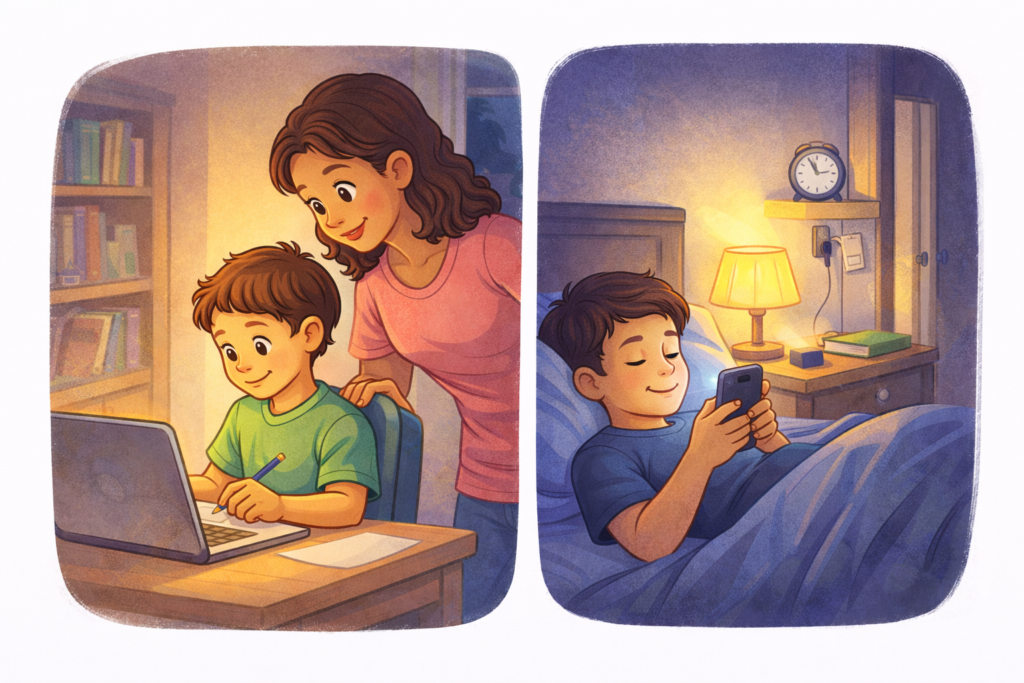
AACAP’s June 2025 guidance still matters here, especially the sleep piece. Removing screens 30 to 60 minutes before bed sounds simple and can be brutally hard in actual households. But sleep is often where everything else falls apart first.
A short explanation, because parents often ask what “remove screens before bed” is really about: it’s less about morality and more about physiology and habits. Late-night scrolling tends to push bedtime later, and for many kids, it keeps the brain in alert mode. Even if a teen insists they’re fine, sleep debt can show up as irritability, low frustration tolerance, and attention issues the next day.
Positive screen time for teens can include
- Learn: documentaries and science videos spark curiosity
- Create: creative design apps build problem-solving
- Connect: video calls with friends and family keep relationships strong
I don’t have a neat conclusion about teens and screens. The evidence is mixed, and the lived reality is mixed. Some teens thrive online. Some spiral. The same teen can do both, depending on stress, social context, and what they’re doing on the device.
Questions people ask
Positive screen time means children use devices to learn,d create, and connect while having time for rest and play.
Limit screen time to about one hour a day and choose content you can watch together.
Short warm video calls with family are the only screen time recommended.
Look at something 20 feet away for 20 seconds every 20 minutes.
Final Thoughts on Positive Screen Time
Technology can be a bridge to learning and connection when guided well. Your presence and involvement turn a screen into a tool for growth and shared memories.
There’s a moment I think about a lot. A toddler on a couch, watching quietly, and the parent sitting beside them, not talking much, just there. The child glances up every so often, like checking, and the parent nods and names one thing on the screen, softly. Then the episode ends,s and the child stands up and starts acting it out with blocks, narrating their own story, and the parent looks surprised, like they expected a fight and got play instead. That surprise is usually where the next choice gets easier, or at least less lonely.
References
- American Academy of Pediatrics, Council on Communications and Media, 2016. Media and Young Minds (policy statement).
- World Health Organization, 2 April 2019. Guidelines on physical activity, sedentary behaviour and sleep for children under 5 years of age.
- World Health Organization, 24 April 2019. To grow up healthy, children need to sit less and play more (news release).
- American Association for Pediatric Ophthalmology and Strabismus, updated 24 February 2025. Screen Time and Online Learning.
- American Academy of Child and Adolescent Psychiatry, updated June 2025. Screen Time and Children (Facts for Families, No. 54).
- Center on the Developing Child at Harvard University, 2016. Materials describing serve-and-return interactions and brain development.
- Bandura, A., 1977. Social Learning Theory.
- Brito, N. H., and Barr, R., 2011. Study comparing toddler learning and retention from videos versus books.
- Neena, R., et al., 2023. Paper on screen use conditions, lighting, sustained near work, and symptoms consistent with digital eye strain.