
I keep coming back to the same moment, the one that happens right before you repeat yourself. The message you send. The tone you choose. The silence you slip into. If you read this, you will leave with three things you can actually use in real time across your relationships in 2026: you will be able to name your pattern while it is happening, you will understand the flip that moves you toward steadier connection, and you will reach a decision point where you can choose a different next step with a partner, a friend, a parent, a sibling, a coworker, even with your own kids.
And I mean it in the broadest way, not as a slogan. Romantic relationships, yes. Friendships that feel one-sided. Sibling dynamics that revert in five seconds. Parents who still pull you into old roles. Kids who know exactly where your buttons are. Work relationships, managers, direct reports, teams, and clients. Mentors. Students. Neighbors. Roommates. In-laws. Community and faith groups. Online friendships that feel oddly intimate. Even the relationship you have with yourself when you are alone with your thoughts at night. The same nervous system shows up for all of it.
I am writing this because the usual advice fails at the same spot. People know what to do. They have read the posts. They can explain their triggers. Then their nervous system lights up, and they do what they always do. This post is meant to solve that specific gap. Not by adding more concepts, but by giving you a simple checklist you can use when you are activated. In my experience, this helps more than most relationship content that stays in the safe zone of “communicate better” and “set boundaries,” as if you can access those skills easily when you feel threatened, dismissed, or unsure.
The Core Question That Changes Everything
When the connection feels uncertain, will I follow my familiar attachment strategy, or will I choose a secure next step?
That question shows up everywhere. In a kitchen after work. In a family group chat. In a meeting where you feel singled out. In the pause after someone says, “We need to talk.” In the decision to send one more message, or to not reply for three days, or to say “It’s fine” when it is not.
It also shows up in quieter places that people do not always name as “relationship problems.” When your child is melting down,n and you feel your own panic rise. When a friend cancels again, and you pretend it does not matter. When a parent calls,s and you suddenly feel twelve years old. When a teammate takes credit, and you freeze. When a neighbor comments,s and you stew for hours. When you sit alone and start negotiating with yourself about whether your needs are “too much.”
Why Your Relationships Don’t Change Just Because You “Know Better”
I used to think insight would do more than it does. I still think it matters. But not in the way people hope.
John Bowlby laid the groundwork in 1969, and Mary Ainsworth’s 1978 work made attachment patterns visible in behavior. I still lean on that. However, the more recent adult attachment research consistently suggests that what we refer to as “attachment” is not merely a narrative you tell. It is state-dependent. It moves. It gets louder under stress. Fraley wrote in 2019 about the debates and future directions in adult attachment research, and what stuck with me was the constant return to context and measurement. What shifts, what holds, and how easily we confuse a moment of activation for a stable identity.
Also, the effects are not limited to conflict. Park and colleagues, published in the early 2020s, pulled together evidence showing that attachment anxiety and avoidance are linked with less frequent positive emotions in daily life. That matters because insecurity is not only about arguments. Sometimes it is about how little warmth you can register when things are supposedly fine. That also shows up in friendships. People who say they “don’t need anyone” but also cannot feel comfort when someone is kind. Or the person who is surrounded by colleagues and still feels oddly empty after a good meeting.
I think about this one a lot in parenting and caregiving, too. Some people do all the right “supportive” behaviors and still feel nothing, then feel guilty for feeling nothing. Others feel too much, all day, and call it love, then burn out and snap at the people they care for. The pattern is not always visible as conflict. It can be visible as numbness, or vigilance, or the inability to receive.
When I look back on cases and on my own life, the turning point was not learning more. It was noticed earlier. Sometimes 30 seconds earlier. Sometimes just early enough to avoid the spiral.
The One Strong Idea: Secure Love Is a Practice, Not a Personality
People treat “secure attachment” like a fixed category. You have it, or you do not. I do not fully buy that framing anymore. Not because attachment is meaningless. Because it turns into a label people defend. They start protecting the label instead of practicing the skill.
I have come to think of secure attachment as repeatable behaviors you can do, especially when you do not feel secure. That fits what I see over time, and it fits the research direction I keep returning to, even if the evidence is not always neat.
Eilert and Buchheim’s 2023 systematic review looked at attachment representations and emotion regulation using objective approaches. Autonomic measures, brain activity, biochemistry, and nonverbal behavior. Their summary was basically that secure attachment aligns with more balanced regulation, and insecure or unresolved patterns are linked with poorer regulation under attachment-related stress. It sounds obvious until you see how reliably it shows up across studies.
Mosannenzadeh and colleagues wrote in 2024 about emotion regulation flexibility in close relationships, the tendency to over-rely on either self-regulation or interpersonal regulation. I read that and kept thinking, yes. This is why generic advice fails. Some people only self-regulate. Some people only outsource regulation. Flexibility is the actual skill. And it shows up outside romance. A manager who never asks for help then burns out. A friend who needs constant reassurance, then feels ashamed for needing it.
It also shows up with siblings and parents. The person who refuses support as a point of pride. The person who turns every interaction into a bid for reassurance. Both are trying to manage uncertainty, just with different tools.
And then there is the couple therapy literature, which is technically about romantic pairs, but the mechanisms are not exclusive to romance. Responsiveness, repair, and emotional accessibility show up in close ties across life. Lebow wrote in 2022 about couples therapy’s empirical foundations, and where the field is going in the 2020s, and even though it is a broad review, it reflects what clinicians already know. Change is built through repeated relational experiences, not through one perfect conversation.
So instead of “Am I anxious or avoidant? the more useful question for 2026 tends to be: what would a secure next step look like right now?
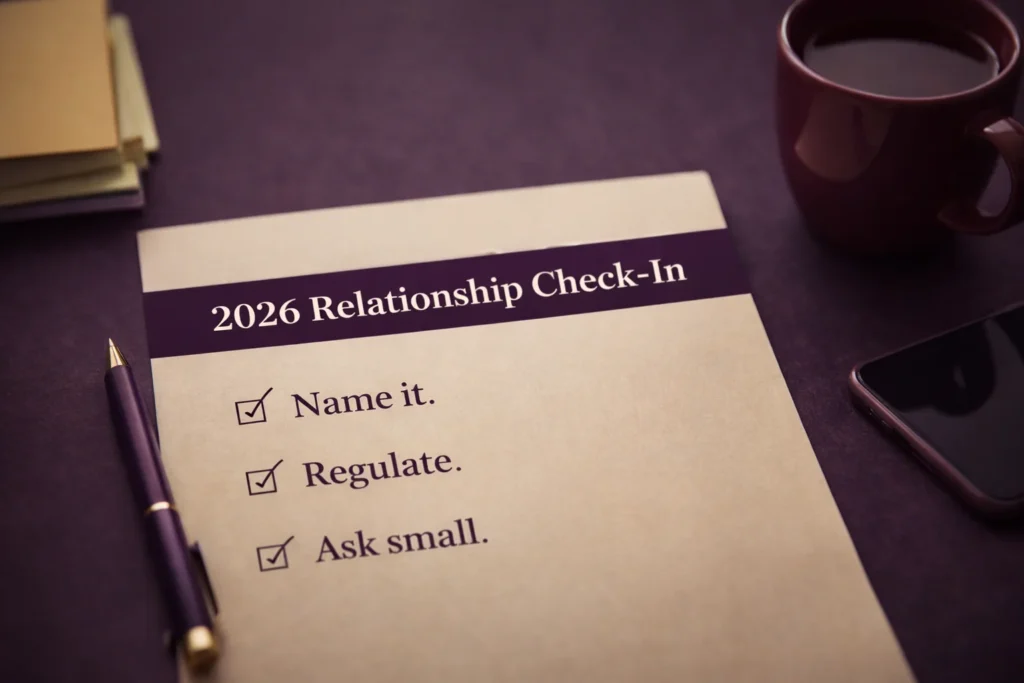
Your Simple Attachment-Informed Relationship Checklist (2026 Edition)
I am calling it “simple” because it has to be. If you cannot use it while activated, it is not a tool. It is a document.
1) Name What’s Happening Without Shaming Yourself
Attachment activation is a stress response, not a character flaw.
Ask:
- “What story am I telling myself about this?”
- “What am I afraid will happen if I’m honest?”
- “Is this a current problem, or an old wound getting loud?”
Example (anxious-leaning):
They haven’t replied in hours. The mind says, I’m being ignored. The body says, panic.
A secure reframe is: “I feel uncertain. Uncertainty isn’t rejection.”
Example (avoidant-leaning):
They ask for clarity. The body says, pressure. The mind says, I’m trapped.
A secure reframe is: “Closeness isn’t captivity. It’s a connection request.”
This sounds straightforward and it often is not. People can name the story, then still act like the story is fact. That is normal. It just means step two matters.
For example, this could apply to a parent who does not respond to your call and you instantly assume you are being punished. Or a friend who replies with one word and you assume they are done with you. Or a child who rolls their eyes and suddenly you feel disrespected and rejected at the same time. Or a coworker who says “Can we chat later” and your body reacts like you are about to be fired. The content changes. The heat in the body is familiar.
2) Identify Your Default Strategy: Protest, Perform, or Protect
Most insecure cycles fall into three buckets:
- Protest: pursue, demand, test, double-text, pick fights for closeness.
- Perform: overgive, overexplain, self-abandon to keep connection.
- Protect: shut down, detach, minimize needs, disappear emotionally.
Main takeaway: Your strategy makes sense. It just may not serve your 2026 relationships.
A practical question:
- “If I do what I usually do next, what outcome will I create?”
I sometimes ask people to imagine their next move as a vote. Not a verdict. A vote for the kind of relationship they say they want. With a friend. With a parent. With a teammate. With their partner. Some votes are tiny. Still count.
This might show up with:
- A partner: you start a fight because you want closeness.
- A friend: you send five check-ins because you cannot tolerate uncertainty.
- A parent: you explain yourself for twenty minutes because you want them to finally understand.
- A sibling: you become sarcastic because directness feels too risky.
- A child: you get controlling because you are scared.
- A coworker: you overperform and then resent everyone.
- A boss: you disappear emotionally and call it professionalism.
- A client: you overextend availability and then burn out.
- Yourself: you numb out and call it independence.
Same three strategies. Different setting.
3) Regulate First, Then Relate
Regulation precedes connection.
Try:
- 60 seconds of slower exhale breathing,
- unclench jaw and shoulders,
- a short walk,
- cold water on wrists,
- naming five things you see.
I hesitate here because regulation advice can get performative online. But the observation holds. When the body is in threat mode, the mind narrows. People become less curious, more certain, more interpretive. The tradeoff is that you might feel momentarily “right,” but you lose access to the part of you that can actually relate.
In family settings, this is the difference between walking into a difficult conversation ready to win versus ready to stay human. In school settings, it is the difference between hearing feedback as information versus hearing it as shame. At work, it is the difference between clarifying a misunderstanding and writing a resignation email in your head. With kids, it is the difference between setting a limit and escalating into something you regret.
4) Make the Ask Smaller, Clearer, and Safer
Secure communication is not dramatic. It is specific.
Instead of:
- “You never care.”
Try: - “I feel anxious when plans are uncertain. Can we confirm by 6 pm?”
Instead of:
- “Whatever, do what you want.”
Try: - “I’m getting overwhelmed. I want to talk, and I need a 20-minute break first.”
A question people ask in plain language is: “How do I communicate my needs without sounding needy?”
My best answer is still this: make one clear request, tied to one moment, with one reason.
This could apply to:
- A friend: “I miss you. Can we pick a day this week and actually stick to it?”
- A parent: “I can talk about this, but not if it turns into criticism. Can we keep it to ten minutes?”
- A sibling: “I want us to stop looping. Can you tell me what you need from me right now?”
- A coworker: “I’m unclear on the priority. Can you confirm what’s due today versus next week?”
- A manager: “I can revise this. What does ‘not quite right’ mean in concrete terms?”
- A direct report: “I want to hear you. Can we slow down so I understand the main issue?”
- A child: “I will listen. First we both take a breath. Then you tell me what happened.”
- Yourself: “I can feel anxious and still wait before acting.”
5) Track Behavior, Not Potential
This is the checklist item that changes decisions fast. Not only dating decisions. Friendship decisions. Family contact decisions. Work relationship decisions. I have mixed feelings about how quickly people use it. It is protective. It can also become rigid if people use it to avoid vulnerability.
Still, I keep returning to this line because it is usually the missing piece.
Consistency is the clearest sign of emotional availability.
Ask:
- Do they repair after conflict?
- Do they follow through?
- Do you feel calmer over time, not more confused?
- Can you be honest without punishment?
Candel and Turliuc wrote in 2019, in a meta-analysis, that insecure attachment is reliably linked with lower relationship satisfaction, with actor and partner dynamics both showing up. I mention that because people assume the other person is the whole story. Sometimes they are. Sometimes your pattern is the bigger driver.
Conradi and colleagues in 2021 found that similarity in attachment patterns across partners can partially buffer negative effects of insecurity. I remember reading that and thinking, yes, some relationships survive because the people can predict each other. Not because it is secure. Because it is familiar. Familiarity can feel like safety. It is not always the same thing.
In my own experience, one of the bigger shifts was stopping the habit of treating intensity as intimacy. Chemistry can be real. Chemistry can also be an alarm system. In family settings, people call it loyalty. At work, people call it “high standards.” In friendships, it becomes the constant checking, the crisis bond, the feeling that calm means you are losing the person.
Track behavior, not potential applies to:
- Friends who only call when they need something.
- Parents who promise change and then repeat the same boundary crossings.
- Siblings who apologize and then do the same thing next week.
- Coworkers who are warm in private and dismissive in meetings.
- Managers who say “my door is open” and then punish honesty.
- Teams where repair never happens, only avoidance and gossip.
- Community groups where people preach care and practice exclusion.
- Yourself, too. The pattern where you say you will rest and then you do not. The pattern where you promise yourself you will speak up and then you swallow it again.
6) Use a 24-Hour Repair Rule
Secure relationships do not avoid rupture. They get better at repair. Or at least they try. Some days they fail. Then they repair that.
Try:
- “Can we revisit this later today? I don’t want distance between us.”
- “I didn’t handle that well. Here’s what was happening for me.”
I used to cite Gottman’s 1990s work here as the definitive stamp. I still think his research on interaction patterns and repair attempts is useful, but I am less interested in “proof” and more interested in what keeps showing up across methods and decades. Repair attempts matter. The absence of repair is corrosive.
The therapy outcome literature is not subtle about the role of repair and emotional accessibility. Mirzazade and colleagues published an RCT in 2025 reporting EFCT increased intimacy and reduced shame compared with control. It is one study. Samples vary. Context matters. But the direction fits what I see. Shame decreases when people feel reachable again. This does not only apply to couples. Shame and reachability show up in parent-child relationships, friendships, even teams.
The 24-hour idea can fit:
- A friendship rupture: “I got defensive yesterday. I want to try that again.”
- A sibling blow-up: “We do this every holiday. Can we repair before it calcifies?”
- A parent interaction: “I can accept you disagreeing. I can’t accept the insult. Are you willing to reset?”
- A work conflict: “I think we misunderstood each other in the meeting. Can we clarify intent and next steps?”
- Parenting: “I yelled. That was mine. I’m sorry. The limit still stands, but I want you to feel safe with me.”
7) Choose the 2026 Standard: Mutuality
Mutuality is the simplest filter for steadier relationships, and also the one people fight with the most.
A healthy relationship requires reciprocity, responsiveness, and respect.
Ask:
- “Am I the only one doing emotional labor?”
- “Do we both move toward problems, or do I chase and they evade?”
- “Do I feel free to be a full person here?”
If you are afraid that raising standards will leave you alone, that fear is not irrational. It just becomes expensive when it keeps you in relationships where you are lonely anyway.
Mutuality looks different depending on the relationship:
- With kids, it is not equal labor. It is responsiveness and repair without making the child manage your feelings.
- With parents, it might be the ability to say no without punishment.
- With friends, it might be alternating support instead of one person holding the entire emotional load.
- At work, it might be clear roles and basic respect, not emotional closeness, but still mutual responsibility.
- With a partner, it might be shared repair and shared vulnerability.
- With yourself, it might be taking your own limits seriously, not only other people’s.
What This Looks Like in Real Life (Three Common 2026 Moments)
Situation 1: The Texting Spiral
You’re waiting. Your mind starts drafting worst-case scenarios. This could be a partner not replying. A friend going quiet. A sibling leaving you on read. A colleague not responding to a message you worry sounded blunt.
Checklist use:
- Name it: “I’m activated.”
- Strategy: Protest (urge to send 5 messages).
- Regulate: breathe, delay 20 minutes.
- Ask: “Hey, can you let me know when you’re free to talk?”
- Track: do they respond with care and consistency over time?
Transformation: you stop auditioning for reassurance and start building real security.
I have watched this sequence play out over and over. Someone waits, spirals, sends a “joke” text that is not a joke, then feels embarrassed, then gets angry, then says “I don’t even care.” That is an attachment story in 40 minutes.
Situation 2: The “I’m Fine” Shutdown
You feel overwhelmed and go emotionally quiet. This shows up in romantic conflict, yes. It also shows up in families after an argument, or at work when feedback lands badly, or in friendships when someone disappoints you and you decide you will “just be chill.”
Checklist use:
- Name it: “I’m protecting.”
- Regulate: body first.
- Ask smaller: “I’m flooded. I care about this. Can we pause and return after dinner?”
- Repair rule: revisit within 24 hours.
Transformation: you don’t disappear to feel safe; you create safety while staying connected.
Situation 3: Dating Someone Who Is “Nice” But You Feel Unsettled
They aren’t cruel, but you feel anxious and unclear. This could be dating. It could also be forming a new friendship, entering a collaboration, reconnecting with a family member, or trying again with someone who has a history of inconsistency.
Checklist use:
- Track behavior: are they consistent and responsive?
- Mutuality: do you feel chosen, or merely tolerated?
- Core question: “Am I choosing secure steps, or chasing familiar uncertainty?”
Transformation: you stop calling anxiety “love” and start choosing steadiness.
I do want to say something cautious here. Some people are unsettled because their body is not used to calm. Some people are unsettled because the other person is inconsistent. Those are not the same. The checklist is partly a way to separate them over time, without pretending you can know it instantly.
Situation 4: The Parent Phone Call That Hijacks Your Whole Day
This might show up with a mother who calls to “check in” and ends up criticizing your choices. Or a father who goes silent when you set a boundary. Or a caregiver relationship where the power dynamics are subtle but real.
Checklist use:
- Name it: “I’m activated. This is old.”
- Strategy: Perform (overexplain) or Protect (shut down).
- Regulate: feet on the ground, slower exhale, shorten the call if needed.
- Ask smaller: “I can talk for ten minutes. I’m not discussing my body, my relationship, or my money.”
- Track behavior: do they respect limits over time?
Consequences if you do not: you spend the rest of the day replaying the call, snapping at your partner, being short with your kids, or making a work mistake because your mind is elsewhere. That chain reaction is not dramatic. It is common.
Situation 5: Work Feedback That Lands Like Shame
A manager says “This wasn’t what I expected.” A client says “We need changes.” A colleague says “You were a bit sharp in that meeting.” Your body reacts like you are unsafe.
Checklist use:
- Name it: “Threat response. Not necessarily danger.”
- Strategy: Protect (go blank) or Perform (overdeliver instantly).
- Regulate: pause before replying, ask for specifics.
- Ask smaller: “What would ‘better’ look like in one example?”
- Repair rule if needed: “I heard that as harsh. Can we clarify intent?”
This might show up with direct reports too. Someone comes to you upset. Your body wants to fix it fast so you do not have to feel helpless. Protest can look like pressure. Perform can look like rescuing. Protect can look like “Just follow the process.” None of those are evil. They just create outcomes.
Situation 6: Friendships That Become Emotional Projects
One friend is always in crisis. Another is always “busy” when you need them. Another makes jokes when you try to be sincere. You tell yourself it is fine.
Checklist use:
- Name it: “I’m minimizing because I hate needing.”
- Strategy: Perform (overgive) or Protest (tests, guilt) or Protect (ghost).
- Regulate: let yourself feel disappointment without converting it into a dramatic decision.
- Ask smaller: “I want to stay close. Can we plan one regular check-in that we both keep?”
- Track behavior: does the friendship become more mutual, or do you keep carrying it?
Sometimes friendships improve with one honest ask. Sometimes the ask reveals the limit. Both are information.
Situation 7: Parenting Moments That Feel Like a Mirror
A child says “You never listen.” A teenager slams a door. A small child clings to you and you feel irritated, then guilty, then irritated again.
Checklist use:
- Name it: “My body is activated. I want control because I feel scared.”
- Strategy: Protest (raise voice), Perform (overexplain), Protect (withdraw).
- Regulate: lower your volume, loosen your hands, slow the pace.
- Ask smaller: “Tell me the one thing you want me to understand.”
- Repair rule: “I got sharp. I’m sorry. Let’s try again.”
I am careful here because parenting advice can turn into moralizing quickly. I am not interested in that. I am interested in whether you can stay connected to yourself while staying connected to them, which sounds poetic and is actually annoying to do at 7:30 a.m. on a school day.
Situation 8: Roommates, Neighbors, and the Low-Level Resentment Loop
This is the relational arena people ignore, then it slowly makes them edgy in every other area.
A roommate leaves dishes. A neighbor plays loud music. A shared space becomes a power struggle. You tell yourself it is petty, so you say nothing, then explode later.
Checklist use:
- Name it: “I’m building resentment because I’m avoiding discomfort.”
- Strategy: Protect (silence) or Protest (angry note).
- Regulate: choose a time when your body is not already tense.
- Ask smaller: “Can we agree dishes are done by night?”
- Track behavior: does the agreement hold, or do you keep renegotiating reality?
Situation 9: Community, Faith Groups, and Belonging That Has Strings
People underestimate how attachment gets activated in groups. It is not only one-on-one intimacy. It is belonging, status, exclusion, approval.
Checklist use:
- Name it: “I’m seeking safety through approval.”
- Strategy: Perform (people-pleasing) or Protect (withdraw) or Protest (conflict).
- Regulate: notice how your body reacts to judgment.
- Ask smaller: “What do we do when someone disagrees here?”
- Track behavior: do values match behavior?
I have seen people stay in communities that erode them because leaving feels like abandonment. That is not weakness. It is attachment.
Situation 10: Online Relationships That Feel Intimate and Then Vanish
A long thread of daily messages. Shared vulnerability. Then silence. Or intermittent replies that keep you hooked.
Checklist use:
- Name it: “I’m attached to the rhythm, not the reality.”
- Strategy: Protest (chase), Perform (overdisclose), Protect (block).
- Regulate: delay action, get grounded, talk to someone offline if possible.
- Ask smaller: “Are you interested in staying in touch consistently, yes or no?”
- Track behavior: consistency again, not potential.
This one is tricky because online relationships can be real. They can also be a place where your nervous system stays activated because ambiguity is built into the medium.
The Unspoken Questions You’re Probably Holding (Quick Answers)
“What if I’m the problem?”
You may have patterns. Patterns are not moral failures. They are adaptive history. Park’s meta-analytic work in the early 2020s on positive emotions made me think more about this. Some people are not just anxious in conflict. They are muted in joy. That is not “being the problem.” That is a nervous system that learned not to lean too far into good things.
This might show up with friends who compliment you and you shrug it off. Or with a child who reaches for you and you feel nothing and panic about that nothing. Or with a partner who offers closeness and you feel suspicious. Or at work, when recognition makes you uncomfortable.
“What if my partner triggers me constantly?”
Then the checklist becomes diagnostic. If regulation and clear asks are met with contempt, punishment, or chronic inconsistency, the issue may not be your attachment. It may be relational safety. I do not say that lightly. People can weaponize it. But the pattern is real.
And I would widen that beyond partners. If a friend punishes honesty. If a parent retaliates when you set limits. If a manager humiliates you in meetings. If a community shames dissent. Those are all versions of low safety. People tell themselves to “just be stronger.” I am not convinced that is the correct lever.
“Can I build secure attachment without the perfect partner?”
Yes, to a point. You can practice secure behaviors: clear asks, boundaries, repair, regulation. But a secure relationship needs two people participating in responsiveness. The close-relationship therapy literature keeps circling that reality. Lebow’s 2022 review is not sentimental about it. Relationships improve when both people engage, and interventions evolve because not all relationships do.
I would apply the same realism to family relationships. You can do beautiful work and still have a parent who does not change. You can do repair attempts and still have a sibling who stays defended. You can do your part at work and still have a workplace culture that rewards avoidance. The question becomes what you do with that information.
“How do I know if this relationship is worth it in 2026?”
Ask one clean question: Do we grow safer and more honest over time, or more anxious and less ourselves?
That can apply to friendships, too. And work relationships. And community settings. And co-parenting dynamics. And the relationship you have with yourself, which is easy to treat as separate and it rarely is.
The Decision That Creates the 2026 Version of You
Stop measuring love by intensity. Start measuring love by safety, consistency, and repair.
That can feel unfamiliar. Sometimes unfamiliar is simply what steadier connection feels like. Sometimes unfamiliar is also avoidance, boredom, fear, or the absence of drama you have been using as a map. I am not pretending there is a perfect internal compass. I just keep noticing that people who choose steadiness tend to stop living inside constant interpretation.
A secure relationship is one where you can be honest and still be held with care.
And that includes the relationship with yourself. People skip that part because it sounds like self-help. I mean it in a narrow way. Can you be honest with yourself about what you need, what you can tolerate, what you are doing to cope, and still treat yourself with care? Some people can do it for everyone else, then turn brutal inward the moment they are alone.
A Simple How-To You Can Use Today
- Save this checklist somewhere accessible.
- The next time you feel activated, use only the first two steps: name it and identify the strategy.
- Choose one secure next step: regulate, make a small ask, or pause for repair.
That is enough to start changing your relational future. Not guaranteed. Not linear. But enough.
I also think it helps to pick one relationship category for a month. Family in January. Work in February. Friendship in March. Parenting or caregiving in April. Then circle back. Not as a challenge. More as a way to notice patterns across contexts. The same moves show up. Just dressed differently.
Closing: Your Relationships Can Feel Different in 2026
If your 2025 pattern was chasing clarity, overfunctioning, shutting down, or mistaking chaos for chemistry, you are not broken. You are patterned. Patterns can change.
In 2026, the win is not never getting triggered. The win is noticing sooner, choosing differently, and building relationships that feel like a place your nervous system can rest.
The goal of attachment work is earned security: the ability to stay connected to yourself while connecting to others.
Blake and colleagues wrote in 2024, using longitudinal birth cohort data, that young adult attachment style is associated with later life satisfaction, with confidence in self and others standing out. I keep that in mind when people treat attachment work as only about romance. It spills into everything. Friendships. Parenting. Work. The way you sit with yourself on a quiet evening.
And I think about van Diest’s 2023 study of EFCT with cancer survivor couples. High-stress context, replicated single-case design, not a glossy story. Still, shifts in affect and dyadic outcomes. Not perfect. Still meaningful. It makes me wonder how much of what we call “relationship issues” is really the body learning, slowly, that reaching does not have to equal risk every time.
Also, I keep noticing how the same person can look “secure” at work and then unravel in family relationships. Or look steady with friends and then panic in romantic closeness. Or be a calm parent and a reactive partner. It complicates the neat categories. Which matches Fraley’s 2019 point about debates and measurement in adult attachment research. People want a single label. Real life is more uneven.
Sometimes I think the checklist is too simple for complex histories. Then I watch someone use step one and step two in a sibling conflict and not escalate, and something changes. Not the whole relationship. Just the next ten minutes. That is often where things actually shift. The small window. I do not love that answer. It is not dramatic. But it is what I keep seeing.
Mini FAQ
An attachment-informed relationship checklist is a set of practical prompts that helps you recognize attachment activation and choose secure behaviors in communication, conflict, dating decisions, and repair.
Anxious attachment often shows up as protest behaviors (pursuit, reassurance-seeking). Avoidant attachment often shows up as deactivation (distance, shutdown). Many people show mixed patterns depending on context.
Regulate your nervous system first, then make one clear request, and prioritize repair within 24 hours. Repeat consistently.
Yes. People can develop earned secure attachment through consistent relational experiences, therapy, and practicing secure behaviors over time. The evidence base is not one single study, and there are measurement debates, but the direction is hard to ignore.
People also ask versions of this that are more specific, and I think they matter:
Sometimes, yes. If both people can repair and be consistent. If not, you still learn something.
Sometimes the whole system reacts first, then settles. Sometimes it never settles.
Not in the same way as home, but you can still build predictability, respect, and repair. Which is often enough.
Kids cannot carry adult repair. Some parents cannot do it. Some workplaces do not reward it. That matters.
References
Ainsworth, M. D. S., Blehar, M. C., Waters, E., & Wall, S. (1978). Patterns of attachment: A psychological study of the strange situation. Lawrence Erlbaum.
Blake, J. A., Thomas, H. J., Pelecanos, A. M., Najman, J. M., & Scott, J. G. (2024). Attachment in young adults and life satisfaction at age 30: A birth cohort study. Applied Research in Quality of Life.
Bowlby, J. (1969). Attachment and loss: Vol. 1. Attachment. Basic Books.
Candel, O. S., & Turliuc, M. N. (2019). Insecure attachment and relationship satisfaction: A meta-analysis of actor and partner associations. Personality and Individual Differences, 147, 190–199.
Conradi, H. J., et al. (2021). Satisfying and stable couple relationships: Attachment similarity across partners can partially buffer the negative effects of attachment insecurity. Journal of Marital and Family Therapy.
Eilert, D. W., & Buchheim, A. (2023). Attachment-related differences in emotion regulation in adults: A systematic review on attachment representations. Brain Sciences, 13(6), 884.
Fraley, R. C. (2019). Attachment in adulthood: Recent developments, emerging debates, and future directions. Annual Review of Psychology, 70, 401–422.
Gottman, J. M. (1990s onward). Research on marital interaction patterns and repair processes. Collected works across publications and programs.
Johnson, S. M. (2008). Hold Me Tight: Seven Conversations for a Lifetime of Love. Little, Brown.
Lebow, J., & Snyder, D. K. (2022). Couple therapy in the 2020s: Current status and emerging developments. Family Process, 61(4), 1359–1385.
Mirzazade, Z., Molazade, J., Hadianfard, H., & Taghavi, M. (2025). The effect of emotionally focused couple therapy (EFCT) on shame and intimacy in couples: A randomized controlled trial (RCT). BMC Psychology, 13(1).
Mosannenzadeh, F., Luijten, M., MacIejewski, D. F., Wiewel, G. V., & Karremans, J. (2024). Adult attachment and emotion regulation flexibility in romantic relationships. Behavioral Sciences, 14(9), 758.
Park, Y., Sanscartier, S., Impett, E. A., Algoe, S. B., Leonhardt, N. D., Schrage, K., Carmichael, C., & Collins, N. L. (2023; early view 2022). Meta-analytic evidence that attachment insecurity is associated with less frequent experiences of discrete positive emotions. Journal of Personality.
van Diest, S. L., den Oudsten, B. L., Aaronson, N. K., Beaulen, A., Verboon, P., Aarnoudse, B., & van Lankveld, J. J. D. M. (2023). Emotionally focused couple therapy in cancer survivor couples with marital and sexual problems: A replicated single-case experimental design. Frontiers in Psychology, 14, 1123821.