

The next morning begins like every other morning in her house, but something small and unfamiliar waits for her on her phone. A message.
Hello, update today’s meals.
She blinks at the screen for a moment, unsure how to respond. It feels strange, almost intrusive, to be asked about her plate. For a second she hesitates, wondering whether she should ignore it, pretend she did not see it, slip back into the quiet life where no one notices what she eats.
But another message follows gently.
Where is your plate? Why didn’t you check in?
The words are not harsh. Not demanding. They are steady. Present. A soft nudge instead of a shove. She takes a picture of her breakfast with shy uncertainty and sends it.
A simple plate. A smaller portion than usual. Nothing dramatic. Nothing perfect.
The reply is encouraging. Calm. Supportive. Someone is there. Someone is watching over her progress without judgment, without pressure, without shame. For the first time, she does not feel alone in her effort.
At first, the daily reminders make her nervous. They awaken old anxieties. The fear of failing. The fear of disappointing someone. The fear of being seen.
But slowly, over days, the feeling shifts.
The messages begin to feel like a hand on her shoulder. A voice saying, I am here. Keep going. You do not have to disappear from yourself again.
She learns that food is not the enemy she once believed it to be.
She is not told to erase her favorites. Not asked to abandon biryani, potatoes, or cake. Not forced into punishment or starvation.
Instead, she learns to manage portions with awareness. She adds vegetables and protein when she can. She drinks more water. She gently reduces excess fried food, heavy carbs, and fizzy drinks without tearing joy away from her plate.
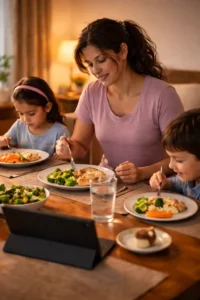
One evening, her children watch her quietly as she serves herself a smaller portion. Later, during playtime, they pretend to eat the way she does, imitating her mindfulness without even knowing it.
She smiles. Something inside her softens.
Food no longer feels like a battlefield. No longer a cycle of restriction and rebellion. No longer guilt dressed as discipline.
It becomes something else.
A companion. A source of energy. A part of life that can coexist with care, balance, and compassion for herself.
She realizes she can still savor biryani. She can still enjoy cake. She can still feel pleasure at her table.
Only now, she does so without shame.
For the first time in years, food does not control her story.
She does.